Israel and the Law

6%

Pacific Press Publishing Association · Mountain View, California · Jan 31, 1911

FromSigns of the Times, Vol. 38, No. 5.

Read the full edition

Israel and the Law

By Mrs. E. G. White
THE Lord gave the Israelites evidences of His presence with them, that they might know that He was leading them, and that they might fear His name and obey His voice. Great and radical changes were to be wrought in the lives of these demoralized people, upon whose characters, habits, and appetites, servitude and the idolatrous associations of Egypt had left their mark. God was lifting them to a higher moral level by giving them a knowledge of Himself through the manifestations of divine power seen in His dealings with them, and an acquaintance with His will as expressed in the laws given for their government.
Moses, who under the divine direction was leading the children of Israel through to the promised land, understood the character and value of the law of God. He assured the people that no other nation had such wise, righteous, and merciful rules as had been given to the Hebrews. “Behold,” he says, “I have taught you statutes and judgments, even as the Lord my God commanded me, that ye should do so in the land whither ye go to possess it. Keep therefore and do them; for this is your wisdom and your understanding in the sight of the nations, which shall hear all these statutes, and say, Surely this great nation is a wise and understanding people.”

God’s Voice

Moses called their attention to the “day that thou stoodest before the Lord thy God in Horeb.” “And the Lord spake unto you out of the midst of the fire: ye heard the voice of the words, but saw no similitude; only ye heard a voice. And He declared unto you His covenant, which He commanded you to perform, even ten commandments.” And he challenged the Hebrew host: “What nation is there so great, who hath God so nigh unto them, as the Lord our God is in all things that we call upon Him for? And what nation is there so great, that hath statutes and judgments so righteous as all this law, which I set before you this day?”
When Moses was about to relinquish the position that he had so long held as the visible leader of the hosts of Israel, he rehearsed in the hearing of the people the dealings of God with them and the rules and regulations He had given them. He endeavored to impress upon their minds the importance of obeying the law of God, and urged them to make its sacred precepts the rule of their daily life. As children of God, they should be willing to suffer any inconvenience, rather than to break one of His commandments. Such a course would be more pleasing to Him than mere professions of loyalty or words of praise.

A Wise and Understanding People

Obedience to God would preserve harmony between man and man and between man and his Maker, and would cause Israel to be regarded as a wise and understanding people. And in the path of obedience alone was there safety for them either as individuals or as a nation; for nothing but obedience would secure the divine favor, and insure to them happiness and prosperity in the land to which they were going. God had plainly stated this to them. If they did not keep His commandments, He would not — He could not — fulfil the rich promises which were given them on condition of obedience.
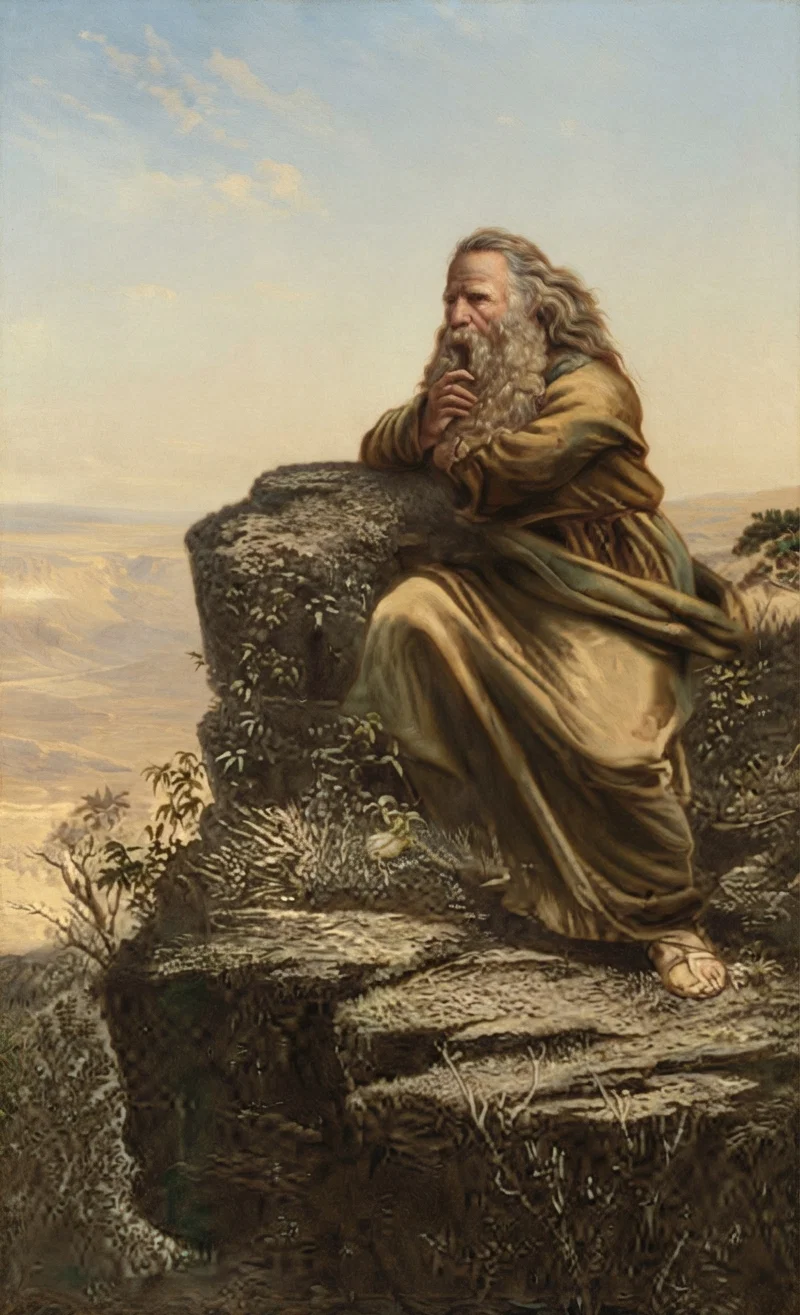
"Moses the Man of God" on Mt. Nebo, who led Israel through the wilderness from Egypt to Canaan, but who was not permitted to go farther
Israel was highly honored of God, and the surrounding nations looked upon them with wonder and admiration. Their laws and discipline, when compared with the laws of other nations, seemed, even to their enemies, in every way superior to their own. And Moses, as their visible leader and lawgiver, appears on the page of history as superior in wisdom and integrity to all the sovereigns and statesmen of earth; yet Moses ever recognizes that he is the servant of God, speaking and acting according to divine direction. He claims no credit for himself, but points the people to God as the source of power and wisdom.

The Law and the Sabbath

When the law was given to Israel, the Sabbath was made specially prominent. It had been instituted in Eden as a memorial of God’s creative work. After He had wrought six days, God rested on the seventh; and He blessed and sanctified that day, setting it apart as a day of rest and worship for mankind. And at Sinai He commanded: “Remember the Sabbath day, to keep it holy.” “In it thou shalt not do any work.” Man was to rest from his labor; and as he should look upon the earth beneath, and the heavens above, his thoughts were to be directed toward Him who brought all these wonderful and beautiful things into existence; and his heart was to be filled with love and reverence to his Maker, as he should behold the tangible proofs of His infinite wisdom and goodness.
The Sabbath was placed in the Decalogue as the seal of the living God, pointing out the Lawgiver, and making known His right to rule. It was a sign between God and His people, a test of their loyalty to Him. Moses was commanded to say to them from the Lord: “Verily My Sabbaths ye shall keep: for it is a sign between Me and you throughout your generations; that ye may know that I am the Lord that doth sanctify you.”
God is merciful. His requirements are reasonable, in accordance with the goodness and benevolence of His character. He claims the Sabbath as His own, and will not let His blessing rest upon those who disregard His holy day; yet the Sabbath institution was designed as a blessing to mankind. Man was not made to fit the Sabbath; the Sabbath was made after his creation, to meet the necessities of his nature. The Sabbath should stand before the people in its moral power, answering its original design — to keep in remembrance the living God, the Creator of the heavens and the earth. But the Sabbath has been treated with great disrespect. Men have dared to detract from its dignity; they have ventured to remove the sanctity placed upon it by the Creator Himself.
Temporal affairs must come under divine restrictions. The Sabbath is not to be molded to meet men’s business arrangements, but business affairs are to be arranged to meet God’s great standard of righteousness. But the god of this world has confused the minds of many on thissubject. They need to come into the divine presence, and listen to the voice of the great I AM.