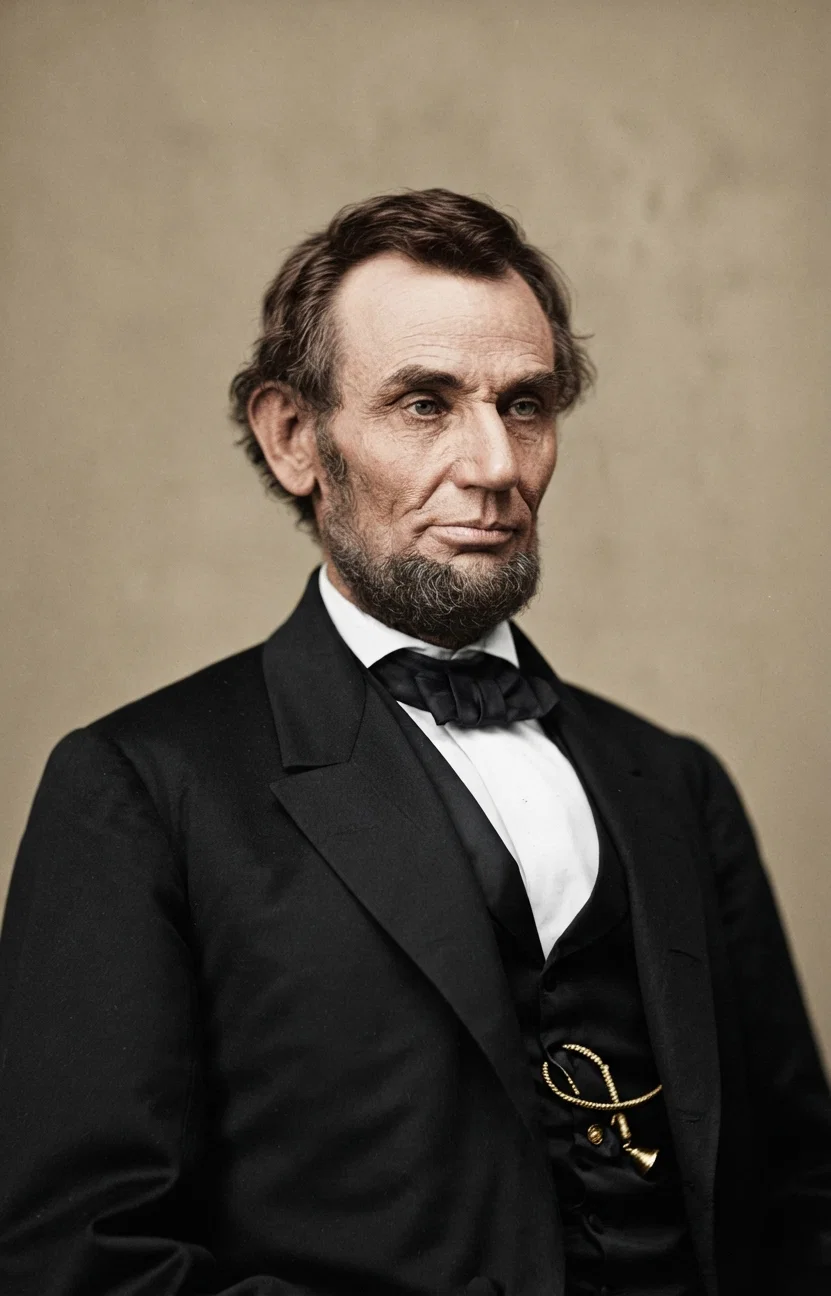
ON February 12, 1809, one hundred and two years ago, was born in Hardin County, Kentucky, one of the most illustrious men of his generation—Abraham Lincoln. It is not the purpose of this sketch to relate his biography, which is probably more familiar to the readers of this paper than that of any other American. Suffice to say that there was nothing in his ancestry, birth, early life, or education, that indicated his later career, or that would have led his most ardent, intelligent admirers to predict for him a great future. Tall—six feet, four inches—awkward, ungainly, uneducated, lacking culture, wealth, prominent relatives and friends, or business capacity—lacking everything outwardly, it would seem—yet he became the sixteenth president of the United States, and honored by the entire world.
His success must have been due to his character, to the principles and motives which actuated him. His reading was not extensive. If he had had access to some of our great public libraries and the mass of newspapers and magazines now poured out upon a satiated people, it is doubtful whether he would have gleaned and gathered the wonderful principles that molded his life and shaped his political career. Among the books that helped to mold his character was Weems's "Life of Washington," "Pilgrim's Progress," and the Bible.
His retentive memory, his natural oratory, his exceedingly good humor at all times, made him many friends; and this, with his later reading of political books that he could borrow, had much to do in shaping his future career.
In his disposition there existed strong affection and sympathy. This was shown in his securing, when but a boy of ten, a minister to preach his mother's funeral sermon two or three years after her death. Thank God, after the death of his own devoted, suffering mother, he found a true second mother in his father's second wife; and she said of her stepson, "Abe was the BEST boy I ever saw or ever expect to see." She was indeed a godsend to the neglected family, and especially to the growing, awkward, homely, longing, sympathetic boy.
Then, too, he was honest and just. He believed in rendering to every one his due, at whatever cost. In his love of justice were born his principles of liberty. He believed in liberty not for himself alone, but for the other man, whoever he might be. It has been said that the Catholics of the Middle Ages believed in religious liberty for—themselves; that the Puritans of New England believed in religious liberty for—the Puritans. Many races and nations believe in liberty for their respective race or people. But Lincoln believed in liberty for all; and the logic of events, to his mind, forced him to the Emancipation Proclamation, which went into effect Jan. 1, 1863. The freedom of the Negroes was not his original purpose, but the preservation of the Union was. Emancipation became to him the only logical step, a forward move in the divine program. His preference, when he felt the logic of the situation, was the purchase of the slaves; but this plan he was forced to abandon. Had he lived, we may well believe that the unfortunate "reconstruction" period following the Civil War would have been far more worthy of the name, and that the enmity existing between the two great parts of a great country would have more quickly healed. He truly was a man "with malice toward none and charity for all;" and his warm human sympathies, his large generosity and sterling common sense, would have adjusted amicably many difficulties that became festering thorns in the body politic.
This is written with no desire to call up one unpleasant reminder on either side of that great contest. It is written in the spirit expressed in the sentiment quoted above. It is written to emphasize that to which all history bears witness,—that while a mere personality is remembered and honored, the principles which made him great are forgotten.
We need to remember the broad human sympathies, the love of justice, honesty, and liberty, which made Lincoln the man possible to become Lincoln the President.
Such as he are needed in the conflict which, since the Civil War, has been growing and deepening—a conflict caused by a sordid, grasping, greedy, growing commercialism, which has been tremendously successful in crushing individuality, in creating class distinctions, in squeezing out of human hearts the old-time sympathies and fellow feelings for the individual man. The conflict has not yet taken form in armed hosts and division of territory; but it is already reaping a harvest which will be more fruitful of evil than that of the Civil War. The harvest of greed, if the sowing be wide and deep, is a fearful one.
ABRAHAM LINCOLN
But there is another field where there is a demand for principles as great as ever moved the heart of a Lincoln or a Washington. There is a far more precious jewel to be guarded than the right of franchise, a greater boon than mere civil liberty. Better the shackles of a galley-slave with the freedom to worship God as he will, than what is called civil liberty with religion prescribed by law. Of course such things are not usually seen. The deprivation of religious liberty is the curtailment of civil liberty. The two go together. Never on this earth did a government grant the former without the latter. This Government has granted both civil and religious liberty. For both of these the fathers fought and died. The latter is menaced now as never before for a century. Large religious bodies are forming to effect a political purpose; and in it, as intimated by the Hon. R. M. Johnson, there is always danger. These religio-political activities are centering around the Sunday-sabbath, which, whether the Sabbath of the Lord or not, has no place under the aegis of civil law. If true, it does not need it; God its Author does not ask it. If false, it should be utterly repudiated, and no government on earth can afford to legislate against God. Lincolns and Jeffersons and Washingtons are needed to-day to lift voice against the mistaken efforts of these religious politicians, to plead for the right of every man to choose not to worship, or to choose to worship God according to the dictates of conscience.