His Peculiar Faith Causes Investigation and Court-Martial His Character Highly Commended—The Case Widely Discussed in Influential Journals
By JEAN VUILLEUMIER
“THEM that honor Me I will honor,” said the Lord to a disobedient high priest. Obedience at any cost is God’s standard of allegiance and love. Therefore we see the greatest blessings and honors placed on those who have been great in obedience,— Abraham, Joseph, David, the three worthies, Daniel, and others.
SACRIFICE LIFE RATHER THAN PRINCIPLE
Those to whom Christ said, “Ye are the salt of the earth,” are those who are willing to sacrifice their life even rather than sacrifice principle, which is only another word for the will of God.
In these times of war, when so much is said about earthly flags and national honor, it is refreshing to see examples of men who are ready to suffer persecution in order to keep God’s flag unsullied and to maintain the majesty of His law.
March 15, Le Matin, the most popular daily of Paris, published an article of one hundred and four lines entitled, “Seventh-Day Adventists—They Are Expecting Christ.” The article quotes in full three verses on the second advent and one on the Sabbath question, as our basis for believing in the near coming of Christ and for keeping the seventh-day Sabbath.
The immediate cause for this article is given as follows by the French daily:
“The council of war of the sixth corps condemned Friday a young soldier who obstinately refused to labor on Saturday, because he is an ‘Adventist.’
“Seventh-day Adventists are not numerous in France. . . . But in other lands, Adventism is more flourishing. In Germany especially military courts have often had to condemn young recruits who, like Joseph, would in spite of all rest on Saturday. Emperor William II himself became interested in their cases, and it is proposed to form for Adventist soldiers a special company which would rest on Saturday and not on Sunday.
“An inquest made by the military authority states that upon entering the army, Joseph asked for permission not to labor on Saturday. This was on December 5. A request for exemption having been refused by the colonel, Captain Delaveau wrote to Elder Augsburger and went from Epernay to Paris to see him, with the hope that he would advise the soldier to work on Saturday.
“Being questioned, Joseph declared: ‘My case is one of conscience. If I disobeyed, it was in order to obey the Bible teaching about the day of rest.’ Before he was formally judged, young Joseph was shut up in the military prison for two months. Then on February 3, he was tried before the military court of Epernay, a clean little city of Champagne, amid those remarkable vineyards which yield the wines consumed by the wealthy, and of which there are in Epernay immense cellars. First to be heard was a report by Dr. Pietrement, who, after giving the physical diagnosis of his client, proceeds to give the intellectual and moral diagnosis, as follows:
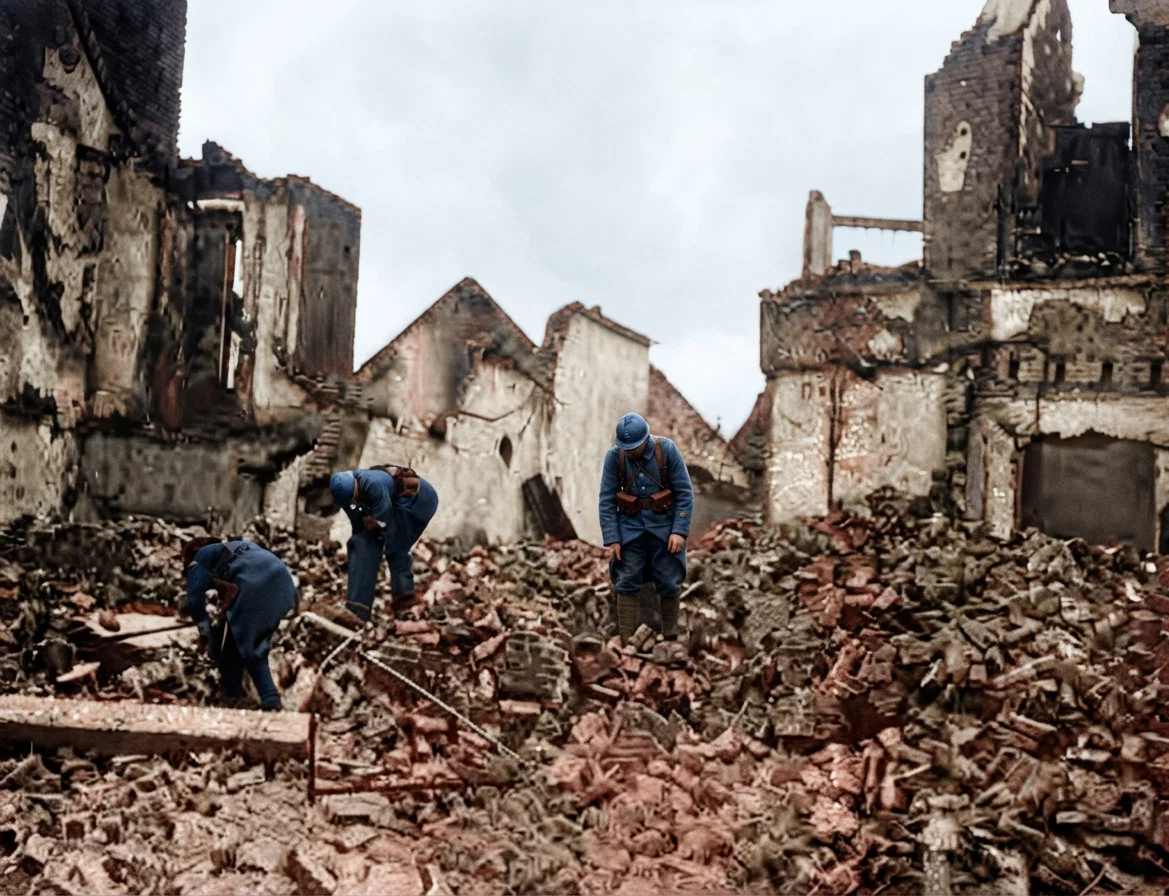
SCENE OF DESTRUCTION WROUGHT IN TERMONDE, BELGIUM, BY THE GUNS OF THE WARRING ARMIES
“ ‘He is an intelligent boy. He speaks fluently about his profession, is versed in machinery and electricity. He is earnest, never goes to saloons, concerts, or theaters. He is chaste and modest, shows tenacity, and is considered a good soldier, having never been punished. The intelligence is normal. He has neither ideas of persecution nor grandeur. The religious sentiment only is particularly developed.’
“On Saturday, day of rest, the Adventists of Paris go to church in the morning. In the afternoon, they meet at their homes, to discuss religion! In the evening, they listen to lectures or to pious readings made by their pastor. In this society Joseph has lived many years. The Bible is his book of predilection. He carries it with him, reads it, marks it, drinks it in. The Bible has become the pivot of his life. He knows many passages of it by heart, quotes the verses, refers to this or that prophecy.
“ ‘If any difficulty arises in his life, he opens his Bible. There he finds the way, and that way he will follow whatever happens. He does not drink, because God forbids it; he does not steal, because a certain command forbids it; he avoids being uncharitable, not
so much because it is wrong, but because the Bible tells him so. And naturally, he can not work on Saturday, because God has commanded to rest on the seventh day, and because his mother has brought him up to respect this day. Joseph explains his scruples and answers the questions about his religion with the smiling sadness of the martyr who suffers for his faith. Two thousand years behind his time, he is the Christian of “Quo Vadis?” following his road, quite outside of the contingencies of this world.’
“Thus closed the report of the military doctor. Then came the report of the prosecuting attorney, which was no less favorable, and which concluded by asking a small penalty, adding that he would be happy if the soldier were acquitted. Lastly came the lawyer’s plea, from which also we will quote:
“ ‘The misdemeanor which is before us gives us an opportunity to enter into an unknown world, a world which we would not have supposed to exist at this time, at least in our country. In a way, you will have to judge a martyr of the faith. Joseph is a Seventh-day Adventist. This religion rests solely upon the punctilious observance of the Decalogue and of the Bible. It is really a repetition, in our twentieth century, of the catholic apostolic religion of the first century. The Catholic6
lic Church, having become a state religion, has added the traditions to the Bible. These traditions are rejected by the Adventists, who content themselves with the texts of the holy Book.’
“Here the lawyer quotes the fourth commandment in full, and some other scriptures, and then adds:
“ ‘The commandments of God, like their Author, are eternal, and it is better to obey God than men. . . . Such is, in all its simplicity, the austere religion of Joseph. Joseph appears before us for having obeyed the law of his God rather than the law of men; for having refused to go to drill on Saturday, the day set apart by the Lord. Bible in hand, he seems indifferent to the things of this world. He is ready, if need be, to die for his faith. What will you do with him?
“ ‘Singular military crime that which results from an opposition between the law of God and the law of man! Can we condemn him for being true to his religious faith? Can a believer hesitate to obey his God first of all? Is there a human law that can coerce him to omit his religious duties? Gentlemen, as you see, the principle at stake in this debate is that of freedom of conscience.’ ”
Young Joseph was condemned to three months in prison. This condemnation was published by the four leading journals of Paris, each stating plainly that it was a case of obedience to the law of God.