Copyright, 1910, by
Milton C. Wilcox. "Let the Revelation speak and tell what is truth. . . . . Uplift Jesus as the center of all hope."
VII. The Church in Thyatira
THE Thyatiran church is symbolical of the condition of God's people during the Dark Ages, when truth was trampled under foot, when false teaching tolerated in previous centuries was now bearing full fruitage. Church and state, that ever evil union, was consummated in a fuller degree than past ages had known, and many were yielding their faith and many dying for their faith.
The student will note that it is not the apostate church that God addresses in this symbolism, however holy her profession, however exalted her pretensions, however mighty and wide-spread her influence. Apostasy may call itself a "church" or "the church;" it may even call itself "the Catholic Church;" but God never so designates. She is a synagogue, a gathering, is likened to a corrupt woman holding alliance with the kings of the world; while the true church is symbolized by a pure woman. The false is not called by inspiration a church, an ekklesia, a regularly, lawfully called-out body of believers. God's church in Thyatira, therefore, are a comparatively "little flock," persecuted, hunted, scattered, torn; many of them imbibing false teaching, but still His people, because the heart is to do His will; many of them backslidden, but not apostate.
The Answer of the Text
[The answers to the questions are from the American Revised Version. Omitting questions, and disregarding sometimes the capital at the beginning and the period at the close of an answer, the text may be read continuously. In notes and comments both versions are used without designation.]
1. How does our Lord represent Himself to the church in Thyatira?
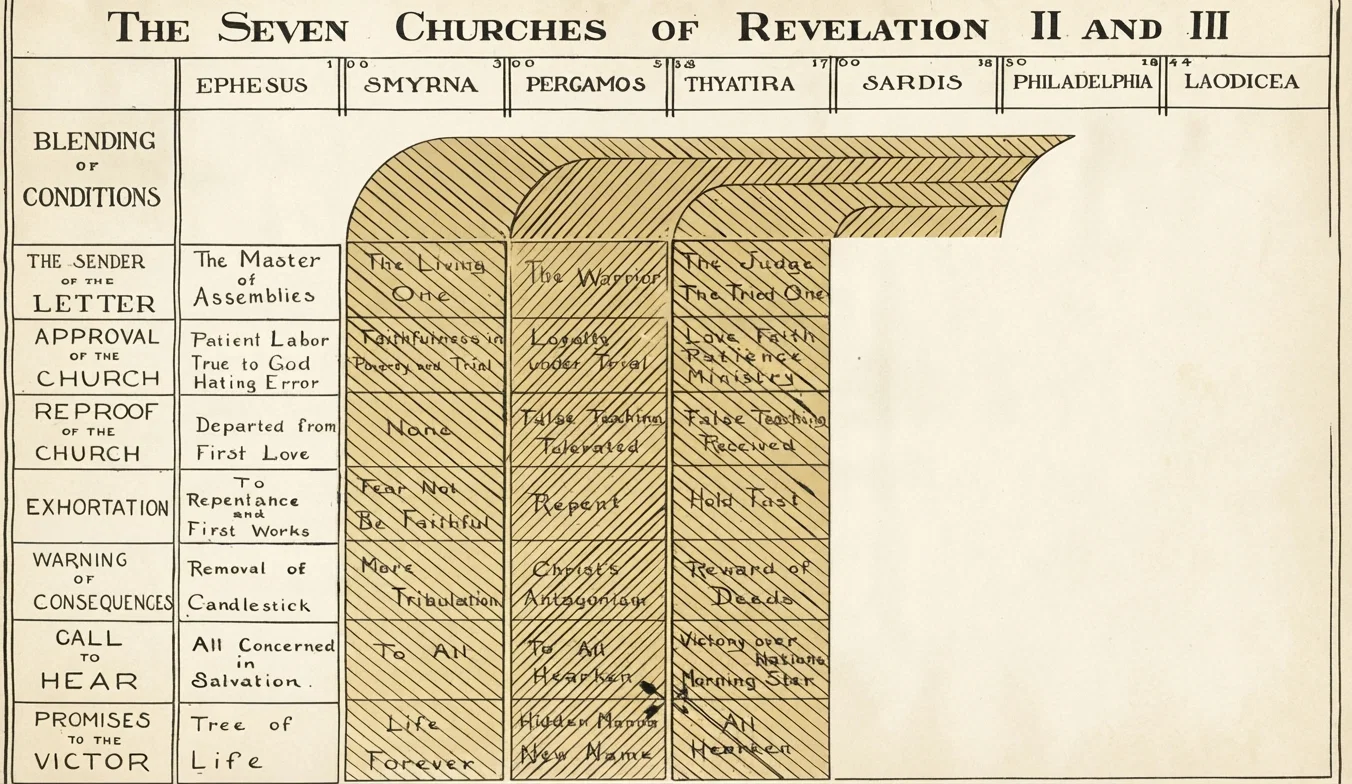
"And to the angel of the church in Thyatira write: These things saith the Son of God, who hath His eyes like a flame of fire, and His feet are like unto burnished brass."
2. For what did He commend them?
"I know thy works, and thy love and faith and ministry and patience [steadfastness], and that thy last works are more than the first."
3. For what did He reprove them?
"But I have this against thee, that thou sufferest the woman Jezebel, who calleth herself a prophetess; and she teacheth and seduceth My servants to commit fornication, and to eat things sacrificed to idols."
4. What had God done for her, and how did she respond?
"And I gave her time that she should repent; and she willeth not to repent of her fornication."
5. What punishment will come in consequence?
"Behold, I cast her into a bed, and them that commit adultery with her into great tribulation, except they repent of her works. And I will kill her children with death."
6. What would all these consequences teach?
"And all the churches shall know that I am He that searcheth the reins and hearts: and I will give unto each one of you according to your works."
7. Of what did He assure the faithful?
"But to you I say, to the rest that are in Thyatira, as many as have not this teaching, who know not the deep things of Satan, as they are wont to say; I cast upon you none other burden."
8. What earnest exhortation does He give?
"Nevertheless that which ye have, hold fast till I come."
9. What is the appropriate promise to the overcomer in Thyatira?
"And he that overcometh, and he that keepeth My works unto the end, to him will I give authority over the nations: and He shall rule them with a rod of iron, as the vessels of the potter are broken to shivers; as I also have received of My Father: and I will give him the morning star."
10. What is still pressed home upon the heart of the individual?
"He that hath an ear, let HIM hear what the Spirit saith to the churches."
Note and Comment
1. "Thyatira" was an important town of Asia Minor, on the Luces River, having a large Greek population, and noted for purple dyeing and weaving. Lydia, Paul's first convert at Philippi, was from Thyatira. Its name is from two Greek words meaning "to bruise," and "incense, or sacrificial rites," a fitting emblem of the true church during the Dark Ages. "The Son of God."-The Divine One. In chapter 1:13 we have the "Son of Man" glorified; here, the Son of God supervising and superintending His church. The eyes of Deity pierce to the inner secrets and motives of the heart; and His feet like burnished brass are to remind us that He has passed through the sevenfold heated furnace. No depth of iniquity can be hidden from Him; no pathway through suffering but what He has traveled.
2. "Thy works."-How the fierce persecutions and manifold trials of the Dark Ages - about A.D. 500 to 1600 - developed the approved graces of love and faith and ministry and patience, or patient endurance,-love for God, which held them despite the many voices calling; faith to walk for God in the darkest spiritual period of earth; ministry, loving service to those in like affliction; and endurance, patience, steadfastness, even unto death. Of that period we read elsewhere, "Here is the patience and the faith of the saints." Rev. 13:10. "They shall fall by the sword and by flame, by captivity and by spoil, many days." Dan. 11:33. That "many days" was the long period of the papal persecutions - 538 to 1798 - shortened at end and beginning in sharpness of persecution for the elect's sake. See Dan. 7:25; Matt. 24:21, 22, 29. In the latter part of this period came the Reformation, when the hopes, the zeal, the earnestness of God's true people were revived. The "last works" were more than "the first."
3. "Jezebel."-The meaning is "unhusbanded," not lawfully married. She, like many of the symbols of the Revelation, is an Old Testament character. Balaam, Jezebel, Babylon, Jerusalem, the beast, the dragon, the candlesticks, the stars, the manna, the scroll, the plagues, the song of Moses,7the symbolic description of Christ's person, the Tree of Life, in fact the whole book is filled with Old Testament imagery and symbolism, familiarity with which will better enable us to understand the Revelation. Jezebel was the daughter of Ethbaal, the sun-worshipping king of Sidon. He was formerly a priest of Astarte, the Phenician Venus, and made his way to the throne by murdering his predecessor Pheles. Ahab, the king of Israel, departing from the command of God, married the corrupt, iron-willed princess Jezebel, herself a devoted sun-worshipper of Baal and Astarte, or Ashtoreth, and herself seemingly a priestess and devotee of the licentious rites. Four hundred priests of Astarte ate at her table, and at Baal's sanctuary there were 450 priests or prophets, with a temple large enough to contain thousands. Into this horrible, cruel, licentious idolatry Ahab and Israel were led. Under the symbols of Jeroboam's calves Israel in a way still worshipped Jehovah and acknowledged His law; but under the influence of Jezebel there was utter separation from Jehovah. Israel turned from their union with God to union with the sinful world. The fornication of their abominable worship was the fitting outward emblem of their deeper spiritual fornication in turning from God to Baal. It was the mightiest step in Israel's ruin. Ahab was not wholly bad, but he could not resist his far stronger paramour.
4. "Who calleth herself."-Jezebel fitly represents the apostasy under the Papacy. She exalts herself as the mouthpiece of God. Like Jezebel, she brooks no oppositions, tolerates no dissenting opinions, persecutes to the death those who lift faithful voices against her. By her teaching she leads astray. By honors she seduces. The word planan, rendered "seduce," as Vincent remarks, "never means mere error, as such, but fundamental departure from the truth." This the Papacy has taught by assuming to change the royal law of God, and by putting man in the place of Christ in the Gospel. But of this more later, when the prophecy is more explicit. All these teachings and seductions the true church should have resisted to the death; but they tolerated them, and were weakened thereby.
5. "Time . . . repent."-God is not willing that any should perish. Not a soul ever sinned in God's universe - angel or man - that God did not give space, time, and opportunity to repent. So He did those in the great antichristian apostasy. There were centuries of exhortation and entreaty and protest before the Reformation, voices within and without the Roman fold, but they were unheeded.
6. "Great tribulation."-Nearly all the wars and strifes and sufferings of the Dark Ages came because of the union between church and state. Plots, conspiracies, rebellions, cabals, cliques, wars, and all the horrible work of the Inquisition came because of the self-assumed authority of the antitypical Jezebel. Century after century dragged on till relief to overburdened men and nations came in the revolutions from the sixteenth century on. Some of these were socialistic and infidel, some of them scholastic and infidel, some of them political, and some of them, thank God, truly spiritual, a return to first principles of salvation through Christ alone and to the Bible as the standard of faith - at least professedly so. The strife of centuries and the loss of millions of lives would have been prevented if the church had kept out of politics, and the civil governments had been left free from her domination, intrigue, and seduction. All that came was the result of the unlawful union of religion with the state, the fornication of the apostasy, who, espoused to God, left her rightful Lord, and united with the world. Yet there was time for "repentance out of her works" and into Christ's works within till the Reformation broke. The warning is as good to-day.
7. "Shall know."-God's Word and fulfilled history make plain, and every true child of God ought to read, the lesson that is taught by the Dark Ages; namely, that no church is good enough to dominate the faith of a single soul. All the spiritual slavery and ignorance and debasement and decadence of the Latin nations have come in consequence of the spiritual fornication of that period. It is one of the saddest things that Roman Catholics are aspiring after, the very things which well-nigh wrecked the world, and that Protestants and civil governments are tolerating, being seduced by the same teaching.