Christ Is Risen

6%

Pacific Press Publishing Association · Mountain View, California · Mar 22, 1910

FromSigns of the Times, Vol. 37, No. 12.

Read the full edition

Christ Is Risen

By Abdiel
ALL over Christendom March 27 will be observed as "Easter Sunday" in honor of the resurrection of Christ. The very term "Easter Sunday" should arouse investigation on the part of every lover of God's Word, of every true Protestant, of every disciple of the Lord Jesus Christ; for neither one of the terms is Christian or Scriptural. The word "Easter" occurs once in the Bible (Acts 12:4); of which the original is "Passover," and is so rendered in the Revised Version. The origin of the word is "Eostre," the name of a heathen goddess worshiped in the springtime by our pagan Saxon ancestors, whose votive offerings consisted of vernal plants and flowers, for Eostre was the goddess of spring, and the worship rendered her was nature worship, the character of which is well known to those versed in mythological lore. The spring or Easter festival is wholly of pagan origin.
The term "Sunday" has a similar origin. It is the name given by our pagan ancestors to the first day of the week, dedicated by them to the worship of the sun. Losing sight of God, the Source of all light, who is light, they turned to worship the creature made by God as a light-bearer. The first day of the week became the sun's day. The worship of the sun is also nature worship, and can be traced back into remote pagan times farther than any other form of idolatry. Sunday has no place in Scripture. It is neither taught as a duty nor revealed as a privilege. It is never presented as a holy day, either by express declaration or by inference.
So much for the term "Easter Sunday." The words are both of pagan origin, pointing us back to the dead heathen worship rather than to a living Saviour.

Not a Matter of a Day

True, the feast of the Passover came in the spring; but the object of the Passover ceased when "Christ our Passover" was "sacrificed for us." 1 Cor. 5:7. True it is that Jesus rose from the dead in the spring of the year, just after the time of the Passover; but what is there in that event which calls for the celebration of a day? He was not a day in coming forth from the tomb. In fact, the Scriptures place no emphasis upon the day of His resurrection, thus showing that the particular time is not in anywise important. The resurrection of Christ has in it nothing which would connect it with a particular day of the week; for the types of which our Lord was the antitype fell on various days of the week.
But apart from any positive declaration of Scripture to that effect, is it not well [[FIGURE]] to set apart a day in honor of the resurrection? Is it not well to draw the minds of the church and the world to that great event of Christendom at least once a year? To this last query I would reply most emphatically that it is well; but how shall it be done? by human devices, or in the way revealed of God in His Word? In devising and carrying into effect human plans and institutions, these evils arise: (1) Not having the Word of God, much more human energy is expended, and always unsatisfactorily, in securing their adoption and observance by the people. (2) This extra energy placed upon a purely human ordinance tends to exalt it above the divine, about which less is done and said. And if the human is designed to be a memorial of any work of God for which God has given a memorial, the acceptance of the human makes void the ordinance of God, and so the one error leads to many others.
Other evils which need not be named follow in the wake of Easter Sunday as a memorial in honor of the resurrection. A large amount of human energy, which should be devoted to God, is expended in the introduction and observation of the day. It exalts the yearly day, by the very manner of its observance, above the simple faith of the Gospel, by appealing to the sordid motive of pleasing God by works which He has not commanded. And finally it blinds the church and the world to the importance of the very thing which Infinite Wisdom set apart as an abiding evidence of a risen Christ.

A Memorial of Christ's Resurrection

All that God asks that we may be received into His family, is willingness on our part. This implies submission and faith; but Biblical faith comprehends it all. "Believe on the Lord Jesus Christ, and thou shalt be saved." Acts 16:31. "He that believeth and is baptized shall be saved," are the words of Christ in Mark 16:16. But baptism is not a work of the man which saves or helps to save him; it is an act of faith. The properly instructed soul will count it a privilege. When a true woman has won the love of a noble husband, her next desire is to show the union of their hearts, the trueness of their love, before the world. She has espoused him, given herself to be his alone, and she desires the world to know it. Therefore the marriage ceremony; therefore the privilege of the bride to name the day. So it is that when we have accepted Christ, when we have yielded all to Him, we wish the world to know it. We desire the truth of the union to be made known. We have become dead to the world, we have renounced its sin, that we might "be married to another, even to Him who is raised from the dead." Rom. 7:4. See also Acts 8:35-38. "For as many of you as have been baptized into Christ have put on Christ." Gal. 3:27. Baptism is therefore the marriage ceremony between the believer and Christ.
But the marriage is "to Him who is raised from the dead, that we should bring forth fruit [by the power of that risen life] unto God." Rom. 7:4. Baptism has direct reference,therefore, to the risen Christ. Here is another testimony: "We are buried with Him by baptism into death: that like as Christ was raised up from the dead by the glory of the Father, even so we also should walk in newness of life. For if we have been planted together in the likeness of His death, we shall be also in the likeness of His resurrection." Rom. 6:4, 5.
The great facts of the Gospel, Christ's death, burial, and resurrection (see 1 Cor. 15:1-4), are the very facts set forth in the ordinance of baptism; and in going forward in that ordinance we declare to the world that we accept of Christ's death and life for us. He died for our sins; His burial was proof of His death; He lives for our justification and victory. Our baptism shows that we should henceforth "walk in newness of life;" and we are married to Him, that "we should bring forth fruit unto God."

An Abiding, Daily Evidence

Now as death came by sin (James 1:15; Rom. 5:12), the triumph over death is the triumph over sin (see Rom. 8:1, 2; Rev. 1:18). The reason why the grave could not hold Christ, was because He was righteous. Acts 2:24. He triumphed over sin in the flesh, and His resurrection was a proof of His power. This is the power for which Paul relinquished all else,—"the power of His resurrection,"—and this power, this "newness of life," this "fruit unto God," is the proof to the world that there is a risen Christ, who has triumphed over sin and death, and who by His grace gives in answer to the faith of His people the same power to them. It is this very righteousness which He longs to put upon them in answer to faith. See Rom. 3:22. It is this very power which He desires them to have in answer to faith. See Eph. 1:15-23. It is this manifestation of the righteousness and power of God which reveals to all men that "Christ is risen indeed." And because the celebration of a day either weekly or yearly, hides this great and all-important fact, we are opposed to it and protest against it as a part of that mystery of iniquity which would make void the mystery of God.
Christ is risen! Proclaim that Christ is risen, but not once a year alone, not once a week alone, but every day and every hour of the day, in the manifestation to the world of "the power of an endless life"—His life who died for us, and who lives to intercede in our behalf, who lives in all those who trust Him. Reader, when, how, where, are you proclaiming that Christ is risen? He is our Passover; let Him be manifest to the world every day.
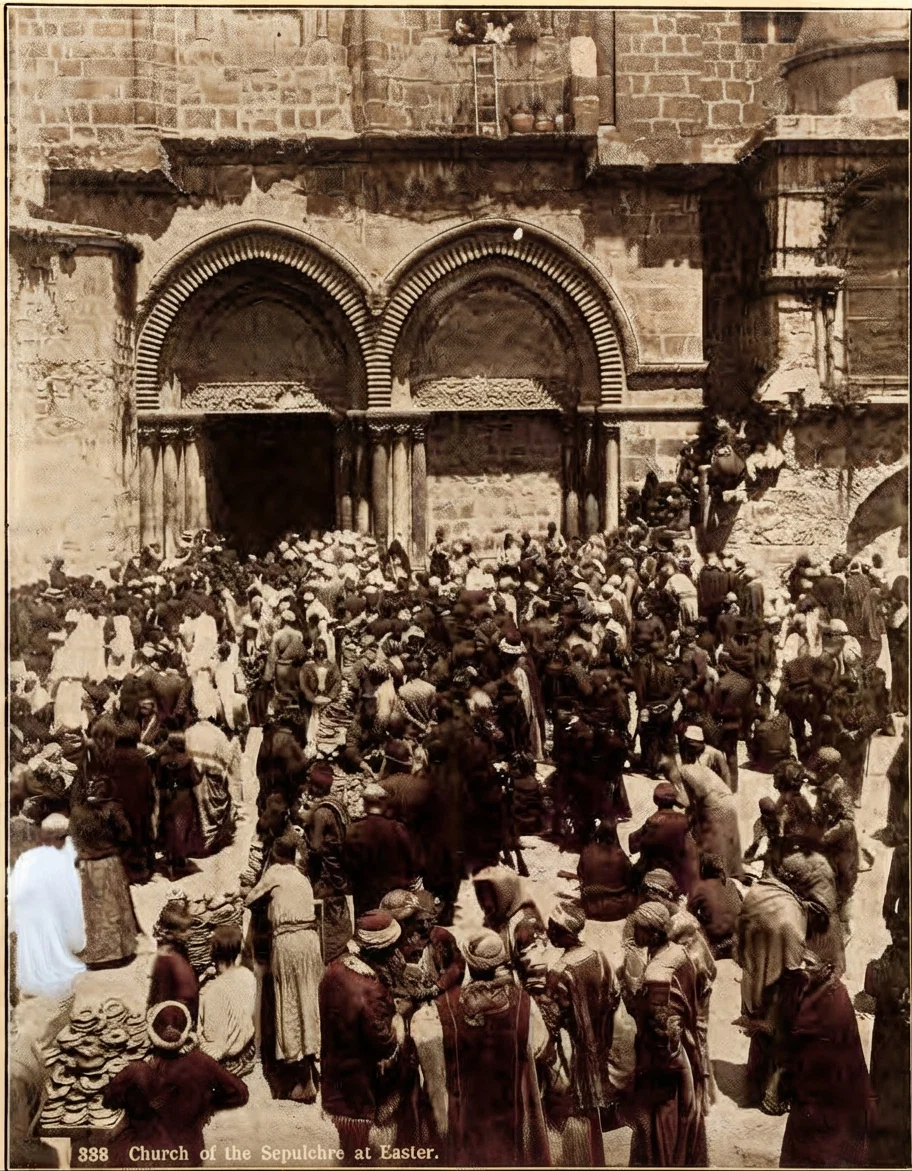
Scene in Jerusalem on "Easter Sunday" at the "Church of the Holy Sepulcher." No one can prove that our Lord was here buried.