Shiloh: the Man of Sorrows

2%

Pacific Press Publishing Association · Mountain View, California · Mar 22, 1910

FromSigns of the Times, Vol. 37, No. 12.

Read the full edition

Shiloh: the Man of Sorrows

By Mrs. L. D. Avery-Stuttle

Chapter IV—The Plotting of Herod

"NOW," continued the prophet, turning to the young man Bar-jona, "I will tell thee where I beheld Him—the Desire of the nation. Not many days ago, as I was praying in my house, the Holy Spirit came upon me, and the angel of the Lord said unto me, 'Arise, O Simeon, and go into the temple of the Lord; for there thou shalt behold the Holy One, even the Shiloh of Jacob.' Then I arose, and threw my mantle about me, and entered into the temple. Then the Spirit led me to a young Babe, the first-born of His mother. In an ecstasy of spiritual delight I listened to the simple prayer of the Nazarene carpenter, as he presented the Child unto the priest according to the law:
'Blessed art Thou, O Lord our God, King of heaven and earth, who hath sanctified us with Thy commandments, and commanded us to perform the redemption of a son. Blessed art Thou, O Lord, our God, who hast maintained us, and preserved us to enjoy this season.'
"When he had left off praying, I took the Babe in mine arms, and lifting up mine eyes toward heaven, I blessed the Most High that He had verified His promise toward me, and that mine eyes beheld His Anointed."
The aged prophet settled back upon his couch, and his voice grew faint and fainter. The roll of parchment slipped from his stiffening fingers; a gray shadow passed over the wrinkled face; the long, white locks fell over the bolster, and surrounded the noble head like a halo; the lips moved in prayer. A gentle breeze stirred the light draperies at the window, which seemed to the spellbound visitors like the soft rustling of an angel's wing. Suddenly the dim eyes opened for a moment and rested upon Bar-jona.
"Young man, understandest thou the words of the Lord which I have read unto thee?"
"They are very plain, O prophet of God."
A look of perfect peace rested upon the marble countenance, as the dying man whispered:
" 'I know that my Redeemer liveth, and that He shall stand at the latter day upon the earth: and tho after my skin worms destroy this body, yet in my flesh shall I see God.' Now, Lord, lettest Thou Thy servant depart in peace; for mine eyes have seen Thine Anointed."
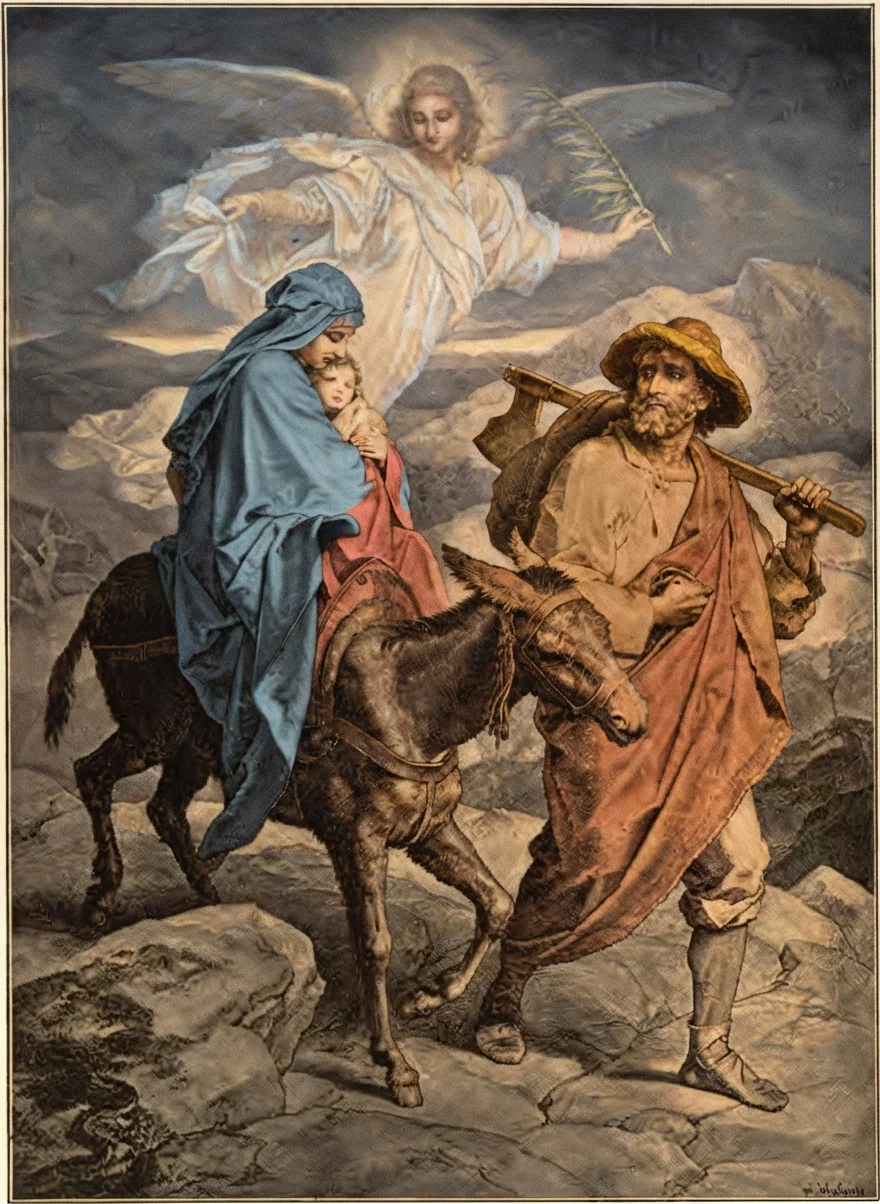
H. Hofmann On the Way to Egypt
The eyes closed once more; the flickering lamp of life had gone out. The silver cord was loosed. Hurriedly the attendants glanced into the peaceful face, and at once broke out into loud and plaintive wailing for the dead. The chamber of death echoed with their mournful cries, as Sylvanus and his young companion sought the streets of the sacred city.
As they passed out of the chamber, they noticed a man standing in the outer doorway, who stepped back hastily as they passed, as if he would avoid them. Something in his appearance arrested the attention of Sylvanus, who glanced quickly into his face:
"Ho, Demas, thou servant of Jozarus the high priest, how camest thou in hither? Verily, I believe thou wast in the chamber, and I saw thee not—eh, fellow?"
"Wherefore should I refuse to go whither my master sendeth me, especially when he maketh my heels nimble with a coin? Verily, the aged patriarch speaketh well but he will speak no more. But, behold, all Jerusalem is filled with his idle tales, and those of Anna the prophetess, who is so aged that she babbleth like a foolish child; so saith my master. What sayest thou, Sylvanus? Believest thou that the carpenter of Nazareth hath indeed departed into Egypt? And pray," continued Demas, sneeringly, "why tarry the wise men of the East at Bethlehem, that they return not hither, even to the palace of our lord King Herod?"
"Verily, Demas," replied Sylvanus, "the princes of the East tarry not in Bethlehem. But I believe thou art a spy, suborned by Jozarus thy master. I thought it not of thee," he continued; while his young companion, Bar-jona, panting with excitement and indignation, exclaimed hotly:
"Give me thy staff, Sylvanus, that I may lay this fellow low. What!" he demanded, as his more prudent companion slipped an arm about him, and compelled the young man to follow. "What! shall the fellow stir all Jerusalem with his prating tongue? Wherefore should the priests and rulers persuade Herod to pursue either the magi or the carpenter of Nazareth?"
"Verily, Bar-jona, Herod the king needeth no persuasion; surely his crown already resteth uneasily upon his gray head," replied Sylvanus.
Conversing thus, the two men passed on toward the eastern gate of the city, while the servant Demas hastened in the opposite direction, his sneering laugh echoing unpleasantly in their ears. We follow them as they pass Mount Moriah, where almost two thousand years before, the patriarch bound his son,—the mountain over which echoed the welcome voice of the angel, "Lay not thine hand upon the lad."
Hastening onward, they pass the bridge which crosses the Tyropeon vale, past the palace of Herod and the hill Zion. Now they reach the gate called Gennath, over which hang the shadows of the three frowning towers of Herod; and finally pass out of the sacred city. As they journey on over the road toward Bethlehem, glancing backward they see the all-glorious temple with its royal porch white and dazzling, as the rays of the westering sun linger lovingly upon it; on over the far-famed Valley of Hinnom, with its perpetual fires and its ascending smoke; past the beautiful mansions of the lordly Pharisee or Sadducee, or the more sumptuous palaces of their Roman conquerors. Now they pass the "Valley of Giants," where were the magnificent gardens of Solomon, climb the hill on its western slope, and gaze with reverent awe over the historic mountain of Zion.
"Seest thou how the bloody theater of the apostate King Herod looms up against the sky?" questioned Sylvanus. "The unholy house is adorned with pagan ornaments, and is an offense unto Jehovah."
"Ah, surely," replied Bar-jona, "when Shiloh shall take to Himself the kingdom and shall reign over Jerusalem, then shall He subdue all the heathen, and Israel shall rejoice over her enemies."
Finally, about a mile from Bethlehem, they pass the sacred place where Jacob buried his loved wife—the tomb of Rachel; and just before reaching the northeastern gate of their home city, they pause to drink at the well of David, the same cooling waters of which were brought to the king by his three mighty men more than ten centuries before.
At last, just as the sun is sinking behind the hills of Judea, our travelers enter the gate of Bethlehem.
"Come in, come in, Sylvanus, and thou, Bar-jona," cried Esther joyfully, while the little child Perpetua hastened to unfasten the door.
"Surely, my husband, thou didst not tarry long at Jerusalem. Didst thou find the carpenter, Joseph of Galilee?"
"What news, my son?" questioned the patriarch eagerly. "Verily, I wot the young Child is safe; surely He who is compassed about with legions of angels, needeth not the protection of feeble arms like thine and mine. But didst thou find the Babe?"
"Nay, father Eliab, the holy Babe journeyeth afar into the land of Egypt; so said Simeon the prophet this day ere he died."
"Is Simeon of Jerusalem dead?" cried Esther and the old man in one voice, while the former, with the babe Matthias in her arms, seated herself by the side of her husband, listening intently as he and Bar-jona related the adventures of the day.
"Yes; they bury him to-morrow in the sepulcher of his fathers. But father Eliab, it is plain from the rolls of the prophets, that not only hath Shiloh already been born, but that He must appear as Messiah, the Anointed, when He is thirty years old. But dost thou remember Demas, the servant of Jozarus the priest?"
Then followed a minute description of the chance meeting with the man servant Demas, of his strange words and still stranger conduct.
"I tell thee, my children," said Eliab, "the words of this Demas are cruel; but this I know, I am assured of, the God of Jacob will protect you. But the heart of Herod is filled with the chief, and Jozarus the high priest deviseth evil. Well saith the prophet David: 'Why do the heathen rage, and the people imagine a vain thing? The kings of the earth set themselves, and the rulers take counsel together, against the Lord, and against His Anointed.'"
Esther pressed her babe closer to her heart, and murmured, "May the God of Israel protect His chosen!" But that night as she laid herself down to sleep, a feeling of unrest and insecurity haunted her. The dream of the magi, which they had related to Sylvanus and Heber but the day before, together with the strange conduct of Demas, was sufficient to arouse the fears of her timid and gentle heart. Why should the angel of the Lord have been sent with a warning to the princes of the East, unless there were arising grave dangers? Again, for what purpose had Jozarus sent his servant Demas to the chamber of Simeon to act as spy? What could have been the real object of the high priest?
Meanwhile, over in Jerusalem, at the palace of Herod, there is excitement and unrest. Lights flash through the latticed windows, and dart and gleam from one end to the other of the sumptuous grounds. Servants gather in little groups, and speak to each other in whispers.
In an inner chamber, closeted with the king, are two centurions. The aged monarch, as cruel and unscrupulous as he is suspicious and jealous, is giving his parting instruction and orders to these officers before they set out upon their murderous errand. The deep, dark eyes of the angry monarch are bloodshot and terrible; and often, as he speaks to his officers, he thrusts his trembling and bloated fingers into his gray hair, while his voice shakes with a passion which he makes no effort to control.
"Look thou, Varro, and thou, Marcus; let not one child escape. It hath also been told me by Demas, the servant of Jozarus the priest, that the Persian princes have already left Bethlehem two days since. I suppose they be now hiding—perchance in the mountains of Moab. But for them I care not, tho I should pursue after them and spill their treacherous blood. But the Babe of Bethlehem—He that is born King of the Jews—hearest thou, Varro—let Him not escape. And hark ye; it hath now been a long time since by their own confession the strange star first shone upon the magi. So, slay ye all the males, from two years old and under; thus shall I make sure the work, and teach the treacherous princes of the East, that I, King Herod, reign over the land of Judea;" and again the bloated fingers coil themselves among the gray locks.
"But hear, O king!" exclaims Marcus, the younger of the two soldiers, while his dark eyes flash indignantly, and the blood surges to his temples; "how knowest thou that the Babe is yet in Bethlehem? Did not Demas tell thee that the old man Simeon, a prophet of the Jews, declared that He was gone into Egypt? Why wouldst thou slay an hundred helpless babes for naught?"
The wrinkled face of Herod grows livid with passion, and his voice shakes with rage, as he turns upon the young centurion:
"Ha! and thou failest me also, thou son of a Roman father. One would think thee a Jew. Verily thou art no Roman soldier; thou wouldst weep like a woman, at sight of blood! What thinkest thou, Varro?" he continued, turning to the other officer, a gigantic man of ferocious aspect; "thinkest thou not that this fine tale concerning the journey of the carpenter of Nazareth into Egypt, is but a cunning fable devised to save his life? Thinkest thou not that the Child still bideth at Bethlehem! Speak, Varro; what sayest thou?"
"Thou speakest well, O king," replied the centurion. "Great is thy wisdom; and, by the gods of Rome, what are an hundred babes, more or less, more Jewish spawn,—to the will of him whom thou hath appointed king?"
"In fact, O king," interrupted Marcus boldly, "thou forgettest that thou art a Jewish proselyte—aye, more; thou hast thyself a young babe, thine own son, who bideth in Bethlehem with his young nurse. Verily, if one hair of his head perisheth, we shall endanger our own heads. Wo be unto the man whose hands drip with the blood of the son of Herod the king!"
The young centurion hoped by mention of this fact, to rouse some faint spark of pity or paternal tenderness in the callous soul of the despot. But the centurion knew not the depth of wickedness in the black heart of the royal Edomite. Once again the claw-like fingers bury themselves in the gray locks:
"I know not, and I care not. Disobey the orders of the king at thy peril. Hearest thou, young man? To-morrow morning at rise of sun, King Herod hath no rival in Bethlehem."