Mexico

6%

Pacific Press Publishing Association · Mountain View, California · Mar 22, 1910

FromSigns of the Times, Vol. 37, No. 12.

Read the full edition

Mexico

THERE has been running for some time in a popular magazine a series of articles entitled "Barbarous Mexico," charging that country with thousands of cases of chattel slavery, with peonage, with inhuman treatment of Yaqui Indians, etc., etc. Not long ago we inquired of a gentleman who had been for some time in Mexico, and who was conversant with conditions in all parts of the republic, regarding the truthfulness of these articles. His reply was in substance that some of these things were in a measure true, and that many things occurred which would not be done in America, but conditions were vastly different in the republic of Mexico than they were in America, and the government found that some things were absolutely necessary that would not be tolerated in the older republic of the North. This gentleman considered, however, that on the whole Mexico was getting as good a government as could be expected, and he doubted very seriously indeed whether a course opposite to that pursued by the present government would get better results.
The government meets constant and persistent opposition from the Roman church and also from the lawless classes; and many of the reports of cruelty and unjustifiable severity are greatly exaggerated. The above is confirmed by an article in the Literary Digest of February 26 which has just come to hand, and which quotes from Mr. Elisha H. Talbot in a series of articles in Moody’s Magazine. It declares that the articles referred to above are a libel upon a "much maligned and sadly misrepresented country." Some of the details mentioned by the above series of articles are pronounced "wicked fabrications" by General Torres.
"No peaceable Yaqui was ever deported to Yucatan or elsewhere; only such are deported as have been guilty of criminal acts; and no Mexican families have ever been deported—only Yaquis, and these after many appeals have been made to them to obey the laws of the land, and after repeated warnings to cease pillaging and murdering."
David E. Thompson, former United States minister to Mexico, is quoted as saying, "The Mexican government has dealt more kindly with these blood-thirsty Indians than justice demanded."
An American lawyer, Robert J. Kerr, says:
"During the period of nine years covered by my personal experience there have been in that district two or three instances of improper treatment of laborers by their employers; but these were investigated as soon as reported, and the offenders were severely punished."
Mr. Talbot has this to say regarding the charge that President Diaz is a despot:
"I doubt if there is a country on earth that can point to a cleaner record in this regard [that is, in the matter of amassing great wealth at the expense of the country] than can Mexico."

The Decadence of France

We have received advance sheets of the North American Review for February containing a striking article on "The Decadence of France," by Mrs. Bellamy Storer, in which Mrs. Storer goes on to show that France is rapidly degenerating into absolute infidelity; that the secular schools, instead of being purely secular, are not only non-religious, but really anti-religious; more than this, are making a religion of infidelity. She gives samples of how in books expressions which refer in any wise to God or providence have been cut out, and nature or the state has been substituted.
For instance, she tells us that in the events of Robinson Crusoe, when he came to a time of great need, he prayed, "Lord, help me, for my need is great." Then he remembered that he had tobacco in a trunk, and in searching for tobacco he found a Bible, in the Bible a promise, and he pleads the promise, and his fever leaves him; but the revised edition of the book in the schools of France omits all mention of the Bible and everything connected with it, and the idea is left that the tobacco cured him.
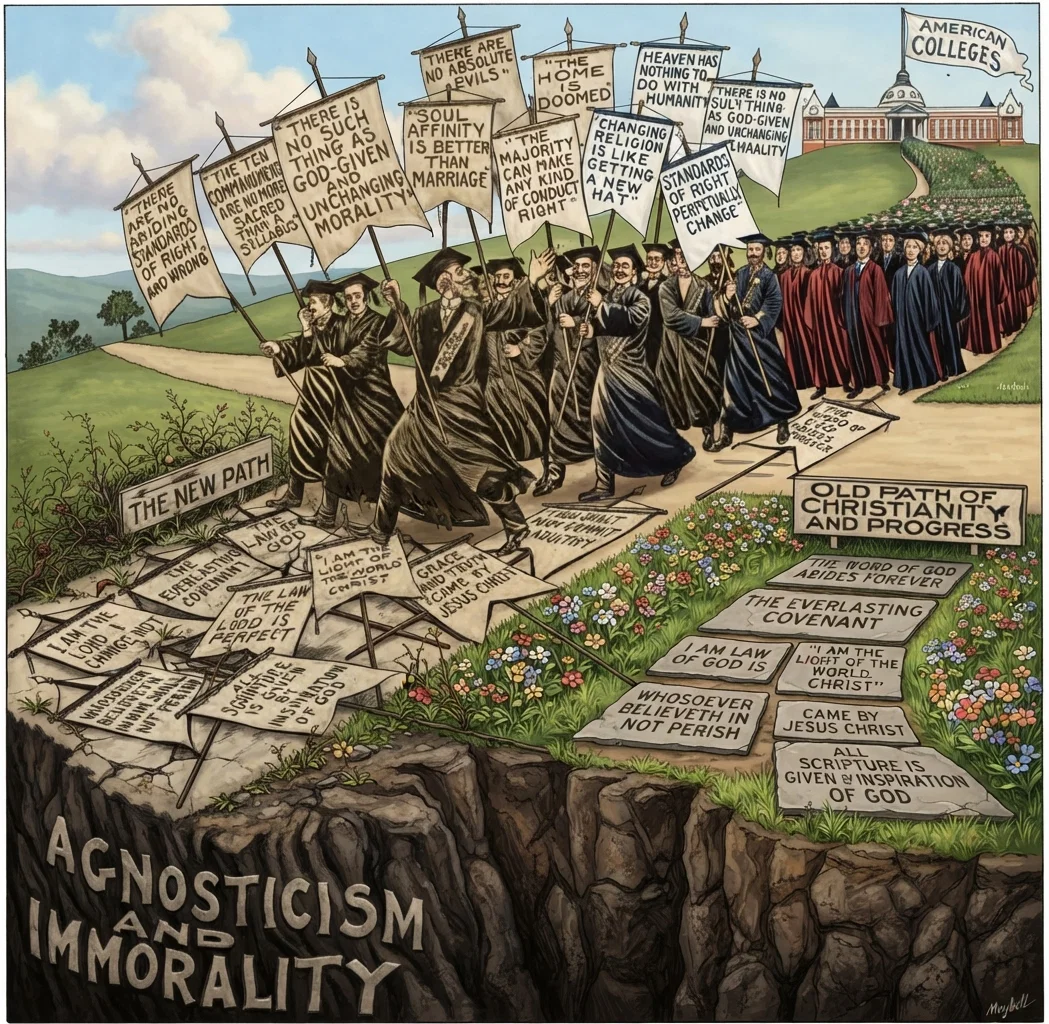
This cartoon is not meant to include all colleges; for there are honorable exceptions, especially among the smaller schools. The expressions on the banners, however, are actual quotations from the teaching of various educators in great universities and colleges. This teaching tramples under foot the very essentials of Christianity. Religious anarchy breeds political and social anarchy and fosters crime.
Of course Mrs. Storer, a devout Roman Catholic, feels that the condition of France is awful beyond description; and it is. It is a sad, sad thing when infidelity is openly and aggressively taught; and yet there is one thing, it seems to us, which Mrs. Storer and other good Catholics ought to think about in the study of the question.
What drove France to infidelity was the recoil from the conditions brought about by the church of Rome, which had ruled it for years. If Protestantism stood where it ought to stand, it would save many of the French from infidelity; there was a time when God desired to save France from her infidelity;
namely, during the Reformation period. But the Protestants were driven out, France was held to Roman Catholicism, and the Revolution followed. Now that Revolution is being repeated. The reaction has swept back again, perhaps not as aggressively as in the eighteenth century, but nevertheless as truly. Infidelity is but the reaction of extreme traditionalism. One puts a man and history in the place of God, and the other puts the living, carnal human in the same place, and both tend to degeneracy.