IN this and subsequent articles it is purposed to enter upon the study, with our readers, of the most wonderful, and to many the most mysterious, book of the Bible, and proceed in easy stages to its close. These studies will not aim to be exhaustive, but expositive, practical, suggestive. Our readers are invited to follow us prayerfully, for only so may we arrive at the truth. We wish them also free to ask questions; for questions oftentimes open avenues to glorious light.
The Name
The book is called in our common version, "The Revelation of St. John the Divine," for which there is absolutely no authority save tradition. The American revision (which we shall use with the common version) gives only "The Revelation of John," which simply means the Revelation sent by John. The Greek term "Apocalypse," meaning "revelation, disclosure," is only a part of the title, the first words of the book supplying the whole—"The Revelation of Jesus Christ."
The Writer
Is John, the beloved disciple, the brother of James, who assumes no title dearer to him than "your brother and companion." Inspiration uses the same expression to designate John's faithfulness that the Lord used to designate Moses; namely, "servant;" "Moses, My servant," "John, His servant." What better reveals the noble character of the man than the position that the angels delight in? for one who excelled in power declares to John, "I am thy fellow servant." Rev. 19:10. Blessed are those who serve such a Master.
The Time and Place
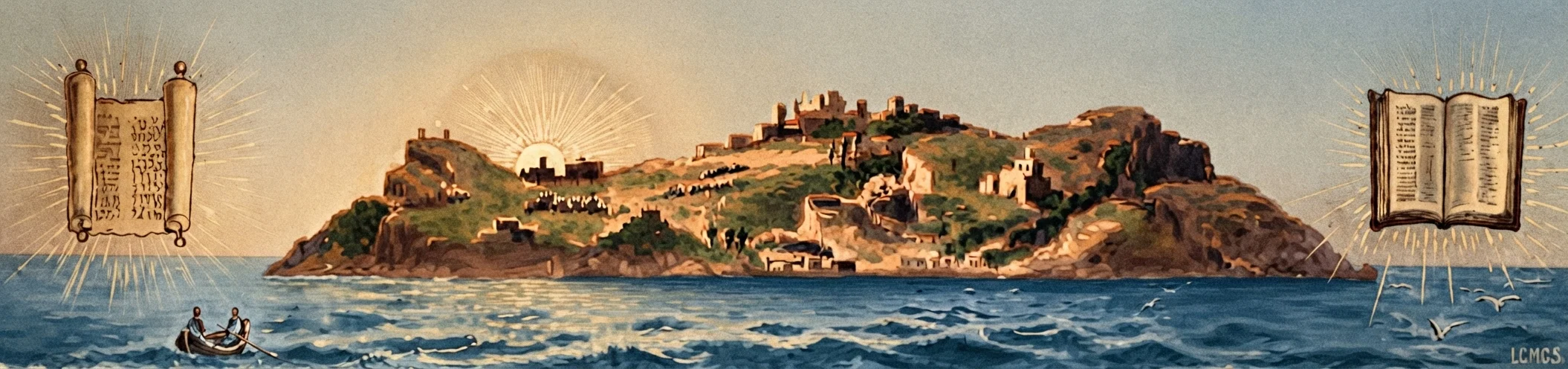
The time of the writing of the book was about A.D. 95 or 96, where it is generally placed by all save the Higher Critics. The place was the rocky Isle of Patmos, about twenty-four miles west of the coast of Asia Minor. Here John was banished by the Emperor Domitian, through whose darkened soul Satan thought to destroy the torch that Christ had lighted in John. But the gloom of his captivity was banished by the glory of God, and his isolation was replaced by the companionship of immortals. The rugged sea-girt isle became a gate of Paradise, and the anteroom of the audience-chamber of Heaven.
The Contents
The contents of the book are remarkable. It is the epitome of all the prophecies, of all the ethical teachings, of all the books which have come before. It sets a divine seal upon them all. The references of Bibles which give them will cite to every book in the Bible except eight; two of the eight have references to the Revelation; while the six others refer to the same great facts, truths, principles, but being small, personal, or purely historical, are not considered of sufficient import to note in reference. But every book in the Book of books finds echo in the Revelation. This it is, doubtless, which gives to its Greek its strongly Hebraistic mold. The practical, soul-stirring truths of all the ages shine with added luster in their new settings, and the prophecies of the past are enlarged and carried forward to the eternity of the glorious consummation.
PATMOS
It is one book, not several. It is a divine drama of the ages. It has its stage, its scenery, its settings. It has its plans, its plots. It has its Hero and heroine and their loyal retainers. It has among its characters kings and warriors. It has its conspirator, its deep, dark-dyed villain. It has its romance, its marriage, its blessedness, its dénouement, its eternal glories which wait.
The one Central Figure is Jesus Christ. The whole plan of the book, of the grand, poetic drama, circles round the one Triumphant One. It presents Him in its very beginning a Conqueror; it reveals His work for His church in this world, in her conflict with the spiritual powers of darkness, and the secular powers controlled by the spirit of evil. All the various phases of her struggles and sufferings, of their efforts, seeming successes, and utter failures, are set forth with a startling vividness, often in highly symbolic language, in moving, acting, living figures in the world's great arena, but all tending to the one great consummation, the extirpation of all evil, and the absolute triumph and everlasting reign of the Good.
While its practical, ethical lessons are taught in language easily understood, its prophecies frequently are presented in striking symbols. It deals in all the imagery of the prophets of the past. It has the living creatures of Ezekiel and Isaiah; the horses, the lamp-stands, the olive-trees, the golden oil, of Zechariah; and the beasts and year-day periods of Daniel.
The numbers three, four, seven, ten, and twelve play an important part in the scheme of the book. Three is the sacred number, four a world number, and seven the perfect number, denoting completeness, fulness. There are seven lines of prophecy in the book that span the Christian era to the consummation of the Gospel message, as follows:
Seven churches reveal the internal condition, the spiritual state, of the church of Christ throughout the Gospel age.
Seven seals reveal the Gospel working through the events of earth to a triumphant end in the triumph of its Author.
Seven trumpets usher in, one by one, great changes and events in the history of nations affecting the work of God in the earth.
The two witnesses, testifying of the power of God through the Dark Ages of earth, in sackcloth.
The seven-headed dragon's reign and his persecution of the church of Christ are shown from the beginning to the end.
The seven-headed composite beast, and the two-horned lamblike beast, are prophetic symbols of powers which the dragon uses in his work against Christ Jesus.
The seven-headed scarlet-colored beast with his gaudy female rider, covering the same period of time as the dragon, but emphasizing the harlot's work and the last days. Nearly all of these are subdivided by seven.
We have also the seven-hued rainbow, the seven lamps of fire, the Lamb with seven eyes and seven horns, the sevenfold ascription of praise to the Lamb, the seven angels with the seven bowls of wrath, the sevenfold judgments, the sevenfold triumph, the seven promises to the victor, and more,—all speaking of the completeness of the wonderful revelation of Jesus Christ.
The Revelation is a fitting close to the Scripture canon. It carries us from the apostolic days, with their backward connecting links with the vital past, to the glorious consummation of a sinless earth, a deathless,6all-victorious King, and immortal subjects. Who would not indeed ardently and devoutly explore this great treasure-house of divine knowledge of potency to save to the uttermost?
THE Master will not keep His hand under our arms when we go on forbidden ground. Presumptuous Peter needed a sharp lesson, and he got it. That bitter cry at the foot of the stairs bespoke an awful fall. How many such are rising daily into God's listening ears.