THERE he lay for hours and hours, a miserable, half-clad, bleeding leper. Starvation, not more cruel or relentless than the gnawing disease, but an added enemy, had driven him forth (if indeed he had a fixed place of shelter) to seek of his less unfortunate fellows a bit of food with which to eke out an existence that was a living death to himself and a source of harrowing pain to all who beheld him. Carefully avoiding the main thorofares, he placed his well-nigh lifeless body on the edge of a rough, cobblestone-paved road connecting two main streets in a foreign concession in the city of Shanghai. With still life enough to feel the sting of the cold wind, he selected a place in the road just behind the splint bamboo fence where the minimum of the chilling north wind sifted through, and where the rays of the impartial and beneficent sun brought the most warmth. Too weak and full of pain to sit upright, he lay on his side seemingly all unconscious of the cold earth and jagged stones under him. His face was turned toward the road to catch the eyes of the passers-by who now and then cast a few “cash” pieces onto the small, ragged piece of grass matting that he had spread just in front of his face for that purpose.
His body, doubtless full of the loathsome disease, was scantily covered with a mass of rags, so hiding at least from the human eye the larger part of the man’s wretchedness, while his feet, hands, and head were fully exposed to the bleak January weather. His feet—mere stumps they were, the insatiable disease having already consumed the toes and beyond, leaving open, running sores, as if with its invisible fangs it had just then made a fresh attack. With some of his fingers entirely gone, and others to the first or second joint, his hands, if such they could be called, were pressed together and moved in the way of Chinese salutation; and this was his only appeal, unless an occasional moan escaped his lips, to the people as they passed back and forth in the way. His face so listless, so pinched with pain, and so hardened with that stoical feeling that runs deep in the Chinese life, together with his almost fixed eyes, plainly told the whole story of the wasting life within.
This man is one of China’s suffering ones, a member of a large class. To meet such cases of abject wretchedness is one of the common experiences of the missionary, and there is perhaps nothing that tells more on his strength. He can not possibly escape such sights, since at every turn they are present; but the fact that in the face of such suffering he is quite helpless to extend any real relief, is still more wearing to his nerves and feelings. All about him is a veritable ocean of physical suffering, whose tides and waves incessantly beat up against him, while he is the mere sport of their buffetings.
A Worse Evil
But why, indeed, should this suffering of which this man is so striking a type, excite our sympathies so profoundly, as tho men of this class were the most to be pitied? It is only right and quite natural that we should feel for, and seek to extend help to, any of our fellow men who are in great physical need; but are we not touched overmuch by the physical sufferings about us, to the exclusion of feeling compassion for a still larger class smitten with the still more deadly leprosy of sin? Are there not many who at the sight of the wretched man described in the above paragraphs would feel their hearts wrung with commiseration, while in the presence of what is still more distressing, say a company of idol worshipers prostrating themselves in abject fear before senseless images, there might be absolutely no feeling of pity?
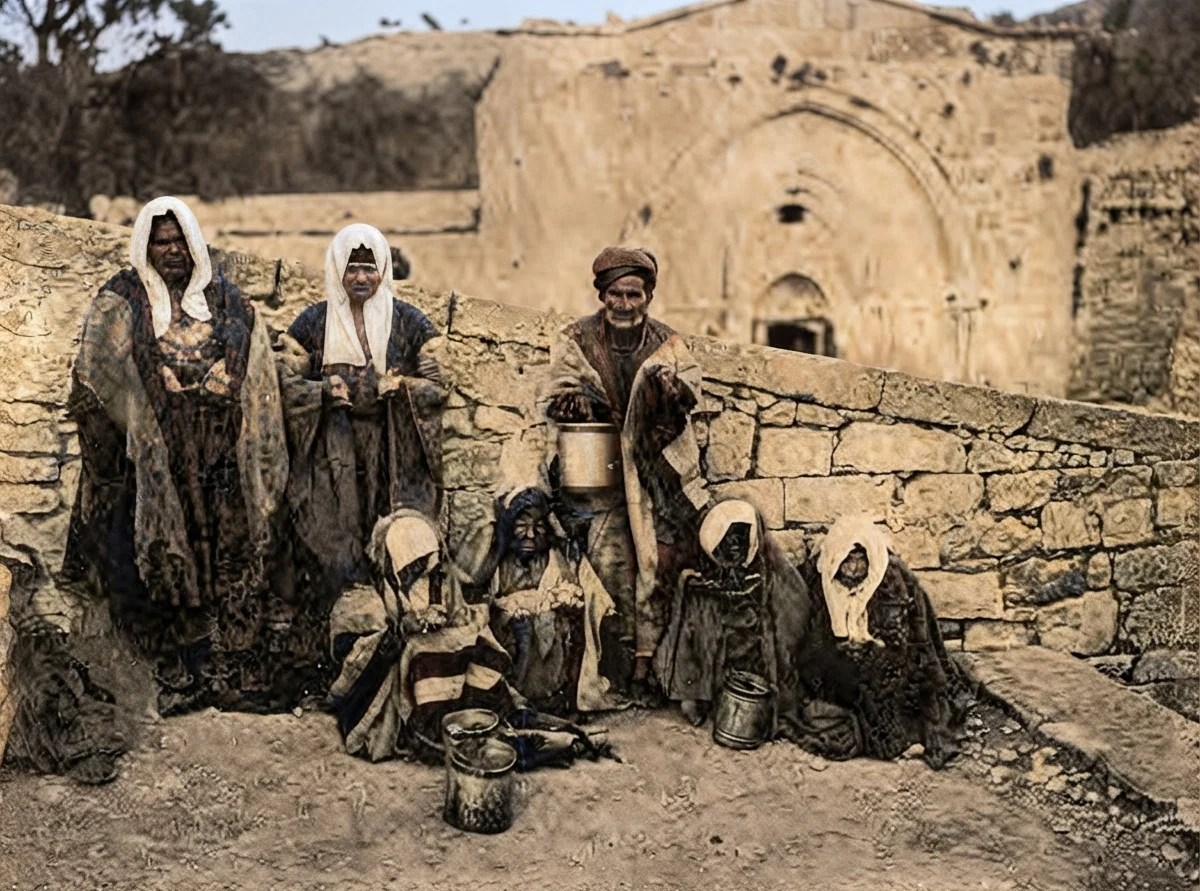
A group of lepers in Syria. The dread disease is the same everywhere.
Why is this? If the physical sufferer deserves our sympathy (and no one can gainsay this), what shall we say of the man who is without hope and without God in the world, upon whom the wrath of God abides, whose fixed vision of the future is “a certain fearful expectation of judgment”? Is it not the spirit of man, the eternal life, that are of priceless value? The present world is marked with physical suffering, and this is particularly true of the great heathen lands where the powers of darkness exercise well-nigh full sway. The spirit of the Gospel leads us to do all in our power to alleviate this physical suffering, but the same Gospel goes infinitely beyond this. The real end of all missionary endeavor is to cast out of the human heart the devil and all his works; it is to go about “doing acts of kindness, and curing all who are crushed by the power of the devil,” and testify “that through His name all who believe in Him receive the forgiveness of their sins.” (Weymouth’s translation.)
Let us then be up and doing; let us know that to us has been committed “the Word of reconciliation,” that invites man to be reconciled to God and so become forever free from the darkness and slavery of Satan. In this great day of God’s mighty preparation and unparalleled opportunity, let us quit ourselves like men, and be “sons of light, and sons of the day.”