Shiloh: the Man of Sorrows

3%

Pacific Press Publishing Association · Mountain View, California · May 24, 1910

FromSigns of the Times, Vol. 37, No. 20.

Read the full edition

Shiloh: the Man of Sorrows

Chapter XII. With the Doctors
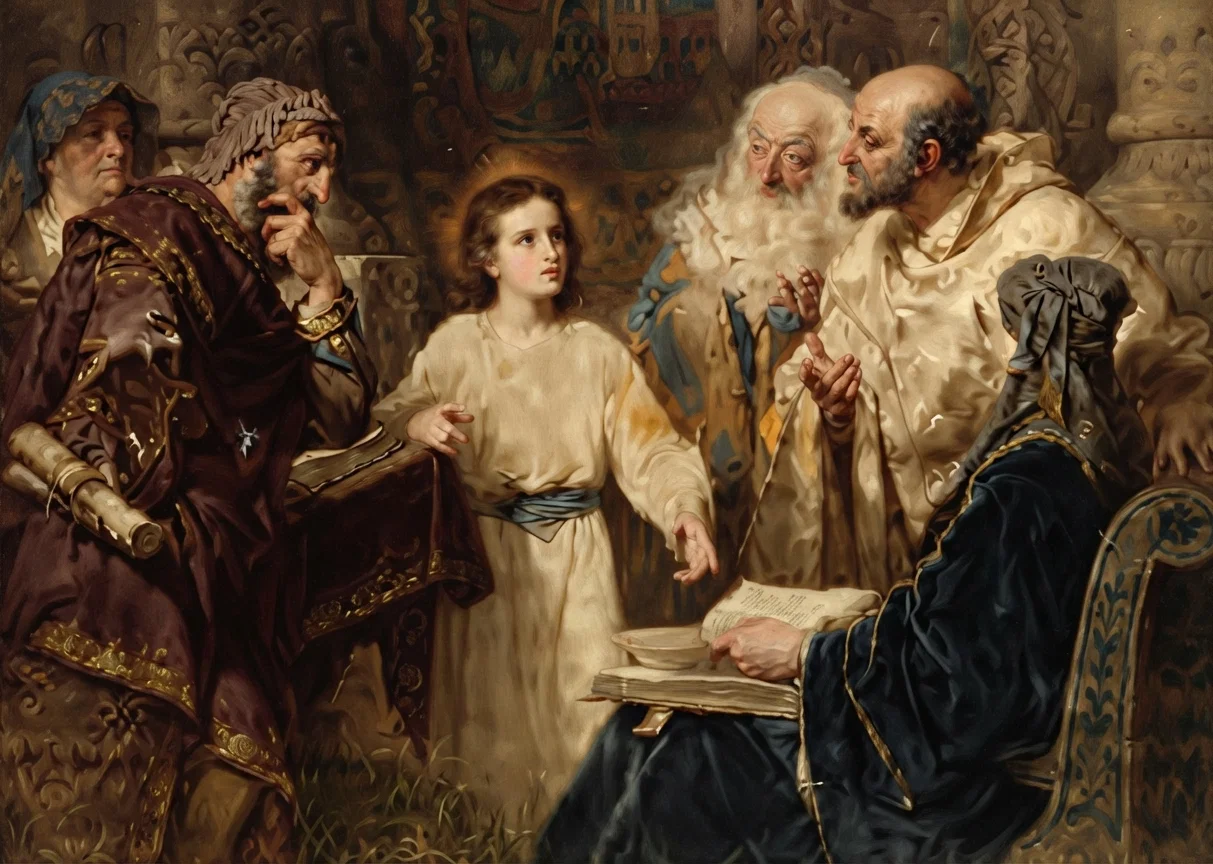
At last the wanderers for the hundredth time approached the temple. The golden light of departing day was bathing it as with liquid fire. So many times had they searched even here, in every court, in every cloister where it seemed possible their Child might be, that now, with a despairing sigh, they were about to pass on. But almost unconsciously they entered through the gate Beautiful and on as far as the court of the women.
Hush! the mother's straining ear had caught a sound that for three dreary days and nights she had been longing to hear.
"Truly, O mine husband, it is the voice of the Child!" she exclaimed, pressing eagerly forward.
"Hold, woman! thou forgettest that thou mayest not enter in hither even into the chambers beyond the court of the women. Behold, I will fetch thy Son."
The carpenter entered an inner door, beside which a young man and a lad were standing, listening eagerly to the conversation between the Child and the learned rabbis. The young man was the fisherman Bar-jona, of Bethsaida; and the little lad with the nut-brown eyes and the dark curls was the boy Matthias, the youngest born of Sylvanus the shepherd and Esther—he whose infant life was saved at Bethlehem from the sword of Herod.
"Wilt thou send yonder Lad to me? Behold, His mother awaiteth Him in the court," said the carpenter, to Bar-jona.
"Who art thou, man, that thou shouldst bring the discussion to a close?" demanded the young man, fixing his earnest eyes full upon the intruder: "for verily the Child speaketh with the wisdom of a seer. I have learned much already by listening to the words of His mouth. Who art thou?"
"Who am I? Why carest thou, friend? The mother anxiously awaiteth His coming—even with tears she awaiteth Him," replied the carpenter.
At mention of the mother the second time, the young man answered: "I also have a child of mine own. I will speak to Rabbi Ben Israel, whom I know well," he continued, approaching the speaker in the center of the room.
Meanwhile from the lips of the strange Child, come the mournful words of the prophet:
"He was led as a lamb to the slaughter; and as the sheep before her shearers is dumb, so He opened not His mouth."
"Peace to thee, rabbi," whispered Bar-jona to Ben Israel; "behold, the mother of the Lad desireth to speak with Him!"
"Ah, is it thou, Bar-jona, and the young lad, Matthias? Surely it is his first Passover. But what thinkest thou of this strange Child? for verily He is an astonishment unto me. He knoweth the rolls of the prophets like unto a master in Israel."
"What sayest thou?" exclaimed a harsh voice at their side. "Wherefore sayest thou this, Rabbi Ben Israel? Doth not this Child usurp authority over His elders? See! He agreeth not even with the most learned teachers in Israel. Now we do know that when Messiah cometh, our nation shall be relieved of all her sorrows. But this Child speaketh unto us strange doctrines. How knoweth He the prophets better than our fathers?"
"It is Jazer, the scribe," muttered Bar-jona to the boy Matthias. Meanwhile Rabbi Ben Israel has delivered his message.
With a deep sigh the Child arose, and with one quick glance about Him, quietly walked from the apartment.
With a look of mingled curiosity and awe upon his countenance, Bar-jona impulsively followed the slight figure as far as the court of the women. As he turned to retrace his steps, a woman's voice, tearful and loving, fell upon his ear; but there was a note of gentle chiding in the musical tones:
"Son, why hast Thou thus dealt with us? behold, Thy father and I have sought Thee sorrowing."
Hofmann Jesus in the Temple with the Doctors "In the midst of the doctors, both hearing them, and asking them questions." Luke 2:46.
Bar-jona turned his head. The Child stood meekly by His mother's side, with His small hands clasped, and His thoughtful, earnest countenance upturned toward heaven. The rapt, wonderful eyes had in them a light not of earth; He seemed for the moment to be piercing the dreary space between the throne of His Father and Himself.
"How is it that ye sought Me?" He asked, turning once more to the woman. "Wist ye not that I must be about My Father's business?"
While Bar-jona still hesitated, the Child turned, and for a moment fixed His wonderful eyes full upon him. In that glance were blended tenderness and understanding and love, infinite.
When Bar-jona and the lad Matthias returned to the apartment they had just quitted, they found the doctors, lawyers, and rabbis still lingering, discussing the remarkable happenings of the past three days.
"A wonderful youth is that, verily!" exclaimed one of the teachers whom they called Nichodemus. "And thou sayest that He hath been in the chamber yesterday and the day before?" continued the speaker, addressing Rabbi Ben Israel.
"Verily, He hath been here this is the third day, and—I speak for myself—I can not but wonder at the wisdom of His words."
The evil eyes of the scribe Jazer flashed as he interrupted:
"It is well thou speakest for thyself, Rabbi Ben Israel; surely thou speakest not for me, nor for others who are wiser than thou, or thy words had been better chosen!"
"Thou hast well said, Jazer," muttered Annas, the high priest, who also sat among the others. "Verily it is beneath one of my position to discuss with infants and children, but it seemeth that some are already being deluded by this bold Lad, and I deemed it my duty, as high priest, to have somewhat to say unto Him. I think, however," continued Annas loftily, "that my words have been sufficient, and that this ignorant Youth will return no more to the temple."
"It may be thou art right," remarked Nichodemus calmly. "It hath surely been the faith of our entire nation that when the Messiah cometh, He cometh in such splendor that the enemies of Israel shall flee before Him; and this Child favoreth not this teaching."
The man Nichodemus was conservative and cautious as well as diplomatic and peaceable, and he thought to put an end to further discussion, as he saw plainly that there was a division of sentiment among his learned peers. But this was not to be.
Jazer, the scribe, envious and full of jealous hatred that a mere child should have aroused such attention among the most learned body of men in Jerusalem, could not hold his peace.
"Hear me, Rabbi Ben Israel, and ye priests and rulers of Jerusalem. It hath not been meet for this learned body to listen to the babblings of a Child. It had been better to have listened to me, a scribe, a writer of wisdom, and learned in the law and traditions of our fathers. Now it hath been many times asked, 'Who is this Youth?' Go ask Shaphan, the rabbi of Nazareth; he will tell you, even as he told me."
As the scribe spoke these words, he fixed his scowling glance upon Rabbi Ben Israel, and sat down. There was a certain malignant triumph in his tones, which was intended to express far more than mere words could do, and to arouse the curiosity of his hearers.
"Who is the Lad, if thou knowest?" questioned one of the lawyers of Jerusalem who stood by.
Again the scribe rose to his feet, and regarded his questioner in impressive silence for a moment, as if he determined the lawyer to realize the vast importance of his message.
"Who is the Lad?" repeated Jazer scornfully. "Listen, ye men of Israel; He hideth in Nazareth of Galilee. His supposed father is an ignorant carpenter, while His mother—I tell you truly, no man knoweth the father of the Child. Shaphan the rabbi knoweth the family well. Nor is this all," continued the scribe impressively. "This Youth keepeth the company of evil-doers. He hath even been found giving bread to men of dangerous character, and associating with such as be outlaws and villains! Now what think ye? Shall we listen any longer to these childish doctrines, when there are those of us who know the law—"
"Thou needst have no further fear, Jazer," interrupted Rabbi Ben Israel; "the Child hath departed, even to Nazareth, with His parents."
(To be continued)