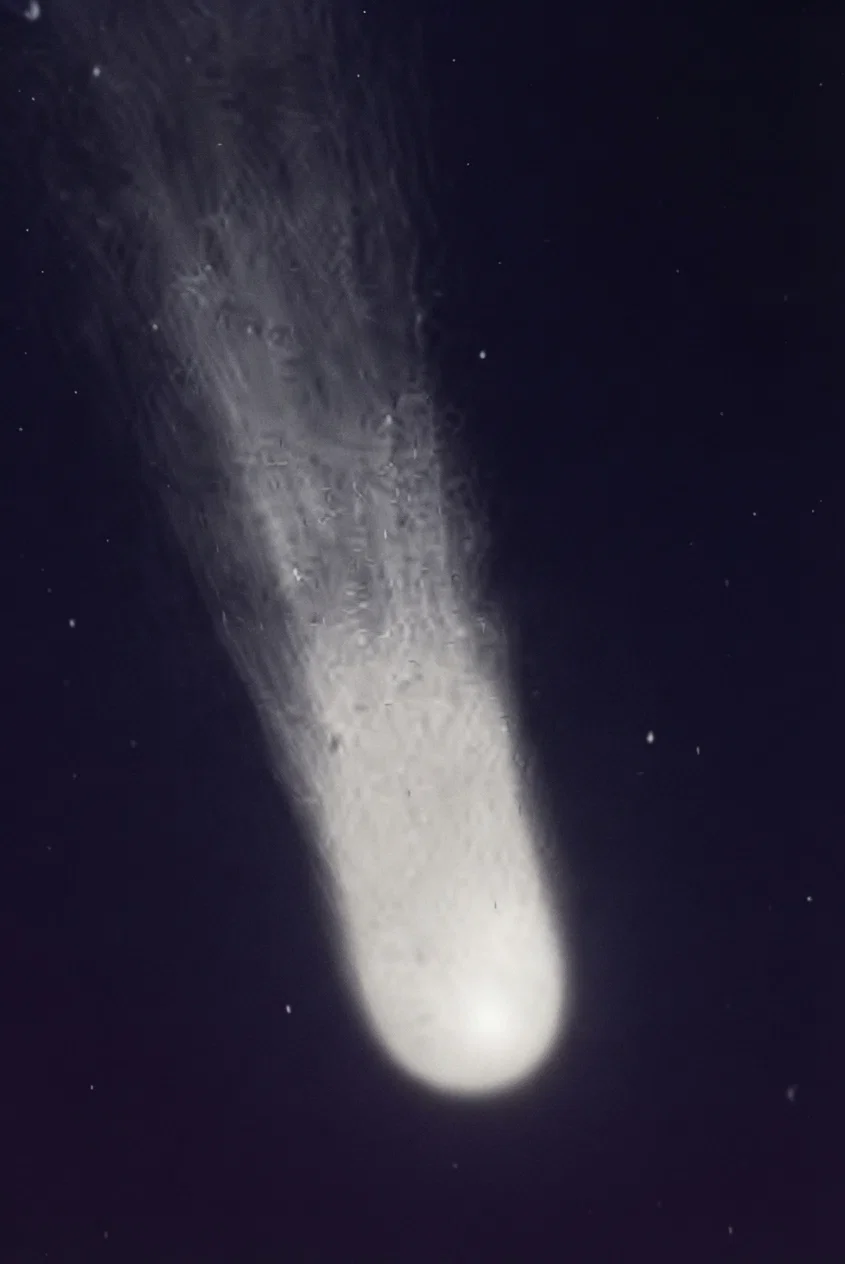
Halley's Comet

33%

Pacific Press Publishing Association · Mountain View, California · May 24, 1910

FromSigns of the Times, Vol. 37, No. 20.

Read the full edition

Halley's Comet

HALLEY'S COMET from a photograph by Dr. Curtiss through the Crossley Reflector, aperture 3½ inches, May 2, 1910. The exposure began at 3:42 A.M. Pacific Standard time and closed at 4:05, 23 minutes. This view shows twelve degrees of tail, or 15,000,000 miles. May 5, eighteen degrees of tail was photographed, the full capacity of the instrument, which indicates 23,000,000 miles. The view herewith given is reversed; the tail points to the right instead of the left, directly away from the sun. The head of the comet becomes invisible from about May 17 to May 21 on account of its apparent nearness to the sun. For a few evenings after the latter date the head of the comet will be seen a few degrees north of the west point in the western sky. A total eclipse of the moon occurs on Monday evening, May 23, from 9:09 to 10:00 Pacific Standard time. This will afford to observers who have a clear sky and freedom from electric illumination an excellent opportunity to view the comet. After May 25 for two weeks the comet should be well seen, constantly growing fainter. Spectrum photographs record sodium, carbon, and cyanogen lines. For the above information and photograph we extend our thanks to Dr. W. W. Campbell, the director of Lick Observatory.