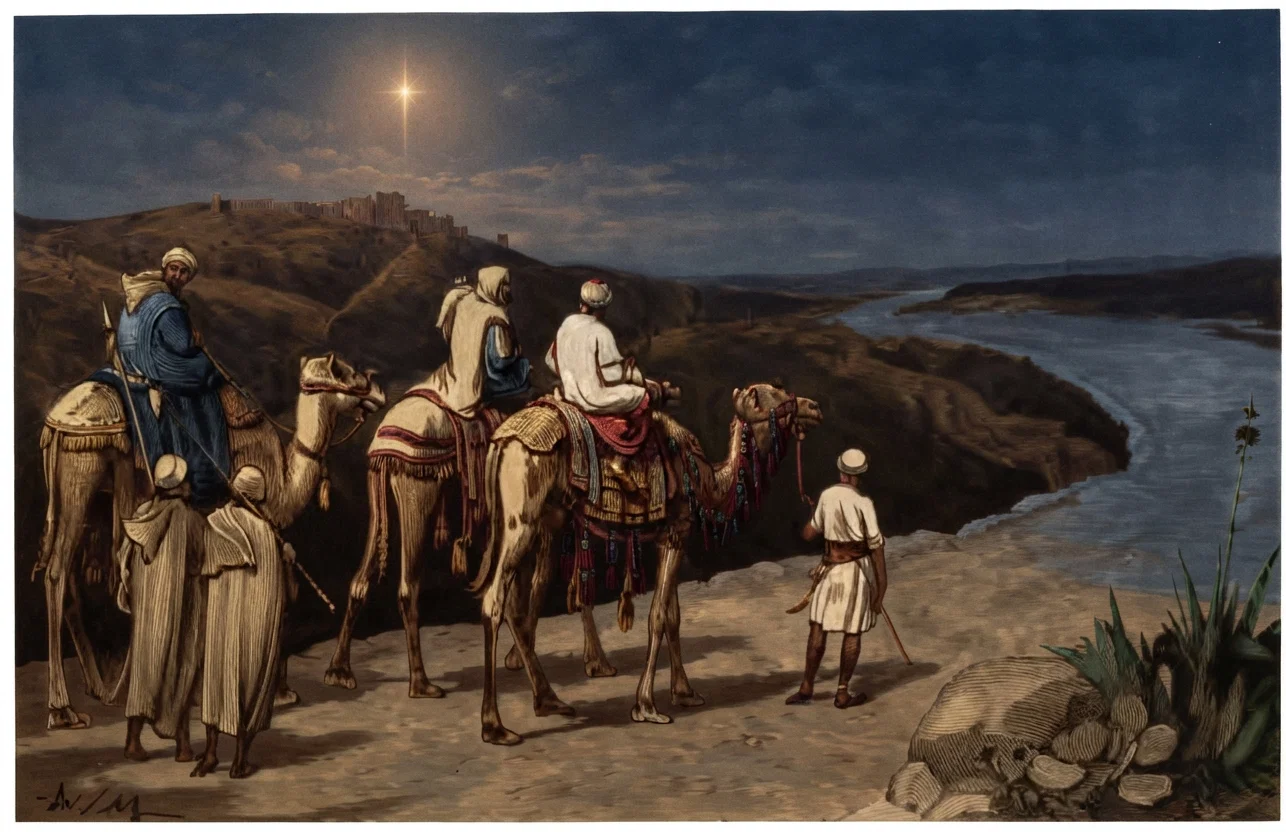
Shiloh: the Man of Sorrows

3%

Pacific Press Publishing Association · Mountain View, California · Mar 8, 1910

FromSigns of the Times, Vol. 37, No. 10.

Read the full edition

Shiloh: the Man of Sorrows

Copyright, 1910, Pacific Press Publishing Association
By Mrs. L. D. Avery-Stuttle

Chapter II—Uncertainty and Faith

"The magi! the magi! did they also see and worship Him? Ah, Shiloh, the Messiah! why may not mine eyes behold Thee also,—the Anointed of Jehovah—the Desire of Israel?"
Great tears rolled down the thin cheeks of the old man, and splashed over the silvery beard, as he paused to listen to the reply of Sylvanus:
"Yes, my father, the stranger assured me that he and all his company both saw and worshiped. They also presented Him gifts, royal gifts,—the gold, the frankincense, and the myrrh of the richest princes and the wisest men of Persia,—for even such they were."
Again the patriarch interrupted the narrator:
"Hold; doth not Isaiah the prophet say even thus: 'And the Gentiles shall come to thy light, and kings to the brightness of thy rising'? And again, David saith of the Messiah, 'The kings of Arabia and Seba shall bring Thee gifts.'"
"True," replied Sylvanus. "But I asked them why they journeyed southward toward Hebron, and returned not northward toward Jerusalem; why they chose not the way by which they came, even as Herod bade them. As I asked this question, my attention was directed toward another of the company. He was still mounted upon his beast—a gigantic camel covered with gorgeous trappings, which glinted and shone as the slanting rays of the setting sun fell upon them. The man's countenance was comely, but his cheek was swarthy, and his eye like the eagle's. His beard was black and glossy, and his locks fell unbound upon the rich mantle that covered his shoulders.
"'Why should we journey back to Jerusalem?' he asked. 'Shall Herod, the crafty Edomite, fall upon us that we die? We have seen and have worshiped at the feet of Shiloh. Now we do hasten into our own country, but not by way of Jerusalem.
'Listen, stranger; last night I dreamed.'
'What sawest thou?' I asked.
The countenance of the man grew sad, as he turned his face over his shoulder toward the north, and waving his jeweled hand in the direction of Jerusalem, he made answer:

The Vision of the Magi

"'I slept, and behold, the bright star that had led us O'er desert and mountain, o'er valley and fen, That beckoned us on toward the Shiloh of Jacob, Appeared in the east, and was leading again.
'But ah, it led not to the palace of Herod— The palace so fair of the Edomite king; But southward it sped toward the mountains of Judah, While high in the heavens loud voices did ring: "Beware ye of Herod—of Herod the king!" While over the palace of Herod so fair, A sword red as crimson hung high in the air.'"
The Magi Following the Star
"I can not wonder that ye return not to Herod!" I exclaimed; "he is an old man and full of days, but age hath not taught him wisdom, nor hath time softened his tyrant heart. Much I fear it would have gone ill with you had ye returned to Jerusalem."
"Then," continued Sylvanus, "I wished them Godspeed, and they hastened on their journey."
"But art thou not fearful for their safety, my husband?" queried Esther, in a tone of anxiety.
"Yes," interrupted Bar-jona, "did they not fear that since Jerusalem lieth so near to Bethlehem, the tyrant might learn of their departure, through spies mayhap, and despatch a centurion with his band to overtake and capture them?"
Before Sylvanus could reply, the trembling voice of Eliab was heard:
"My son, hast thou forgotten that the God of Abraham, Isaac, and Jacob lives? Dost thou not remember the godly Daniel and his companions?"
"In very truth," declared Sylvanus, "the men appeared neither fearful nor in unseemly haste; but the camel maketh good speed, you know, and they must soon be out of reach among the mountains of Moab. But verily I fear much for the safety of the holy Babe."
"I trust they may have found a safe retreat by this time," cried Esther, clasping her babe Matthias closer in her arms.
"My daughter, my daughter!" protested Eliab, "where is thy faith? Doth the Keeper of Israel slumber? Hath sleep closed His eyelids? Is His hand shortened that it can not save?"
"Nay, Father Eliab," replied Esther; "verily I believe in the God of Israel; and also Sylvanus is a man of faith, but he knoweth the temper of the king."
"Yes; his pathway to the throne was red with blood. Alas that it must be said that he is of the faith of Israel! I tell thee, Father Eliab, the king will brook no rivalry. Already much I fear he meditateth the murder of the infant King, and unless protected by Jehovah—"
"It shall not be!" interrupted the young guest, Bar-jona, impulsively. "Shall we not seek the Babe and His parents on the morrow, and speak unto them words of warning? Thinkest thou the family are yet in Bethlehem?"
"That I can not tell; I only know that when the strangers from the East visited them, they were no longer in the place where my shepherd companions and I visited them and bent low to worship. Now they abide in an house, and here the strangers gave the gifts. But I have heard that their home is in Nazareth, and that the father is by trade a carpenter. They may have returned home in peace."
"Thinkest thou not," ventured Esther, "that they would at least remain either at Bethlehem or at Jerusalem, until the Babe might be presented at the holy temple according to the law? I will venture that if they be gone, it is but lately."
"I tell thee," again declared Eliab, "I tell thee that the Lord Jehovah will preserve His Anointed. I know not how; I only know the time is come, according to the prophets, when the long-promised Shiloh must appear. 'Behold, a virgin shall conceive, and bear a Son, and they shall call His name Immanuel.' Now, thinkest thou, Sylvanus," continued the old man, his dim eyes shining, "thinkest thou that God will not preserve Him who must bruise the head of the serpent?"
"True, father; but thou dost forget that the Almighty sent the daughter of King Pharaoh to preserve the life of the infant Moses. Who knoweth but it be His will that we seek at least to warn the parents of the Babe, that Herod's soldiers smite themnot! I tell thee, father, I like not the dream of the magi. It bodes no good: "'Beware ye of Herod—of Herod the king!'" "I verily believe the tyrant will be angry at the departure of the strangers, who have dared to disobey his command; that he will pursue after them, and failing to find them—ah, I dare not think or say what he might do. I only know King Herod stoppeth not for youth or age; he respecteth not the person of any who stand in his pathway."
And so it was agreed that on the morrow the carpenter of Nazareth must be warned.