An Examination of the Only Record in the New Testament of a Religious Meeting on the First Day of the Week
By Carlyle B. Haynes
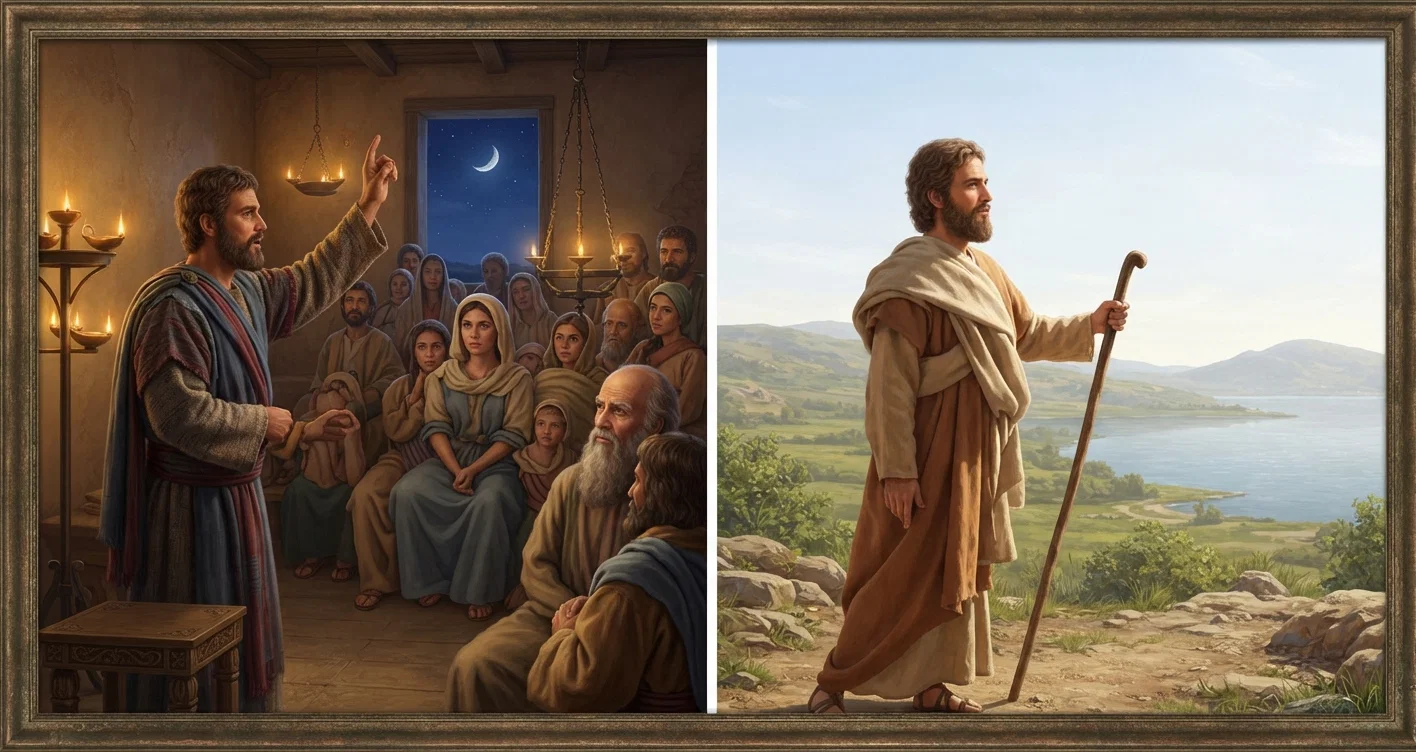
THE seventh mention of the first day of the week, in the New Testament, is in the book of Acts: "And we sailed away from Philippi after the days of unleavened bread, and came unto them to Troas in five days; where we abode seven days. And upon the first day of the week, when the disciples came together to break bread, Paul preached unto them, ready to depart on the morrow; and continued his speech until midnight. And there were many lights in the upper chamber, where they were gathered together." Acts 20: 6-8.
There is no doubt that this passage contains the record of a religious meeting on the first day of the week. And in this it is unique, for it is the only passage in the Bible which does contain such a record. Because of this, it is worthy of close study.
At this meeting, Paul was preacher. And it was a special meeting, a farewell meeting to Preacher Paul. Paul and his company had stopped at Troas on their way to Jerusalem. Acts 20: 16. At the time this meeting was held, they had been at Troas for seven days (verse 6), and now the last meeting of their stay was called; and while Paul tarried to conduct it, his companions, having already made their farewells, were on their way by boat to Assos, Paul intending to walk to the same city, after this last meeting was ended. Acts 20: 13, 14.
The meeting was held at night, for Paul wished to get an early start in the morning. "There were many lights in the upper chamber, where they were gathered together." Paul was "ready to depart on the morrow," and "he continued his speech until midnight." Unquestionably this was a night meeting.
A Saturday Night Meeting
Now, according to Bible reckoning of the days, there is but one night to the first day of the week, and that is Saturday night. The Bible days begin and end at sunset, while by our present reckoning, the days begin and end at midnight. The first day of the week of the Bible begins when the sun sets Saturday night, and ends when the sun sets on Sunday night. Therefore this meeting which Brother Paul conducted at Troas, being held during the night of the first day of the week, was held on what is now known as Saturday night. That is, this meeting was a first-day meeting, but not a Sunday meeting; for our Sunday is not the same as the Bible first day, Sunday being from Saturday night at midnight until Sunday night at midnight, and the Bible first day being from Saturday night at sunset to Sunday night at sunset.
Affords No Comfort
HENCE this verse affords no comfort to those who cite it as proof that the apostles kept Sunday. This meeting, while it extended over into Sunday morning, was in reality and properly a Saturday night meeting, beginning after the Sabbath had already passed.
Composed of Parts of Two Days
IT may be well, in this connection, to point out that those who now observe Sunday are not observing any one day at all, but parts of two days. By beginning the observance of Sunday at midnight, they observe a part of the first day of the week; and by continuing its observance until Sunday at midnight, they observe a part of the second day of the week, for the Bible second day begins at sunset Sunday night. In addition to this, none of the time observed, on either the first or the second day, is holy time.
Not a Collection
THE eighth instance of the mention of the first day of the week, in the New Testament, is in the book of 1 Corinthians: "Now concerning the collection for the saints, as I have given order to the churches of Galatia, even so do ye. Upon the first day of the week let every one of you lay by him in store, as God hath prospered him, that there be no gatherings when I come. And when I come, whomever ye shall approve by your letters, them will I send to bring your liberality unto Jerusalem. And if it be meet that I go also, they shall go with me." 1 Cor. 16: 1-4.
There is no doubt that this passage contains the record of a religious meeting on the first day of the week.
This passage has been made the basis of the claim that the early Christian churches were accustomed to hold their services on the first day of the week, and take up a collection at these weekly meetings. But the passage itself says no such thing. Paul does not here give instruction to hold a weekly meeting. Instead of holding a meeting on the first day of the week, "every one" was to "lay by him in store." They were not to put their gifts into a public collection, but to lay them by "in store," at home; and when Paul came, these were to be gathered and sent to Jerusalem for the relief of "the saints" there, who were suffering want. It was a special relief fund, not a regular weekly offering. It was made up on the first day of the week, when the brethren all returned to their work after their observance of the Sabbath, and had opportunity to cast up their accounts,
and see how the Lord had "prospered" them. Then they were to "lay by" themselves, at home, or at their places of business, the amount they decided to give, and keep it "in store" until Paul came to Corinth.
There is in this passage no evidence at all of Sunday sacredness, or that the early churches held weekly meetings on the first day of the week. In fact, the evidence all points in the other direction.
First Day Mentioned Eight Times
AND now our task of studying every passage in the New Testament that mentions the first day of the week is completed. There are no other texts that speak of this day. It is mentioned eight times in the New Testament. And in these eight passages, there is no command to keep it; there is no record of its being appointed as a Sabbath; there is no account of the placing of any blessing upon it; there is no account of its being made holy; there is no record that any sacredness was attached to it; there is no promise of blessing for its observance; there is no threat of punishment for its nonobservance; it is never once called the Sabbath, nor is any sacred title given to it; there is no record that the apostles kept it, or commanded it to be kept; there is no record that the early Christian churches observed it; in fact, there is nothing—absolutely nothing—in all the Bible that gives the slightest hint of a Sunday institution. The observance of Sunday is a practice for which there is not a shadow of Bible authority, and it is therefore a practice that should be immediately discarded by all Bible Christians.