THE Chamber of Commerce of the United Kingdom of Great Britain is busying itself extensively now with "the subject of the defense of trade and employment within the empire after the war."
The conference of the allies recently held in Paris was for the purpose, in the main, of discussing the question of commerce, and of forming an offensive and defensive commercial alliance.
Speaking of the meeting just before it convened, Premier Asquith called it a conference
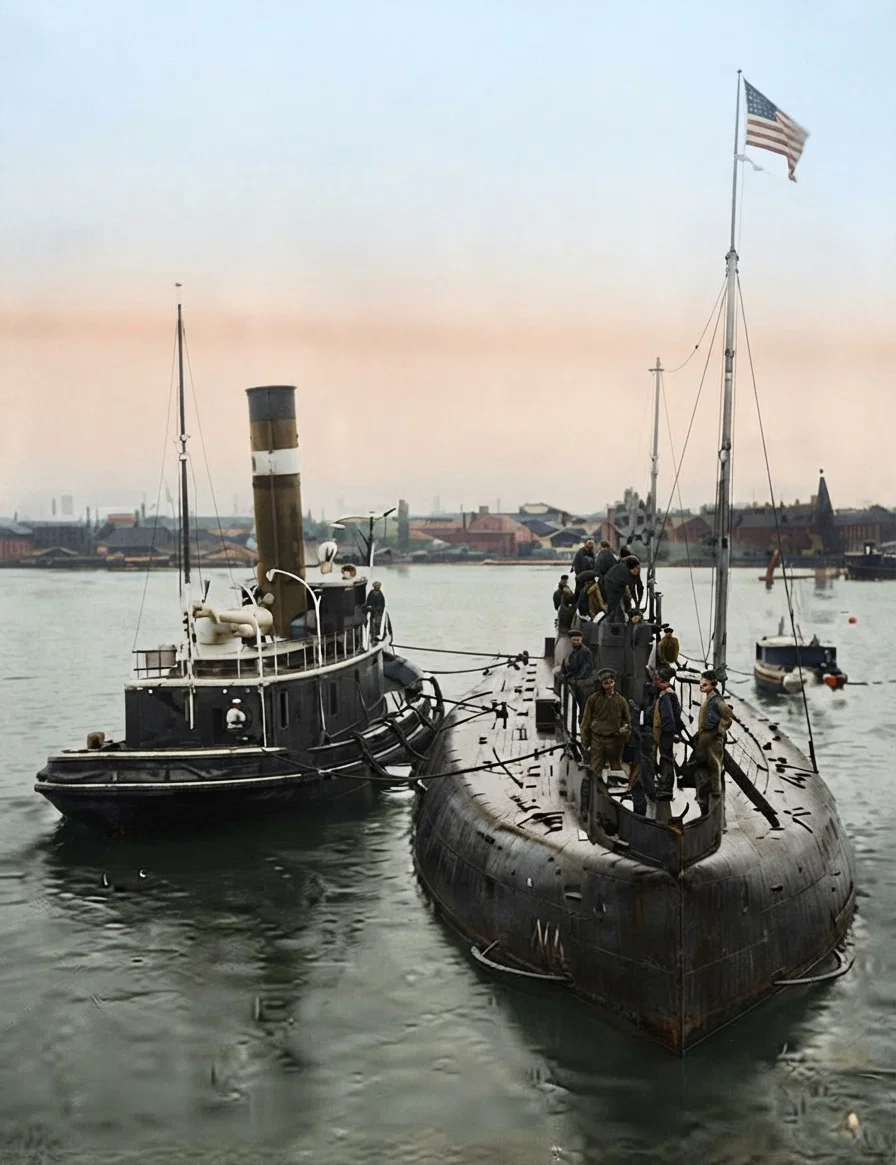
The submarine Deutschland, which recently entered Baltimore harbor after crossing the Atlantic with a cargo of dyestuff. The photograph shows her beside the tug that is taking her to her berth. The entrance of a submarine into the occupation of commercial shipping is causing international discussions, and bids fair to lead to international complications and strifes.
"at which all the allied states will be represented, and at which the whole of this question of the economic and commercial relations inter se, and as between them jointly and individually on the one side, and our present enemies on the other, will form the subject of debate and deliberation."
The French government took the initiative in convening this conference; and upon the subject, the parliamentary correspondent of the London Times in a recent issue said:
"It is understood that the French government some time ago took the initiative in advocating an unsparing commercial war against Germany. It is only within the past week that the British government have given their adhesion to the proposal."
Another paragraph from this same article in the London Times reads: "The obvious method is that the allies should agree that at the end of the war, none of them should make commercial agreements with the enemy without the consent of the others. There is, however, a party in the British Cabinet which is willing to go further than this. Some ministers, it is understood, are ready to decree an absolute prohibition against trade with Germany for a specified period. Whatever may be the outcome, it can be asserted with confidence that Germany will shortly feel the rigor of a commercial alliance."
We take no interest whatever in discussing the right or wrong of these proposals, or whether they are expedient or inexpedient. There is a far greater question involved. Men generally recognize that the war which is now in progress in Europe really has for its foundation the great question of commerce. It is a war as to whether this nation or that shall dominate trade, and shall drive railroads in this direction and that, and whether or no they shall control certain waters and harbors for the use of commerce.
And now, rising up in the foreground, so strongly as almost to shut out the vision of everything else, is the question of commercial supremacy, which is to enter into the discussion of the proposals of peace following the great struggle.
Any one with half an eye ought to be able to see that the conflict is in reality not being settled. The great bone of contention is still there. The love of self and the love of money, which the apostle said would make the last days perilous, is still one of the prominent features in the controversy. This war will without doubt temporarily cease, but it will leave feuds and international hates and complications that will further prepare the world for the great Armageddon that lies just ahead. He who is standing under the clear light of God's prophetic word will not become confused by the conditions of this time, but will understand clearly each step in the great program of this last controversy with sin and evil.