Printing in Chinese

7%

Pacific Press Publishing Company · Mountain View, California · Sep 30, 1908

FromSigns of the Times, Vol. 35, No. 9.

Read the full edition

Printing in Chinese

By H. W. Miller, M.D.
In a Chinese printing-office between six and seven thousand characters are required in each font. The type is distributed in as many separate compartments in the type-cases. In some type-rooms the type-cases are arranged in a semi-circle so as to save the type-setter as much walking as possible. But in small printing-offices where but one font of the same kind can be afforded, they are placed in a straight row so that two or more type-pickers can work at the same time. As in the English type, we have some letters as "e" and "i" that are used much more frequently than other letters, "q" and "z" for instance, so in the Chinese we have some characters that are of much greater frequency than others. In a complete font of type, we have four hundred of the most common characters. It will be remembered that each character is a word. Out of a font of seven thousand characters, at least five thousand would not have more than eight of one kind, as of the less common characters we have but eight each. The five hundred most frequently used characters are placed in adjoining sections in one type-case, and their position must be memorized by the type-pickers. Then the remaining six thousand or more characters are arranged according to the radicals, and the type-picker finds them by following the radical index the same as he would in the dictionary.

"Type-Pickers."

They call the men that gather the type type-pickers instead of type-setters, since it is not practical to set up the matter ready for print as the characters are found, for it is necessary to put in the punctuation after the characters are all gathered together. The styles of type are known as No. 2, which is the larger; No. 4, the medium, and No. 6, the small. There is still a smaller size than the No. 6, and still a larger than the No. 2, and also a No. 3 between the No. 2 and No. 4, and a No. 5 between the No. 4 and No. 6. So it will be seen that to carry a full stock of Chinese type, seven different fonts of seven thousand characters each are required, making a total of forty-nine thousand different characters. This accounts for the large size of the compositor’s room in a Chinese printing-office.
Formerly, as in the Hebrew language, there was no punctuation used, but now punctuation is indicated by a small circle at the end of a sentence and a comma to separate the clauses. After the type-picker has gathered all the type for the manuscript, it is placed in the hands of the compositor, who makes it up in the right lengths for the form and sets in the punctuation. Since Chinese is always printed vertically, he sets the type in rows from right to left. The end of a paragraph is indicated by a large circle, or the end of that line may be left blank as in English and the next paragraph begun at the top. Where it is desired to indicate respect, it is customary to leave a space just before the name, if the name appears in the context; or if the name is at the beginning, it should be from two to three characters higher on the page than any other part of the context; therefore, it is necessary sometimes, to give emphasis to a name, to make all the lines on the rest of the page two characters short, in order to give prominence to this name or title.
Even with a complete font of type, where the most common characters number four or five hundred, it will be seen that but a few pages of text could be set up at a time without exhausting some of the characters of the font. So one of the first requisites of a Chinese printing-office is a foundry where not only stereoplates can be made, but more preferably electroplates, of all the printed matter. But printing-offices of any capacity usually have type-casting machines and a full set of matrices for casting their own type. The latter is something that an American press seldom, if ever, installs, and only the larger of the printing-houses require the electro- or the stereoplating.
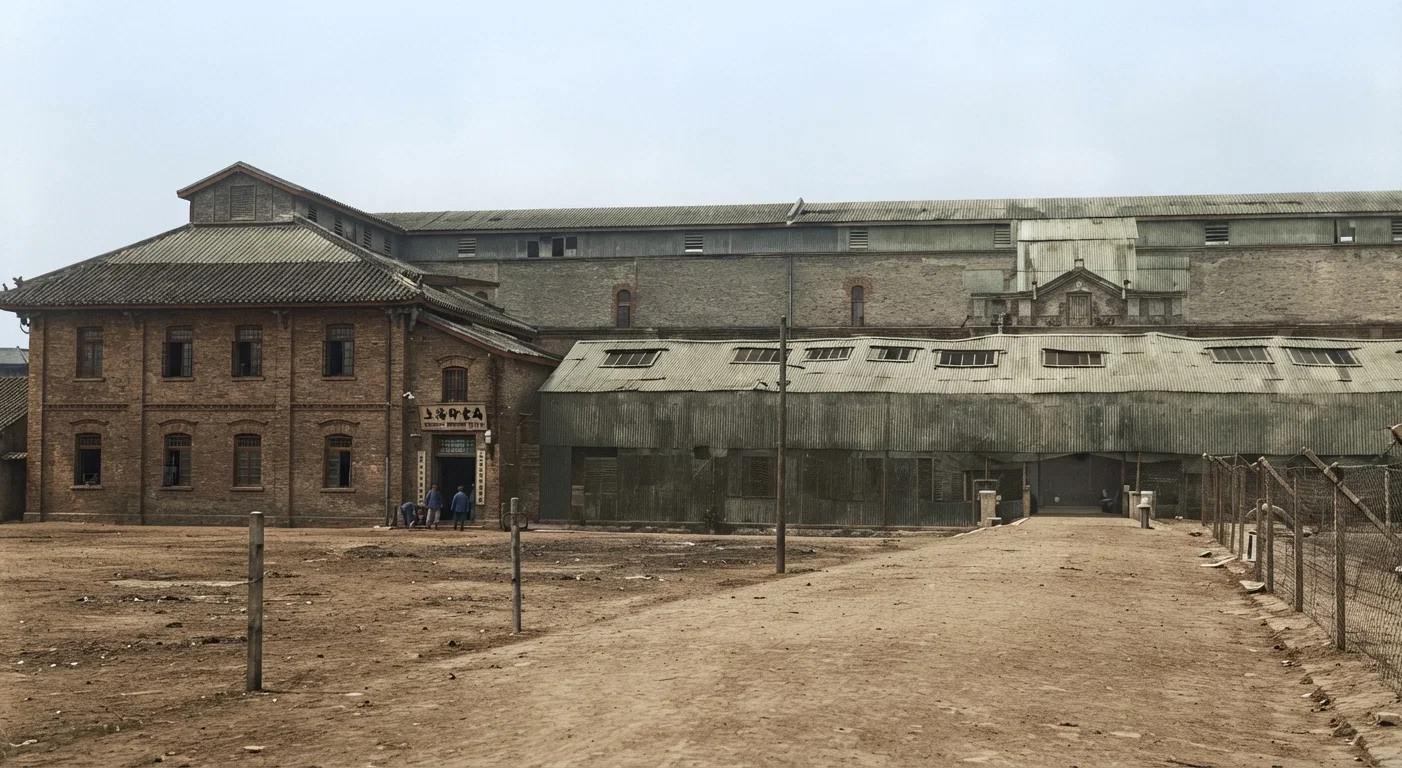
Native Chinese Printing-Office, Shanghai, China, showing about one third of the building.

Few Illustrations.

One drawback in the printing of Chinese books in the past has been the unfortunate neglect of illustrating, due largely to the fact that facilities were not at hand with which this could readily be done. Almost all the illustrating had to be done by the process of lithographing, by transferring the picture to the surface of a smooth stone and then printing from this. This method of illustrating has been used for several decades in China, but only of late have there been photoengraving-plants in the East. In the near future we hope to be able to secure illustrations from photoengraving-plants here. Some illustrations used in the past have been those cut from wood, so necessarily they would be very coarse.
The method of binding books in China varies considerably from that used in other countries, since the Chinese seldom use the cardboard or cloth binding, but the bindings are made by folding a piece of stiff paper; and on the side of the book, which would correspond to the back of an English book, would be found the title. The leaves of the book are printed on only one side of the paper; the blank side of the paper is folded inward so that the line on which the paper is folded forms the margin of the page. In the center of the page as it is printed is a little index showing the place to fold the sheet. These pages are folded exactly at this point by women and children in the Chinese bindery just as fast as they can reach out their hands to pick up the separate sheets. They get so expert at this that a machine could hardly be expected to do the same kind of work faster. Then the pages are collected; and instead of getting the margins of the pages even by cutting them they are beaten down on a plain surface until the pages are all even, when they are stuck together by an awl being pushed through the back of the book and afterward secured by a paper plug. The paper is then trimmed at the top, bottom, and back, and stitched together. It is not done with a modern paper-cutter, but by a native who simply takes a circular knife, presses the books together with his foot, uses a wooden gauge at the top to indicate the size, oils his knife by touching the edge to a candle, and by a few sweeps trims the edges of a pile of books about a foot high. They are cut as neat and clean as it would be possible to do with the ordinary paper-cutter.
After all, the greatest difficulties in the process of making books in China are met by the proof-reader, owing to the great similarity of so many characters in the Chinese language; some of them differing in the length of one line or the addition of a dot. Nothing less than ability to write all the different characters used and a trained eye to readily recognize the difference between characters so similar, will enable one to do this line of work successfully.

Chinese Adaptability.

The natives take well to the art of printing. In a very short time, by carefulness with them, they can carry a large part of the responsibility of the work. It will be found that a Chinese compositor can set up a page of Chinese and correct it ready for press even in a shorter time than an English compositor can do the same amount of work with the English, except with a linotype. Such a thing as a linotype in the Chinese would be an impossibility so far as we can see now. As yet there has never been a typewriter made that was at all practical, and the two or three attempts ever made toward making one were for curiosity.
In this world have been perfected remarkable agencies for disseminating knowledge;