Love for the Erring

5%

Pacific Press Publishing Company · Mountain View, California · Nov 11, 1908

FromSigns of the Times, Vol. 35, No. 15.

Read the full edition

Love for the Erring

"Then drew near all the publicans and sinners for to hear Him. And the Pharisees and scribes murmured, saying, This man receiveth sinners, and eateth with them.
"And He spake this parable unto them, saying, What man of you having an hundred sheep, if he lose one of them, doth not leave the ninety and nine in the wilderness, and go after that which is lost, until he find it? And when he hath found it, he layeth it on his shoulders, rejoicing.
"And when he cometh home, he calleth together his friends and neighbors, saying unto them, Rejoice with me, for I have found my sheep which was lost. I say unto you, that likewise joy shall be in heaven over one sinner that repenteth, more than over ninety and nine persons which need no repentance."
IN the company about Jesus there were shepherds, and also men who had money invested in herds, and all could appreciate His illustration. The wide-spreading tablelands on the east of Jordan afforded abundant pasturage for flocks, and through the gorges and over the wooded hills had wandered many a lost sheep, to be searched for and brought back by the shepherd's care.

Seeking the Lost.

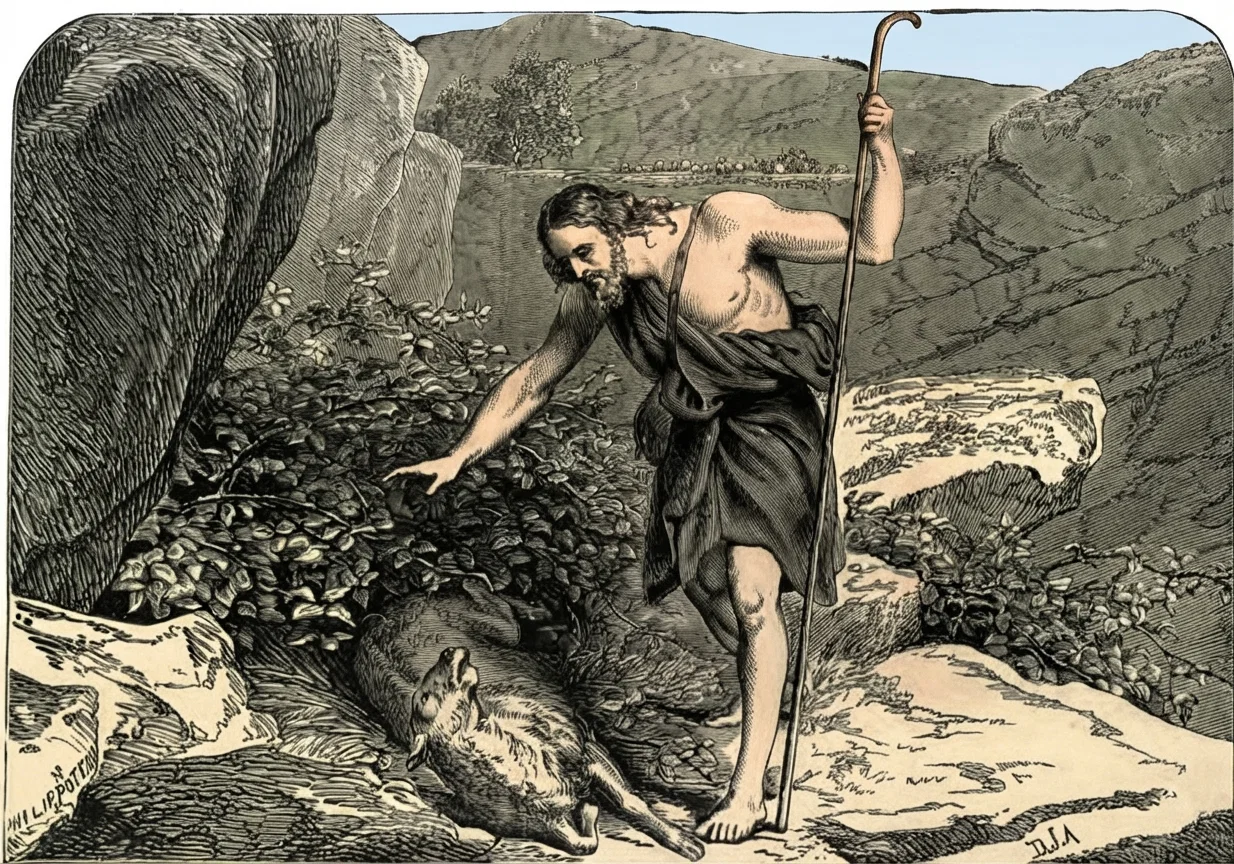
The shepherd who discovers that one of his sheep is missing does not look carelessly upon the flock that is safely housed, and say, "I have ninety and nine, and it will cost me too much trouble to go in search of the straying one. Let him come back, and I will open the door of the sheepfold, and let him in." No; no sooner does the sheep go astray, than the shepherd is filled with grief and anxiety. He counts and recounts the flock. When he is sure that one sheep is lost, he slumbers not. He leaves the ninety and nine within the fold, and goes in search of the straying sheep. The darker and more tempestuous the night, and the more perilous the way, the greater is the shepherd's anxiety, and the more earnest his search. He makes every effort to find the one lost sheep.
With what relief he hears in the distance its first faint cry. Following the sound, he climbs the steepest heights, he goes to the very edge of the precipice, at the risk of his own life. Thus he searches, while the cry, growing fainter, tells him that his sheep is ready to die. At last his effort is rewarded; the lost is found. Then he does not scold it because it has caused him so much trouble. He does not drive it with a whip. He does not even try to lead it home. In his joy he takes the trembling creature upon his shoulders; if it is bruised and wounded, he gathers it in his arms, pressing it close to his bosom, that the warmth of his own heart may give it life. With gratitude that his search has not been in vain, he bears it back to the fold.
He leaves the ninety and nine within the fold, and goes in search of the straying sheep.
Thank God, He has presented to our imagination no picture of a sorrowful shepherd returning without the sheep. The parable does not speak of failure, but of success and joy in the recovery. Here is the divine guarantee that not even one of the straying sheep of God's fold is overlooked, not one is left unsuccored. Every one that will submit to be ransomed, Christ will rescue from the pit of corruption and from the briars of sin.

God Will Forgive.

Desponding soul, take courage, even tho you have done wickedly. Do not think that perhaps God will pardon your transgressions and permit you to come into His presence. God has made the first advance. While you were in rebellion against Him, He went forth to seek you. With the tender heart of the shepherd, He left the ninety and nine and went out into the wilderness to find that which was lost. The soul, bruised and wounded and ready to perish, He encircles in His arms of love and joyfully bears it to the fold of safety.
When the straying sheep is at last brought home, the shepherd's gratitude finds expression in melodious songs of rejoicing. He calls upon his friends and neighbors, saying unto them, "Rejoice with me; for I have found my sheep which was lost." So when a wanderer is found by the great Shepherd of the sheep, heaven and earth unite in thanksgiving and rejoicing.
"Joy shall be in heaven over one sinner that repenteth, more than over ninety and nine just persons, which need no repentance." You, Pharisees, said Christ, regard yourselves as the favorites of Heaven. You think yourselves secure in your own righteousness. Know then that if you need no repentance, My mission is not to you. These poor sinners who feel their poverty and sinfulness are the very ones whom I have come to rescue. Angels of heaven are interested in these lost ones whom you despise. You complain and sneer when one of these souls joins himself to Me; but know that angels rejoice, and the song of triumph rings through the courts above.

The One Lost Sheep—the World.

The rabbis had a saying that there is rejoicing in heaven when one who has sinned against God is destroyed; but Jesus taught that to God the work of destruction is a strange work. That in which all heaven delights is the restoration of God's own image in the souls whom He has made.The rabbis understood Christ's parable as applying to the publicans and sinners; but it has a wider meaning. By the lost sheep Christ represents not only the individual sinner, but the one world that has apostatized and has been ruined by sin. This world is but an atom in the vast dominions over which God presides; yet this little fallen world—the one lost sheep—is more precious in His sight than are the ninety and nine that went not astray from the fold. Christ, the loved Commander in the heavenly courts, stooped from His high estate, laid aside the glory that He had with the Father, in order to save the one lost world. For this He left the sinless worlds on high, the ninety and nine that loved Him, and came to this earth, to be "wounded for our transgressions" and "bruised for our iniquities." God gave Himself in His Son that He might have the joy of receiving back the sheep that was lost.
"Behold what manner of love the Father hath bestowed upon us, that we should be called the sons of God." And Christ says, "As Thou hast sent Me into the world, even so have I also sent them into the world,"—to "fill up that which was behind of the afflictions of Christ, . . . for His body's sake, which is the church." Every soul whom Christ has rescued is called to work in His name for the saving of the lost. This work had been neglected in Israel. Is it not neglected to-day by those who profess to be Christ's followers?
How many of the wandering ones have you, reader, sought for and brought back to the fold? When you turn from those who seem unpromising and unattractive, do you realize that you are neglecting the souls for whom Christ is seeking? At the very time when you turn from them, they may be in the greatest need of your compassion. In every assembly for worship, there are souls longing for rest and peace. They may appear to be living careless lives, but they are not insensible to the influence of the Holy Spirit. Many among them might be won for Christ.
If the lost sheep is not brought back to the fold, it wanders until it perishes. And many souls go down to ruin for want of a hand stretched out to save. These erring ones may appear hard and reckless; but if they had received the same advantages that others have had, they might have revealed far more nobility of soul and greater talent for usefulness. Angels pity these wandering ones. Angels weep, while human eyes are dry and hearts are closed to pity.
O, the lack of deep, soul-touching sympathy for the tempted and the erring! O for more of Christ's spirit, and for less, far less, of self!