Biennial Session of the India Mission of Seventh-Day Adventists
By George F. Enoch
THE biennial session of our Indian mission met in Lucknow, India, from October 21 to 30, 1910. There were more than ninety workers and delegates present, representing the various parts of India and Burma. Most encouraging reports were received from the mission stations already established in the Bengali, Tamil, Hindustani, Santali, and Marathi language areas and from Burma.
A very important item of our work in India that was brought prominently to the front was the need of more workers for the great English-speaking population scattered in all parts of the empire. Papers were read covering all branches of the work, ably discussing many of the perplexing questions facing us. At this session the work was more fully organized. Five local mission fields were organized; namely, the North India Mission, West India Mission, South India Mission, Bengal Mission, and Burma Mission. These were united to form the India Union Mission of Seventh-day Adventists, comprising all India, Burma, and Ceylon.
It was decided to locate the sanitarium work permanently in Mussoorie, and to take immediate steps to purchase property there. It was also decided to open a school for the children of our missionaries and others.
As the conference met day after day and considered the tremendous task before us, and the shortness of the time left us, all felt the solemnity of the hour as never before, and the consecration services of the first and last Sabbath days will long be remembered.
The area of India is one half that of the United States, but its population is four times as great, or twice that of North and South America combined. Any one of the three mission fields in India has a population nearly equal to that of the United States. Nine tenths of this vast population live in more than 700,000 villages, four fifths of which are inhabited by 500 people or less.
There are more than one hundred languages, twenty-three of which are spoken by more than one million people each. The people of one language number eighty-eight millions.
It seemed clear to the conference that well-equipped mission stations must be founded in at least seventeen of these language areas. Mission schools, training schools, the colporteur, the medical, and the evangelical work must be established in strategic centers throughout their territory with an army of teachers, colporteurs, doctors, nurses, evangelists, and a few able leaders to direct in organizing the work. For the most part, however, the natives of the country are needed who are filled with the Holy Spirit, whose hearts are burdened for the salvation of souls. It seems this must be realized before the work can be finished and Jesus can come.
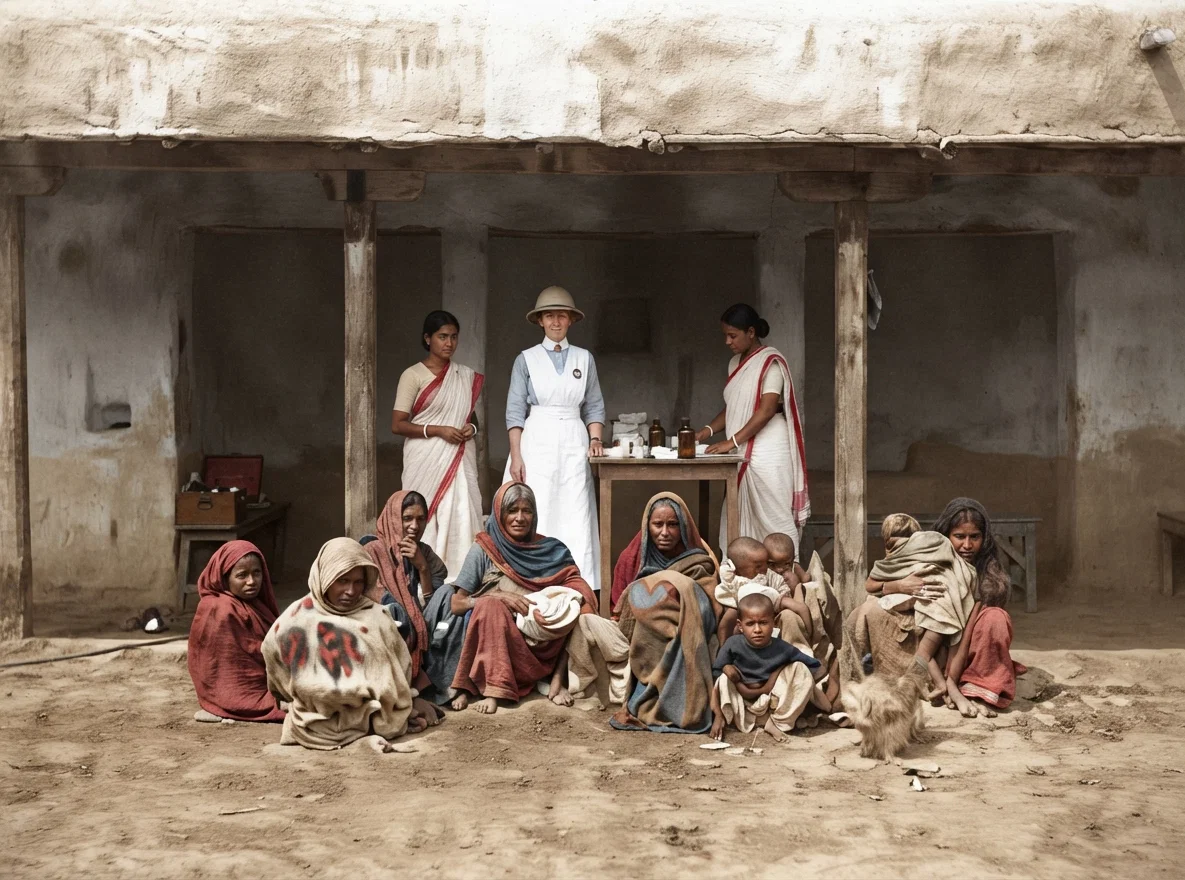
Our dispensary at Lucknow. Some of the patients may be seen in the foreground. In the back are Dr. Shryock and her two Bengali assistants.
Prof. W. W. Prescott from the General Conference was present, and gave most helpful Bible studies morning and evening throughout the conference. These studies particularly emphasized the strong, fundamental principles of Christianity and the necessity of a living experience in the things of God.
On the last Friday of the conference a memorial service was held in remembrance of our dear brother Elder J. C. Little, who died August 10 of cholera. The Lord drew very near, and altho we could not understand why our able young brother should be taken from the work he loved so well, still we closed up the ranks with courage, determined to work more earnestly than ever before for the finishing of the work. Elder J. L. Shaw was re-elected as superintendent of the field, and the workers returned home to work with renewed energy.
GEORGE F. ENOCH.
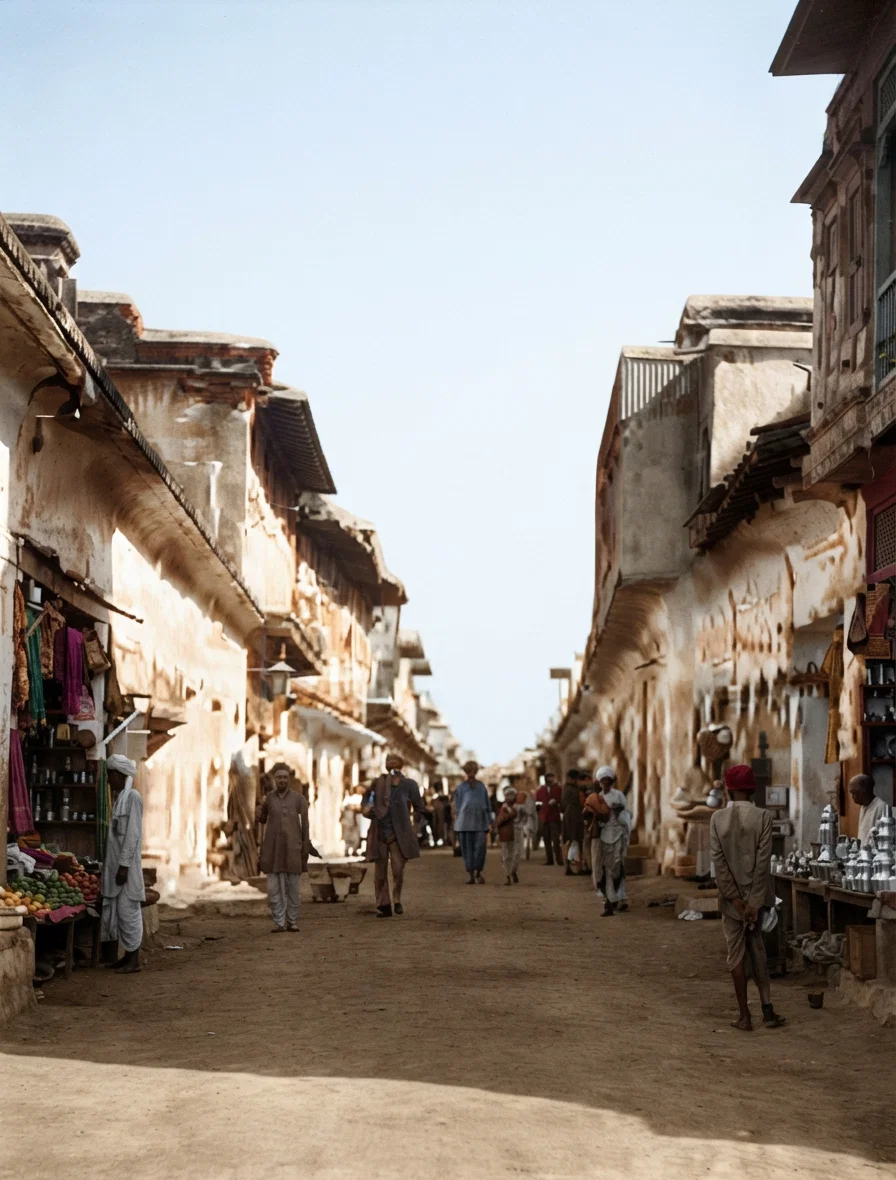
The main street in Najibabad. It is about one fourth of a mile long, and lined on either side with native shops. It is an exceptionally clean street.