Shiloh: the Man of Sorrows

2%

Pacific Press Publishing Association · Mountain View, California · Mar 15, 1910

FromSigns of the Times, Vol. 37, No. 11.

Read the full edition

Shiloh: the Man of Sorrows

Chapter III—Seeking the Messiah
THE rising sun had scarcely appeared above the hilltops of Bethlehem, and the shadows in the valleys were still heavy, when the family of Sylvanus was astir.
"Come, Bar-jona," said Sylvanus, "didst thou not journey from Bethsaida to learn somewhat of the Messiah? Come, then, we will seek the young Child this day. Mayhap we shall find Him still in Bethlehem. If not, we will go to Jerusalem."
"Hand thy father his staff, Perpetua, my child," said Esther; "and mind, Sylvanus, that thou return by set of sun."
"Surely, my Esther; the storm of last night is gone, and I think the day will be fair; so thou shalt see me ere the red sun hideth his face. Heber, lad, thou shalt keep the sheep this day without thy father. Young David kept his flocks alone in these same hills and valleys; and look you, the son of Achbor will be near you; he keepeth watch by day while Achbor sleepeth."
"Verily, my son," exclaimed Eliah, as he offered the parting salutation, "verily, if thou bring me news of Shiloh when thou returnest thou shalt receive warm welcome."
"List, Sylvanus," cried Esther, following her husband and young guest to the outer gate, "if thou goest at all up to Jerusalem, thou shouldst visit the aged Simeon; thou knowest his house is near the temple."
"Good, my Esther; it shall be even as thou sayest," returned Sylvanus, as they hurried down the street.
Straight to the one inn in the little town they made their way. This structure was a small one-story building entirely of limestone, which bore even then the marks of great age.
"Canst thou tell us of Joseph the carpenter of Nazareth?" they inquired of Jason the host.
"Truly," replied the man; "there was scant room at the inn, and I believe the carpenter of Nazareth hath his lodgings with Cleopas, the merchant. I was indeed loath to turn him away with his young wife when first they came from Nazareth to be taxed, for verily they be of the royal house of David."
"It is well; Bar-jona and I will visit the house of this merchant." Saying this, they turned from the inn, and soon paused before the door of one of the better houses of Bethlehem. In answer to their knocking, a maid opened the door, and led them into an inner room.
"How art thou, Abigail?" inquired Sylvanus of the merchant's wife. "Dost thou know the whereabouts of Joseph the carpenter? doth the family of Nazareth still bide with thee?"
Bar-jona bent his head eagerly to listen to the answer:
"Nay, friend Sylvanus, they have departed. Last night in the darkness they left us. Last evening before departing," continued the woman sociably, "they gave me this chain of pure gold, for they had many ornaments of great value. See! is it not fine enough for Cæsar's bride—and more than enough to pay me for their food and lodging?" and Abigail displayed a beautiful necklace of Persian workmanship.
"Yet," she continued, "the wife of the carpenter was plainly clad, as were her husband and little Babe."
"But had they no visitors while they tarried here?" questioned Sylvanus, glancing at Bar-jona, with a nod.
"Visitors? O yes; some princely strangers from the Far East. They came one day, and I saw them bow before the Babe, which slept in its mother's arms. But I trow, Sylvanus, they could not have been of the seed of Israel, for they worshiped Him as a god, and gave Him many gifts. I wondered, tho my heart beat joyfully, when I heard them call Him Shiloh—the Messiah—the King of Israel. They abode with us for some time, but they too have gone again to their own country, even yesterday."
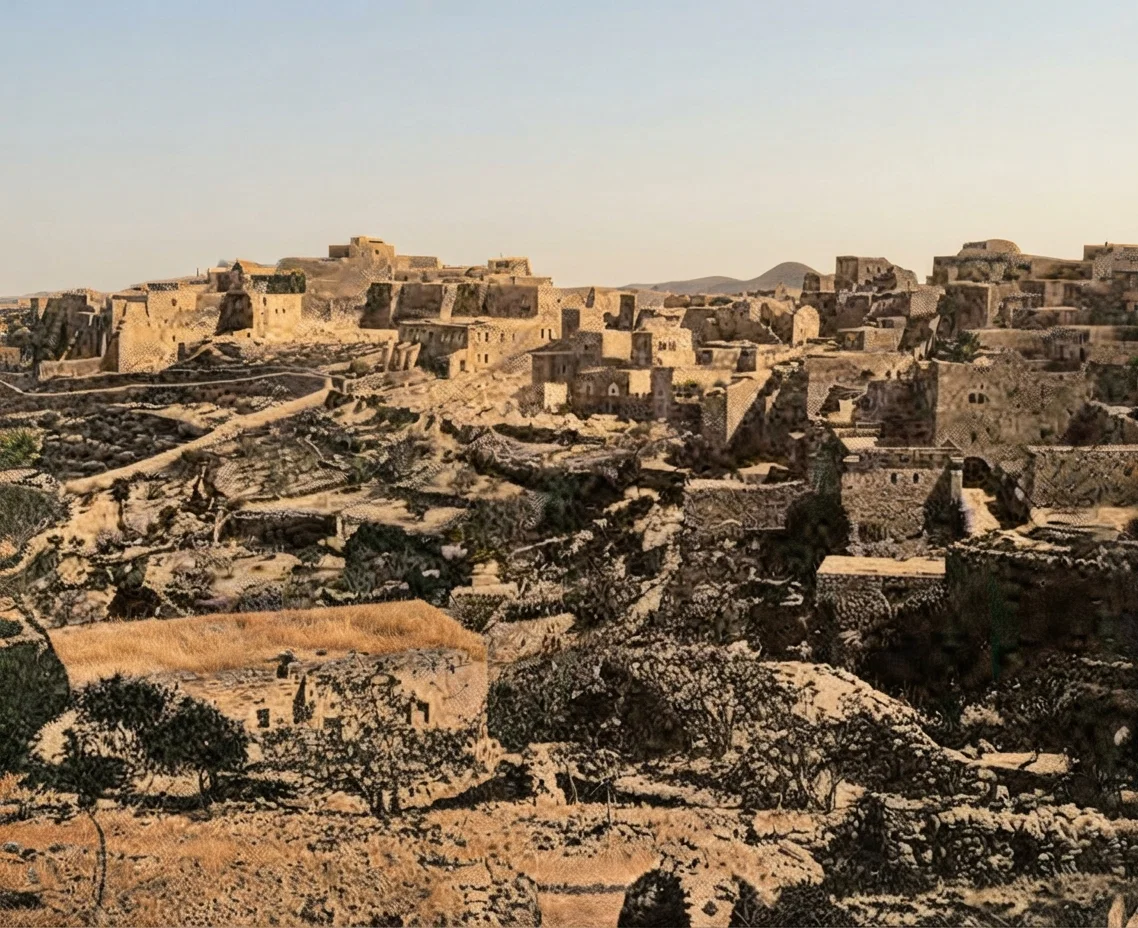
Modern Bethlehem — the city which of old was the human birthplace of Him "whose goings forth have been from . . . the days of eternity."
"Believest thou not that He is the King of Israel—our long-promised Saviour?" interrupted Bar-jona impulsively.
"Verily, I did believe, and my good husband also, until I went but yesterday up to Jerusalem, and conversed with the learned Jozarus, the high priest. He saith that when Messiah appeareth, He will come in splendor; and he exhorted me to study the prophets, for they do prophecy of the glory and power of His coming."
"Suppose thou tellest this daughter of Israel what thou sawest in the fields of Bethlehem, and of the singing of the heavenly messengers, and of the words they spake to thee," exclaimed Bar-jona, turning his face appealingly toward Sylvanus.
"Surely thou forgettest, my young friend, that every ear in Bethlehem hath heard the tale already," answered Sylvanus; "but the words of Jozarus, the high priest, have more effect than mine."
"Nay, say not so," corrected Abigail courteously, while a crimson blush overspread cheek and brow; "only thou knowest that the business of the shepherd is with sheep, but the work of the priest is the study of the prophets."
"Thou sayest well," agreed Sylvanus; "but we must not forget that if any, howsoever wise, speak not according to the law and to the prophets, it is because they have no light in them."
"But is it not quite fitting that we pay heed to the words of our teachers, those who better understand the meaning of the prophets? But of a truth," continued the woman, "the story which the strangers told was indeed wonderful. They declared that a shining star led them all the way, and that it hung over our roof as they entered. Indeed, I myself noticed a strange light in the heavens the same hour we gave them lodging. Some of my neighbors saw it with me; but as we looked, it melted away."
"Verily it was the Star of Jacob," declared Bar-jona.
"But even this also I asked of Jozarus," replied the woman; "and he assured me it was but some wandering comet, or peradventure it might have been the afterglow of the sun already set, or mayhap it was the shining of the fires the shepherds sometimes build at night upon the hills hereabout; so spake the high priest at the temple yesterday."
Sylvanus only sighed as he replied quietly: "'There shall come a Star out of Jacob, and a scepter shall rise out of Israel.' But," he continued, "sayest thou that the carpenter of Nazareth departed in the night?"
"Yes; when we wakened in the morning, behold, they were gone, and we have been much troubled thereat."
"Whither went they, thinkest thou?"
"I know not for a certainty; to their home in Nazareth as I suppose, and by way of Jerusalem, where they perchance still tarry."
"Then must we also journey thither," replied Sylvanus, rising.
In a large upper chamber in Jerusalem, lying upon a couch in the center of the room, was an old man, while two or three attendants passed noiselessly about the apartment.
The draperies were pushed aside, and the lattice was open, that the cooling air might fan the broad, white brow of the dying prophet. The old man's silvery locks lay upon his shoulders, and his lips moved in prayer: "I thank Thee, O God of Abraham, that Thou hast verified Thy promise toward me, Thy servant, for that mine eyes have seen Thine Anointed. And now, Lord, what wait I for? Now lettest Thou Thy servant depart in peace."
Even before the prayer was finished, the attendants ushered two visitors into the room, the elder in the dress of a shepherd, the other, of a fisherman. The dark eyes of the dying man lit up with joy.
"What, Sylvanus, is it thou? and this young man—"
"Bar-jona, a fisherman of Bethsaida. He cometh up to Jerusalem that he may bear more certain word back to his godly father. For they of Bethsaida have heard somewhat of the rumors concerning the Messiah's birth. Tell us, O Simeon, prophet of the Lord, what thinkest thou? Is the time almost fulfilled when Shiloh must appear?"
"Listen, my sons. When last the flowers of springtime covered the hills and valleys of Benjamin, I lay, even as now, upon this cot. My attendants said that I must die.By study of the prophets I was certain that the Messiah must soon be born; and I desired to live, so that I might behold Him. To this end I prayed that I might live. One night, when death seemed very near, I prayed again more earnestly. The windows of my chamber opened toward the holy temple, as ye see them even now. The full moon rode high through the cloudless heavens, for it was the time of the Passover. The gold and silver vine over the entrance of the temple, emblem of the prosperity and fruitfulness of Israel, the workmanship of cunning men, glinted and glimmered as the rays of the moon bathed it with mellow light. That night the heaven of heavens seemed very near. And as I opened my mouth in prayer, while I was yet speaking, the angel of the Lord stood by me, and the messenger of the Most High spake unto me: 'Fear not, O Simeon, for God shall put His Spirit upon thee, and thou shalt not see death until thou hast seen the Lord's Messiah,—the Anointed.' Then the angel departed from me, and I slept. In the morning I arose, and my strength came into me. When my attendants came to me in alarm, I said unto them, 'I shall live, and not die; behold, I shall see the Lord, even the Messiah, in the land of the living.'"
"But tell me, O Simeon, seer of the Most High, hast thou in very deed behold Him—the Shiloh of Israel—the holy Babe—didst thou behold Him?" cried Bar-jona, while an expression of intense eagerness lighted his youthful countenance. Then he continued impulsively: "We go to seek Him, Sylvanus and I, even now. Tell us, hast thou seen Him? Where is He, that I may hasten unto Him?" and the young man arose as if to depart from the room hurriedly.
"Trouble not thyself, young man," cried the prophet, mildly. "Come here by my side, that I may lay mine hand upon thy head; for already mine eyes wax dim; my days are numbered, and I must sleep with my fathers. But first I would tell thee, Sylvanus, thee and the young man, what the Lord hath graciously shown me; for I know ye are true Israelites."
"Fear ye not the rage of Herod; for behold, the young Child and His parents have departed into the land of Egypt. Even thus said the angel unto me. Verily, Sylvanus, thou knowest the words of Hosea the prophet,—'Out of Egypt have I called My Son;' and it shall be fulfilled the second time when the cup of the iniquity of Herod is full, and he be dead who seeketh the life of the young Child. Then shall Shiloh return from the land of the Pharaohs, and shall dwell in Nazareth of Galilee. For even as God called Israel from Egypt, so shall He call this His Son."
"Verily, O Simeon," exclaimed Sylvanus, "thou speakest with assurance concerning the Messiah. But dost thou know that already the priests and the rabbis of Jerusalem have rejected Him? They scorn alike the testimony of us—the shepherds who have seen Him—and of the magi."
"But tell us, tell us, O thou seer," interrupted Bar-jona, "when sawest thou the Babe? For behold, thou art old, and thy strength faileth. Perchance thou sawest Him in a vision of the night."
The pallid face of the man of God lighted up with a holy radiance. "I will tell thee, Bar-jona, where and when I beheld Him who is the Desire of Israel. As soon as I had received the assurance of the angel that I should not see death until I had seen the Christ, I began more earnestly and carefully than ever in my long life to search the books of the prophets, that I might know of a surety when the time was fulfilled."
"I know not that the prophecy was so definite," said Bar-jona, moving a little nearer the aged man. "I would that thou wouldst make it plain unto me, O Simeon; for surely the words of the prophets must be fulfilled tho the heavens fall."
"Thine ambition is a laudable one, and thy words are true, young man. Hear me; I will read the words of Daniel, the holy seer, tho mine eyes are dim," replied Simeon, taking from beneath his bolster a roll of parchment, and indicating the place with his trembling finger:
"Know thou and understand, that from the going forth of the commandment to restore and to rebuild Jerusalem, unto the Messiah, the Prince, shall be seven weeks and threescore and two weeks.' My sons," continued the aged speaker, producing another roll, "my sons, it was about four hundred fifty and three years ago, and in the seventh year of Artaxerxes, since this great king of Persia gave command to Ezra, the priest of the Most High, to restore and to rebuild this city, even Jerusalem; for it was then laid waste and desolate. Seven weeks of years, and threescore and two weeks, are sixty-nine weeks of years, or four hundred eighty and three years which must pass away from the time Ezra received this command, which, my sons, is here given in the Chaldaic tongue, exactly as it was penned by the Persian king. Four hundred eighty and three years from that time must pass away before Shiloh, the Messiah, is anointed. Of this time, four hundred fifty and three years have already passed, leaving still thirty years before the anointing."
"But, Sylvanus," continued the speaker, "thou knowest that no Israelite is anointed, or set apart, for the ministry of the Most High, until he be thirty years old. Hence, the Messiah, the holy Babe, must have been already born, or the promise of Jehovah faileth."