THE Chinese, while for centuries opposed to the entrance of any European power, are not slow in seizing an opportunity, especially if there are pecuniary benefits to be derived from it, since the foremost of the five blessings is that of wealth. They are always ready to supply the necessities, and even quick to run in competition with foreigners. When, upon one occasion, some Europeans found a desirable location on the top of a mountain for a summer resort for missionaries, the question was, owing to poor facilities for getting up, how they would get provisions and material there for building purposes; but no sooner was the enterprise undertaken than the Chinese began to build brick kilns on the top of the mountain, gather fuel together for burning the brick, and soon there followed stone masons who dug into the ground and found stone. It was soon noticed that several native huts were being built on the inclines of the mountain, and a Chinese village was established before operations of building the resort were under headway. There they had their chickens to supply eggs, and in fact everything was provided there in anticipation of the foreigner's wants.
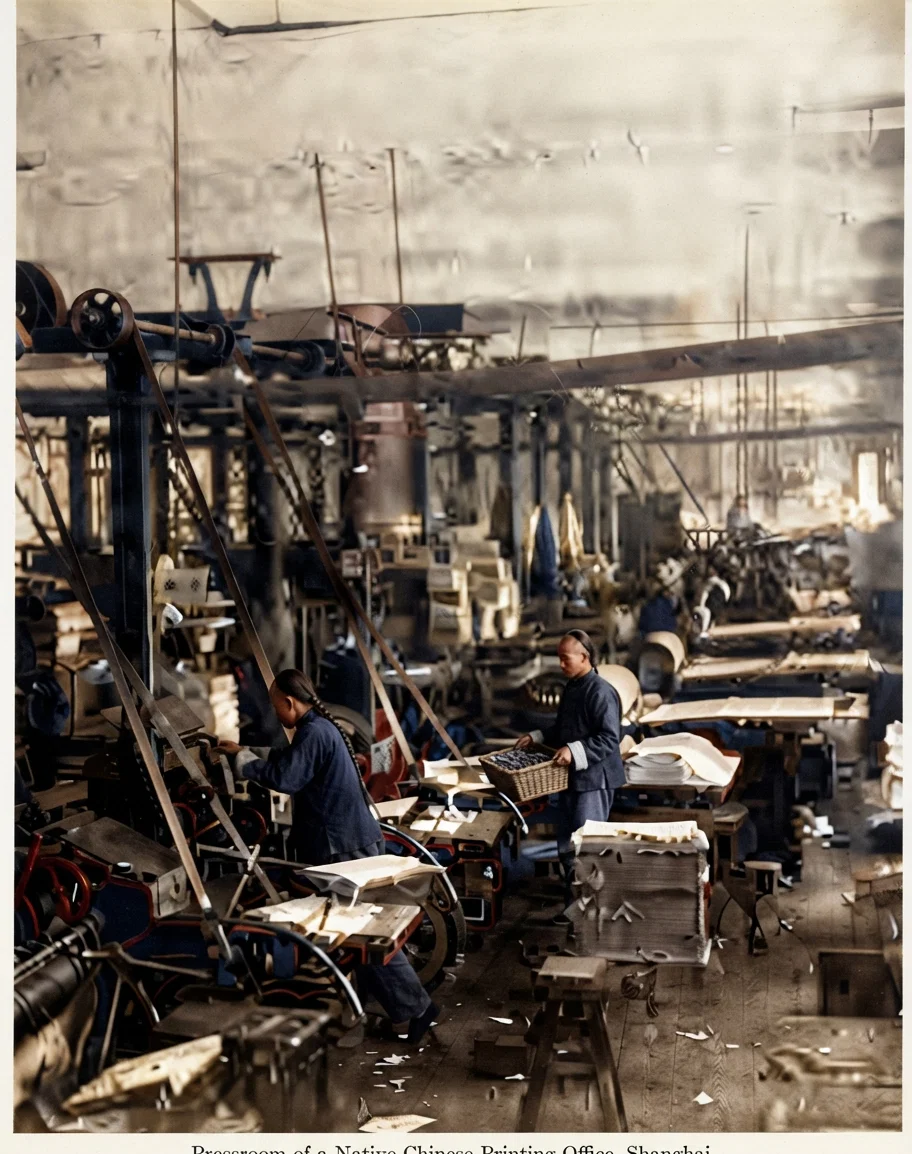
Pressroom of a Native Chinese Printing-Office, Shanghai.
This is a characteristic that marks the progress in the Chinese Empire. A Chinese servant is considered better than other servants because he anticipates your wants. Perhaps no other people are better readers of character than the Chinese. If a man should stop in the street a minute, hesitating, the minute would probably not pass before two or three Chinese would be at his assistance, who had undoubtedly anticipated the reason of hesitation and so offered their services. Thus in reference to Chinese literature, they have become intensely active in supplying the demand.
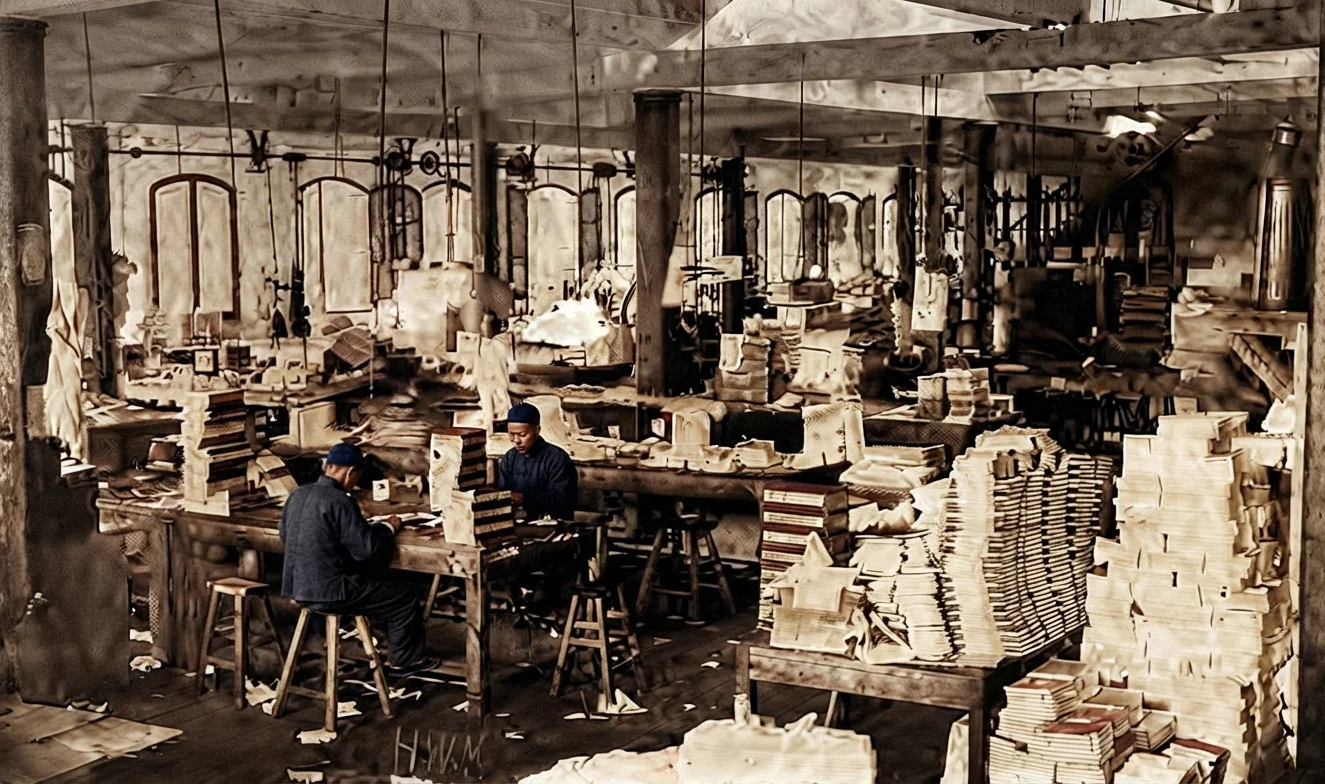
Portion of Foreign Binding Department of a Native Chinese Printing-Office.
After the complete Bible was translated, the Bible Societies began to publish a small edition. Owing to the complexity of printing in Chinese by the carving of wood characters, there were matrices made in Paris for casting the most common characters in Chinese type. Using these matrices as models, other sets of matrices were made, so that it is possible to set up by regular method of composition Chinese manuscript. But owing to the inadequate facilities for traveling, the distribution of literature was largely limited, through several decades, to that of Bibles, Bible tracts, and hymn-books, which were circulated by missionaries residing in different parts of the empire; and the art of printing was practically limited to the publishing-houses run by missionary societies.
Thus the circulation of literature from year to year was comparatively small, and the demand for literature in the whole empire of China was met by four or five publishing-houses located in the port cities. In 1905, Dr. Griffith John, who had been a resident in China for fifty years, made the statement that ten years before that date such a thing as a newspaper for the natives was not known in the empire, except the Peking Gazette, published principally for the use of the officials; and that only five years before there were not more than ten or twelve newspapers, located chiefly at the ports. But now there are native newspapers found all over the empire. In all the large cities will be found the newsboys running about with as much eagerness to dispose of their papers as is characteristic of newsboys in any country. There are so many newspapers in the city of Shanghai, and the number is being added to so rapidly, that it is almost impossible for one to keep informed as to the numbers and kinds issued. The Japanese, being in such close proximity to China and having a language so similar, have in many respects anticipated China's needs, and there are to be found large foundries for making Chinese type as well as machine-shops for the manufacture of printing-presses. They also supply a large amount of paper to the Chinese. To-day we have in China equally large type-foundries and machine-shops.
Just a few years ago, some of the Chinese workmen in one of the mission presses, including in all sixteen individuals, organized a printing company for the production of Chinese literature. They started with sixteen five-hundred-dollar (Mexican money) shares, and within a few years—a little over a month ago—one of these shares was sold at auction for a little over eleven thousand dollars gold. They operate over a score of large cylinder presses and almost an equal number of job-presses, and this does not include their lithographic department. Their printing-office is complete, including photo-engraving. They advertise themselves thus: "Commercial Press, print in Chinese and foreign languages. Printers, publishers, lithographers, type-founders, stereotypers, matrix-makers, book-binders, and book-sellers. Dealers in printing-presses and foreign paper." Within about five minutes' walk from this large printing-office is another large plant, the Presbyterian Mission Press.
With a constituency of 426,000,000 who arise and assert their desire for knowledge concerning the progress of the world at this8time, the present facilities may in a year or two be duplicated and then be unable to meet the demand. Who could have believed fifty years ago that in such a short time China would have publishing-houses that would be excelled by few even in the most civilized countries? I was told that the publishing-house just referred to puts out a hundred new books every year, besides printing other editions of books already issued by their press.
But in all this mass of literature issued by the hundreds of presses found in this empire, and with all the facilities at hand for duplicating thought by the art of printing, little do we find that is supplying the actual demand—that of telling to the natives who are already startled at the progress of the modern methods what these things mean.
At present we are conducting our printing work in a native Chinese house. It is the best we can do in starting our work here. While we know that it has never been show or display which advances the cause of God, still we know that it is pleasing to Him that His work should be honored in the selection of respectable quarters for carrying it on. Institutions do to a certain degree give character to the work they represent. We are sadly in need of suitable buildings for our publishing work. We can only locate things temporarily in a Chinese dwelling-house, for we may be turned out any time by a native landlord prejudiced or disaffected to the work of the Gospel. However, we believe that God's protecting care will rest over our work here until suitable quarters are provided. We must be able to supply the demand for literature for the enlightenment of the natives which will make them wise unto salvation. A suitable building is our greatest need now; and we believe, after considering the magnitude of the opportunities which lie in the publishing work, that many will respond to our urgent need at this time.