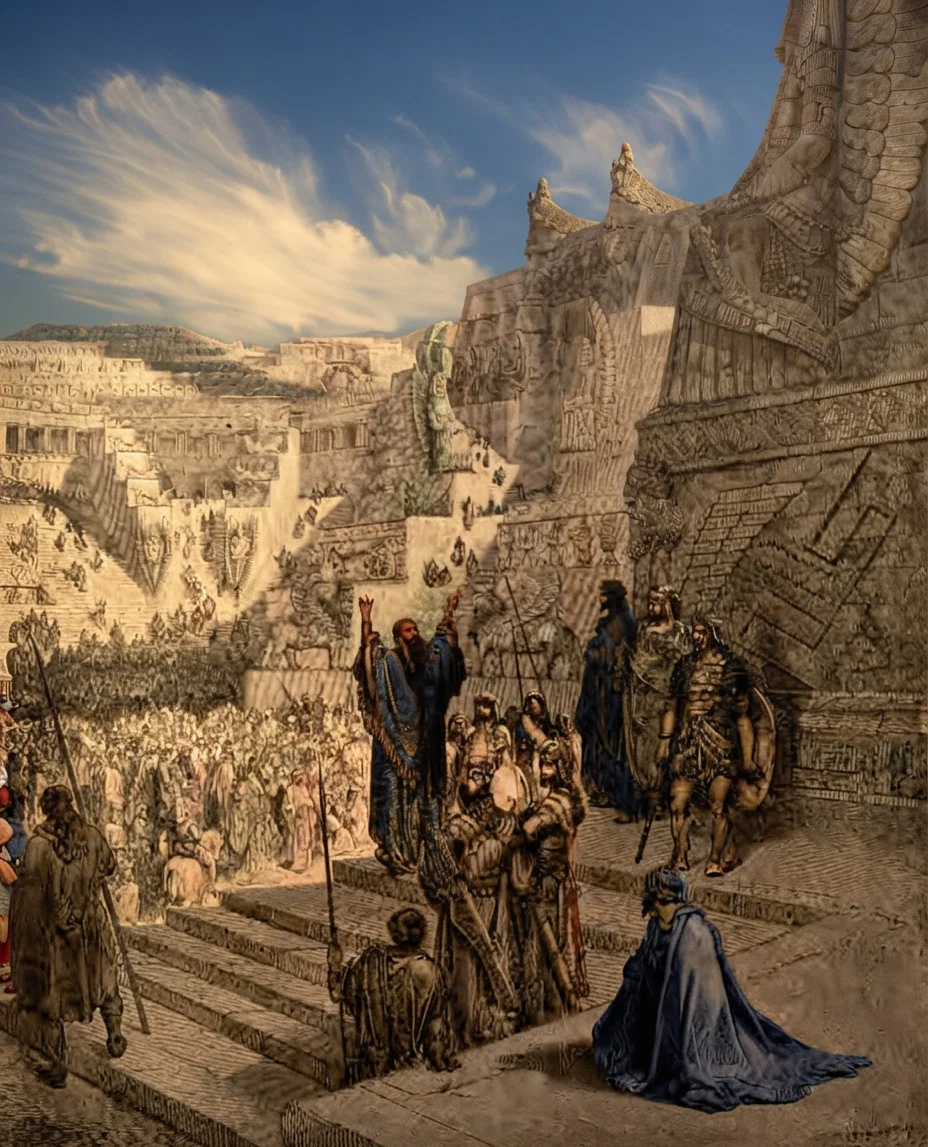
WHEN Cyrus issued his remarkable decree giving God's people the opportunity to return to Jerusalem, every loyal soul among the Israelites responded with vigor and enthusiasm. Whenever God calls a people, He makes response entirely dependent upon free will. He wishes no forced obedience; and those whose hearts loved God and their native land, were ready at once to return, even tho it meant hardship and the exercise of faith.
We read: "Then rose up the chief of the fathers of Judah and Benjamin, and the priests, and the Levites, with all them whose spirit God had raised, to go up to build the house of the Lord which is in Jerusalem. And all they that were about them strengthened their hands with vessels of silver, with gold, with goods, and with beasts, and with precious things, beside all that was willingly offered." It was not a decree in which all the Jews would be compelled to return to Jerusalem, but rather an opportunity for those who wished to go, for those who longed to see the desolate house of God restored. It was a time when men could choose for themselves, whether they would remain in Babylon to acquire wealth and to live in ease and comfort, or be real pioneers and go back to the ruins of that holy city and undergo hardships, sacrifice, and the loss of many comforts and enjoyments that were now theirs. But God would have only the willing-hearted. He would have only those who were truly His children; not those who were called Israel, but those who at heart were Israel.
God was at work upon the hearts of men, as the Scripture says: "All them whose spirit God had raised, to go up to build the house of the Lord." God was working upon the hearts of men; and those who were in touch with Him, whose lives were yielded over to Him, felt a marvelous impulse, a great quickening of the Holy Spirit, to give all they were and all they could do to accomplish the great purposes which heaven had in restoring the temple and the city, and preparing a place for the coming of the Messiah in the future days.
And God's Spirit was at work upon the heart of Cyrus. He brought forth the vessels of the house of God that Nebuchadnezzar had brought from Jerusalem. These sacred vessels which had been put away in the house of the Babylonian gods, even these vessels "did Cyrus king of Persia bring forth by the hand of Mithredath the treasurer, and numbered them unto Sheshbazzar, the prince of Judah." It was a goodly treasure, and a great encouragement to those who had undertaken the task of restoring the temple worship in their beloved and sacred city of Jerusalem.
Seventy years had elapsed since the Jews had been taken captive by Nebuchadnezzar and carried away from their native land. Almost two generations had passed away, and in all probability there were very few then living who remembered seeing the land of their fathers. Notwithstanding the fact that the youth now grown up to maturity had never seen their native country, a great host of them were eager to return. They collected in one vast assembly, with all the treasures which they were allowed to take, and the stores of provisions and baggage, along with horses and mules and other beasts of burden with which to transport them.
Going up to Jerusalem under the decree of Cyrus. Ezra 1:1-3
When assembled for the march, a very exact census was taken and it was found that the number was 49,697.
In the train were some seven or eight hundred horses, about 250 mules, and about 500 camels. The greater portion of their baggage and stores was carried by asses, of which they had nearly seven thousand. Jacob Abbott, in his life of Cyrus the Great, well remarks: "The march of this peaceful multitude of families — men, women, and children together — burdened as they went, not with arms and ammunition for conquest and destruction, but with food and implements for honest industry, and stores of
provisions and utensils for the peaceful purposes of social life, as it was, in its bearings and results, one of the grandest events of history, so it must have presented, in its progress, one of the most extraordinary spectacles that the world has ever seen." — Page 194.
The number of Jews who, Ezra says, returned at this time, seems very small as compared with what we might expect. And it is a sad fact to chronicle that from this time on we will find in general the Persian nation, the people of the world, more willing to further the work of restoration than were God's people themselves.
Some reliable writers inform us, indeed, that excepting the priests and Levites, those who returned from the captivity were largely inferior mentally and physically. So kindly were the Jews treated in Babylon that not one half of them chose to return to their native country. They had come to respect the land of exile more highly than they did the holy land of Palestine.
But even so God makes the call only for those who choose to return. He thus allows those who love their pleasure and ease more than they love Him and His plans, to remain behind. Only those who love Him enough to sacrifice their homes and associates, need come.