India In 1909

6%

Pacific Press Publishing Association · Mountain View, California · May 3, 1910

FromSigns of the Times, Vol. 37, No. 17.

Read the full edition

India In 1909

(From Our Own Correspondent)
English Rule — New Political Reforms — Bomb Outrages — The New Press Act — Religious Matters — New Theology and Christianity — Movements within Hinduism.
SOME conditions developed very rapidly in India during 1909. In so far as India is concerned, the educational system of the West has been leavening the ideals of the East for more than a half century. While it is true that even at the present moment this educational system does not touch the great mass of India's millions, still that portion of the community which has always ruled, which the great masses have always followed, has been reached and transformed through it. In every large center in India there are universities and high schools numbering their students by the tens of thousands.
English rule in its beginnings in some features was necessarily modeled after Oriental ideas. However, the handful of Europeans which has been scattered throughout India all these years, well-nigh swallowed up in the great multitudes, have dispensed justice with as unbiased a mind as could be expected under the circumstances, and the British RAJ has brought such peace to this assembly of nations and warring communities as had been unknown to them for many centuries. To the unbiased student of history, the rapid extension and firm hold British rule has taken in India can never cease to be a matter for thoughtful study. Earthly governments must necessarily reflect some of the weaknesses of those who govern, and hence we must expect to find some flaws in that system by which this assembly of nations has been governed. Nevertheless the stories of oppression and misrule, assiduously circulated by those who have their own selfish purposes to serve, are not to be believed.

New Political Reforms

England herself has been one of the first to recognize that through that system of education for which she was responsible and for which she has spent much time and money, such a change had come over the ideals of the most influential portion of the Indian community that political reforms were necessary. Some of her most able statesmen threw all their powers into the effort to change the situation for the better. The enormity and responsibility of their tack can only be known to those who have studied the situation in the Orient on the ground. Most fortunately for India, this crisis in Indian affairs has found at the helm two clear-headed, conscientious men, of rival parties 'tis true, still working together in perfect harmony. These two men are Lord Morley, of Blackburn, the Liberal; plain John Morley, the historian and writer on political economics; and the Earl of Minto, the Conservative, an experienced proconsul whose recent past was governor-general of Canada.
These two men had scarcely more than drafted their proposals for reform, when suddenly India was shocked by a series of

Bomb Outrages

which have revealed a quite widespread anarchical conspiracy.
Ever since the mutiny of 1857, the native population have been forbidden the possession of firearms. This has been England's safety. But these outrages have revealed the startling fact that some of India's bright youth have gone to European anarchistic centers and there learned the secrets of bomb-making. The ingredients which make up these deadly weapons are simple and easily procurable. For the most part those who have been caught red-handed in this nefarious work are young men scarcely out of their teens. But it seems very evident that back of these young men are older men, with selfish aims, who, while having the wisdom to keep themselves out of the clutches of the law, fill these young men with false ideas of patriotism, and devotion to what they are taught as duty.
Until the last few months these outrages were confined chiefly to Bengal. But near the close of the year, while Earl and Lady Minto were riding in an open carriage through the crowded streets of Ahmed-Abas, a city of Western India, a bomb was thrown at their carriage which fortunately failed to explode at the moment. In December, Mr. A. Jackson of the Indian civil service, a man who had spent many years in India, who was perhaps one of the best Mahrati and Sanskrit scholars in India, who was dearly beloved by the people, who had made a point in his lifetime to be a special friend of the Brahmins, was wickedly shot to death near Bombay, by a Brahmin, while attending a pan supari party given by the native population in his honor. The investigations following this crime have revealed the fact that the misguided youthful criminal was but a tool in the hands of quite a large band of conspirators, who are now undergoing trial in the Bombay courts.
Lord Morley and Earl Minto wisely decided that these outrages should not delay them in introducing the reforms formulated before the outrages began. Accordingly, late last year writs were issued for the election of representatives for the various legislative councils in India, as also for a few select men for the viceroy's council, the supreme council forIndia. While it is true that this is representative government in a very modified form, the government having the power of disqualifying any man <em></em>brought forward who is not acceptable to them, and also having the power to appoint a sufficient number of members to ensure the passing of urgent measures, the principle of representation being based on communities rather than the will of each individual, still representatives of the people of India for the first time have the privilege of making their votes felt in the legislative councils of this great empire. In the electorate it is generally conceded that the Mohammedans have the advantage of the Hindus. Almost all of the sedition so far has been confined to the Hindus. In this great forward movement England is striving to rule India according to the wishes of the best classes of Indian society.

The New Press Act

It is worthy of note that the very first act of this new supreme council, containing for the first time representatives of the people who could vote, was the passing practically unanimously of a stringent press act. All parties recognize that the power of the press is being used with startling success in spreading the seeds of sedition and anarchy. This is particularly true of a certain class of vernacular papers. The new press act requires every press established hereafter, to make a large cash deposit. If convicted of issuing seditious matter, this deposit is forfeited and a much larger one required. The second conviction forfeits the second deposit, and the government confiscates the press. The powers of evil have not been slow to bend the wonderful possibilities wrapped up in the press to the work of scattering broadcast seeds of evil. We are years behind with the good seed, and will never be able to do what might have been done some years ago. (Concluded next week)
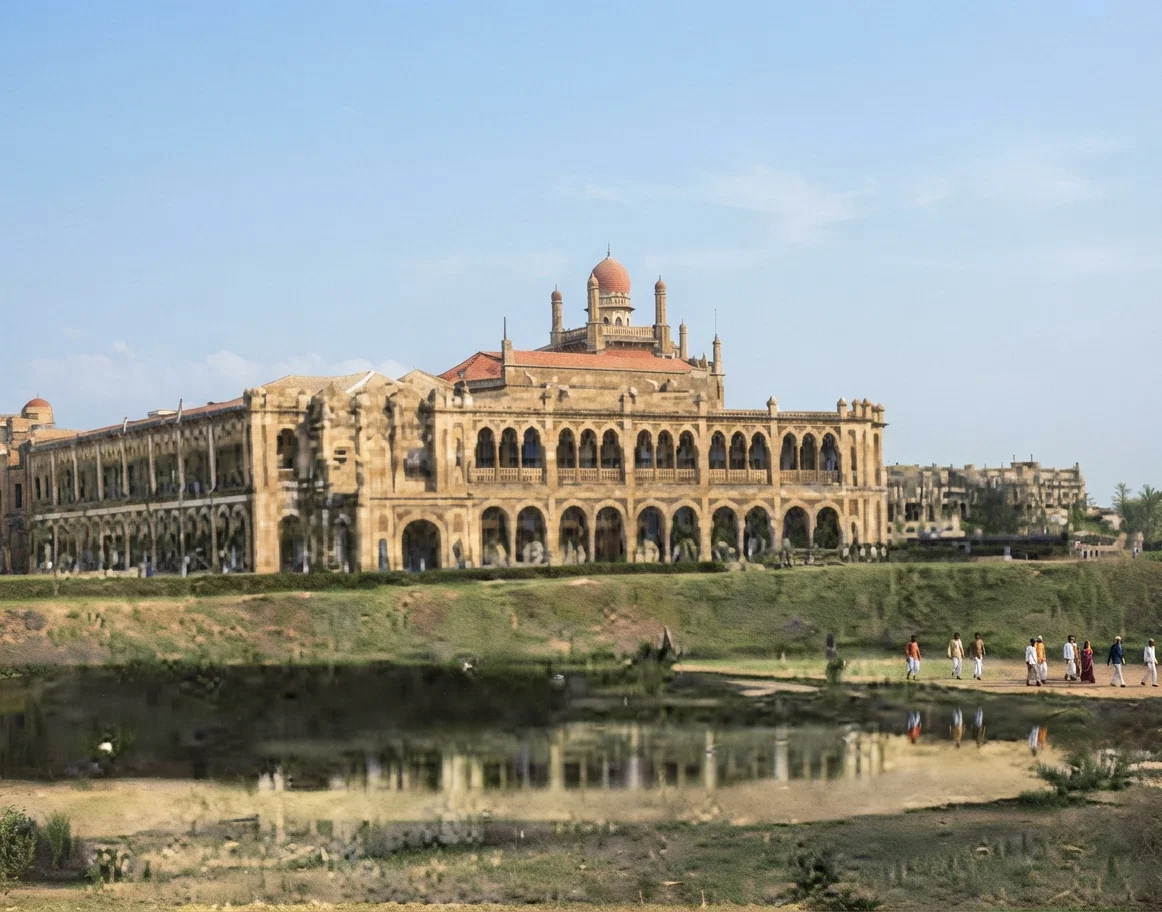
Board of Revenue Building, Madras
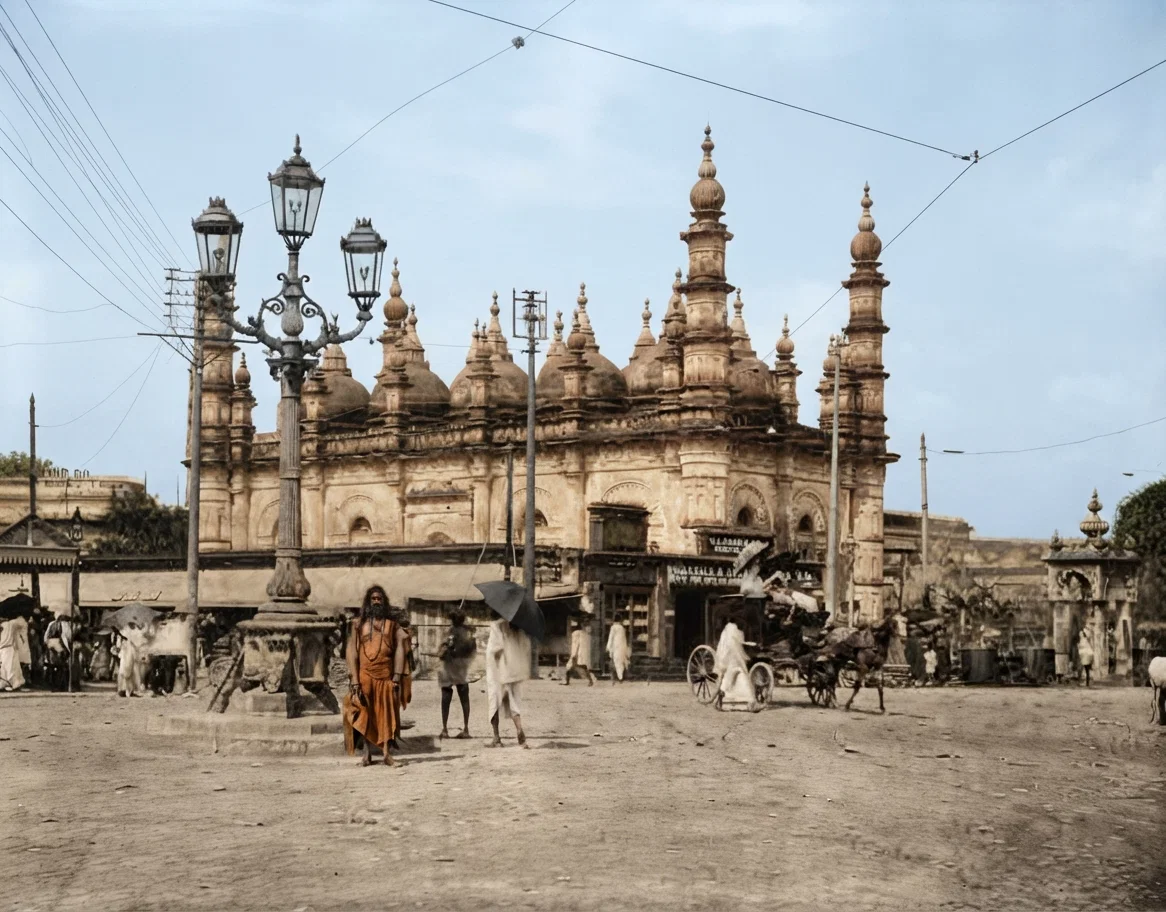
Prince Golam Mohamed mosque, Calcutta. The ancient mosque and the modern electric trains and lights make a rare combination of old and new.
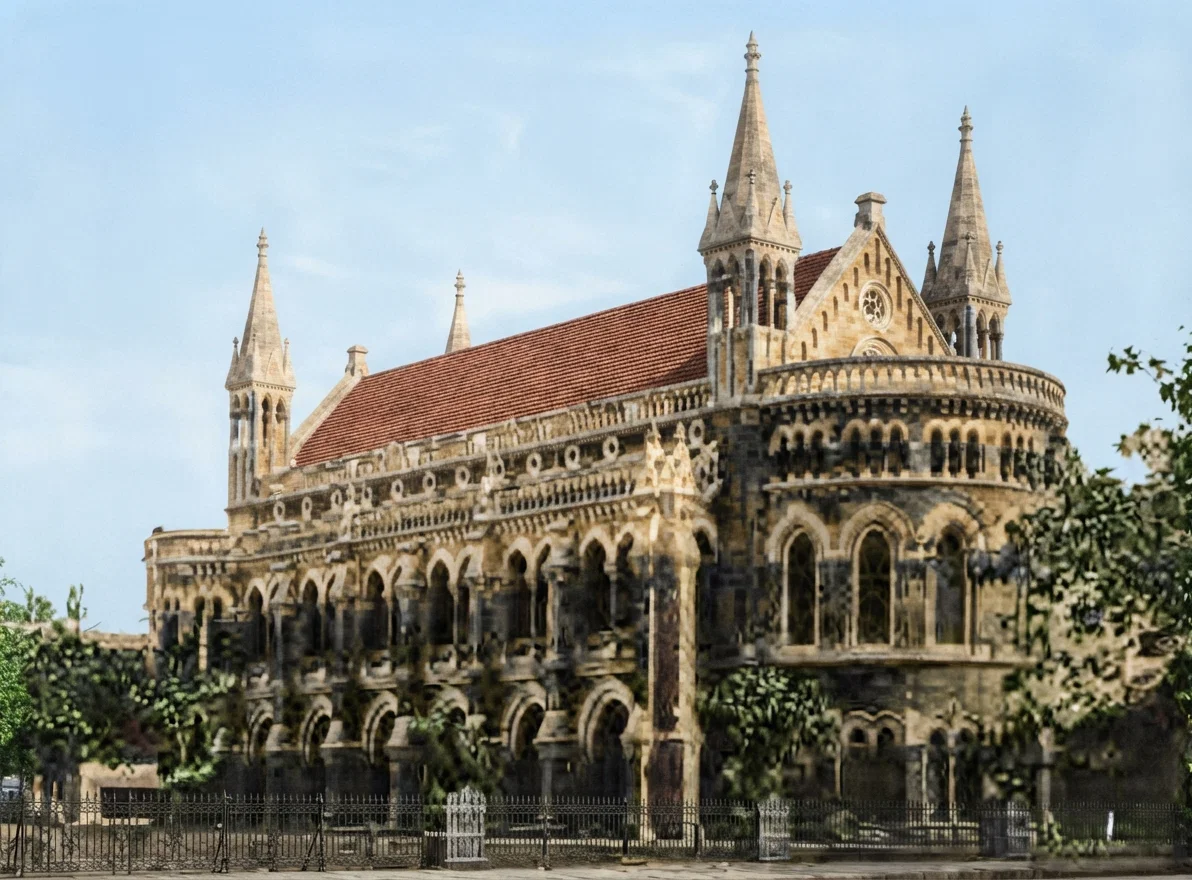
University Hall, Bombay