Our Rome Letter

5%

Pacific Press Publishing Company · Mountain View, California · Jul 29, 1908

FromSigns of the Times, Vol. 34, No. 31.

Read the full edition

Our Rome Letter

An English Jew Mayor of Rome.
THE record of the Jews from the time that the first band of Hebrew slaves was brought to the "Eternal City" to grace the chariot wheels of great Pompey, as he returned in triumph from the conquest of Jerusalem, until the present day, when a Jew rules the destiny of "the Ancient Capital of the Cæsars," would make volumes of interesting history. While under the Roman rule, the Jews were at times "commanded to depart from Rome," and were subject to many humiliating conditions, their real hardships overtook them when the papal power laid its iron hand heavily upon them. Pope Eugenius IV (1431-39) forbad Christians from trading, eating, or dwelling with them, and prohibited them from walking in the streets, from building new synagogs, or from occupying any public office. Afterward Pope Paul IV (1555), in order to heap greater ignominy upon them, compelled them to run races down one of the principal thoroughfares of Rome amid the hoots of the populace. These races were run during the carnival just before the beginning of Lent. On this occasion the asses ran first, then the Jews with only a band around their loins, followed by the Barbary horses.
Finally, after being subjected to this barbarous humiliation for over two hundred years, the heart of one pope became so softened toward the Jews that he allowed them to pay a sum equivalent to 1,500 francs annually instead of running the customary races. While this change somewhat ameliorated their condition, they still were subjected to infamous treatment, as one can see from the following quotation from Gregorovius:
"On the first Saturday in the Carnival, it was the custom for the heads of the Jews in Rome to appear as a deputation before the Conservators in the Capitol. Throwing themselves upon their knees, they offered a nosegay and twenty scudi with a request that this might be employed to ornament the balcony in which the Roman Senator sat in the Piazza del Popolo. In like manner they went to the Senator, and, after the ancient custom, implored permission to remain in Rome. The Senator placed his foot on their foreheads, ordered them to stand up, and replied in the accustomed formula that the Jews were not adopted in Rome, but allowed from compassion to remain there."
However, Pope Paul IV, animated by that burning charity of which we have heard so much of late, shut up the whole Jewish population of Rome within the walls of the Ghetto (or Jewish quarter) and commanded that they should never appear outside of it, unless the men wore yellow hats or the women yellow veils; for as the papal bull says, "It is most absurd and unsuitable that the Jews, whose crime has plunged them into everlasting slavery, under the plea that Christian magnanimity allows them, should presume to dwell and mix with Christians, not bearing any mark of distinction."
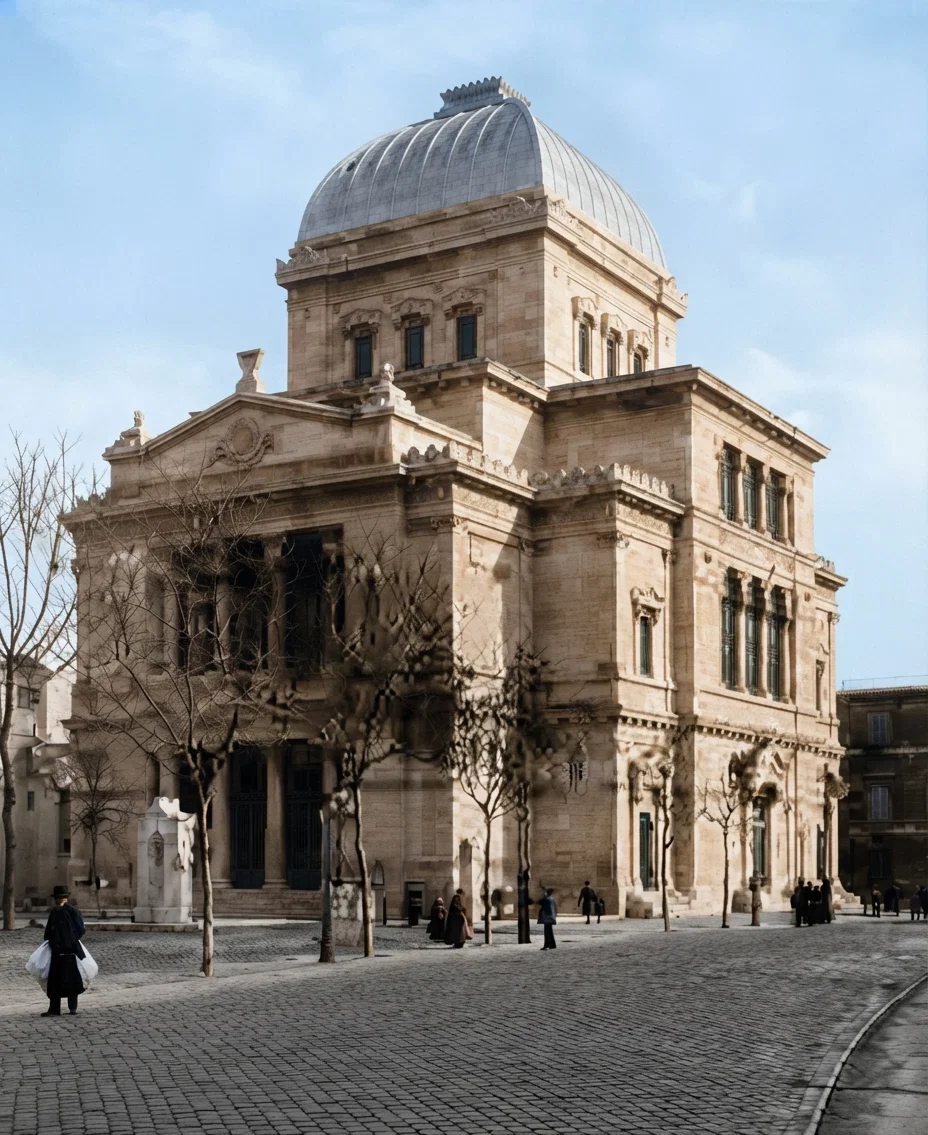
New Jewish Synagog, erected a few years ago in the Ghetto.
The day when the Jews were shut up within the walls of the Ghetto remains famous in their annals as a time of great mourning, and there is still to be seen the Gate of Weeping at which many of them stood to give vent to their great grief. Under Clement XI and Innocent XIII, all trade was forbidden to the Jews except that in old clothes, rags, and iron. It seems that the Papacy must have indoctrinated very well in this matter for they have ever since been faithful to their charge.
Finally, one pope, seeing that among his predecessors one had provided athletic sports for the Jews (racing them down the Corso with the wild horses), another had fenced them in, and still another had assigned them a business (junk-dealers), nothing remained for him to do but to teach them religion. So Gregory XIII forced the Jews to hear a sermon every week at a Catholic church. Every Sunday, police agents were sent into the Ghetto to drive men, women, and children into the church with scourges and lash them while there if they appeared to be inattentive. One writer of that time gives us this graphic description of the scene:
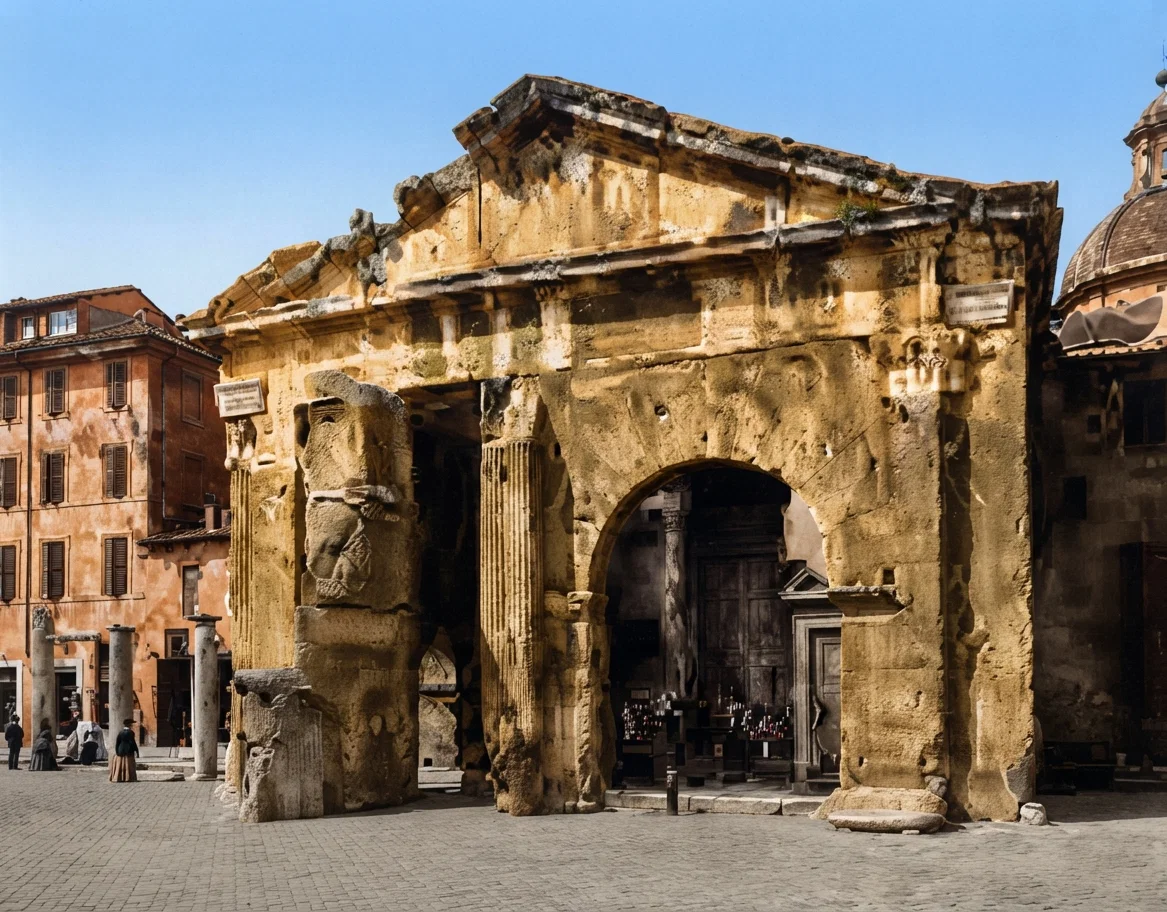
The Church of St. Angelo in Pescheria, where the Jews were compelled to attend church during papal rule. The portico is a remnant from the time of the Roman Empire.
"Now was come about the Holy Cross day, and now must my lord (the bishop) preach his first sermon to the Jews. As it was of old cared for in the merciful bowels of the church, that so to speak, a crumb at least from her conspicuous table here in Rome should be, tho but once yearly, cast to the famishing dogs, untrampled and bespitten upon beneath the feet of the guests; and a moving sight in truth this of so many of the besotted, blind, restive, and ready-to-perish Hebrews materially brought—nay (for He saith, 'Compel them to come in') haled, as it were, by the head and hair and against their obstinate hearts, to partake of the heavenly grace."
Surely one could say that the church left no stone unturned in its attempt to force religion down the Jews' throat, for they did this work of converting them with a vengeance. To complete the picture nothing could be more striking than the words of Browning describing the feelings of the Jews under these circumstances:
"Groan all together now, whee-hee-hee, It's a work, it's a work, ah wo is me, It began when a herd of us, picked and placed, Were spurred thru the Corso, stripped to the waist; Jew-brutes with sweat and blood well spent To usher in worthily Christian Lent. It grew when the hangman entered our bounds, Yelled, pricked us out to his church like hounds. It got to a pitch, when the hand indeed Which gutted my purse would throttle my creed. And it overflows, when, to even the odd, Men I helped to their sins, help me to their God."
This custom of compelling the Jews to attend church and listen to a sermon weekly was only abolished by Pius IX, the predecessor of the last pope. By the same pope also the walls of the Ghetto were removed so that the Jews can circulate freely in the city. This race that has been despised and ill-treated by the Papacy for so many centuries has finally triumphed in the home of Catholicism, and a representative of the Jewish people occupies to-day the highest post of honor that is in the power of the city of Rome to bestow upon any man.
The present mayor of Rome, strange to say, is not only a Jew, but an Englishman; for Ernest Nathan was born in London, England, in 1848, of a good English family. Joseph Mazzini, the famous Italian patriot, found a refuge from the political storm that was raging in Italy during the days preceding the Italian independence in the Nathan household in London. The manuscripts and private papers of the great Italian statesman fell into the hands of the present mayor of Rome, who has written some very valuable books on the life of Mazzini. By a special act of Parliament he was made an Italian citizen in 1888.
Having been closely connected with Joseph Mazzini, who is the idol of the popular parties, he is highly esteemed by the Italian people. In the last election the clerical party that had held the reins of the municipal government at Rome from time immemorial, seeing its utter inability to cope with the well-organized popular parties, gave up the fight and did not even present its candidates to the voters. Consequently the municipal government fell completely into the hands of the liberal and socialist parties. As the power of electing the mayor of Rome lies in the city council, that body amid great enthusiasm elected Ernest Nathan by a unanimous vote. The new mayor is an indefatigable worker and has already shown great capabilities in the administration of his office.
It is needless to say that the pope and his party do not look with much pleasure upon the new state of things in their home. They are in hopes, however, that after a short experience with the popular parties the peoplewill be satisfied to return under the protection of the maternal wing of the church. But at all events the Jews have emerged from their position of being "dogs," kicked and scuffed by the Papacy, to that of rulers of the "Eternal City."
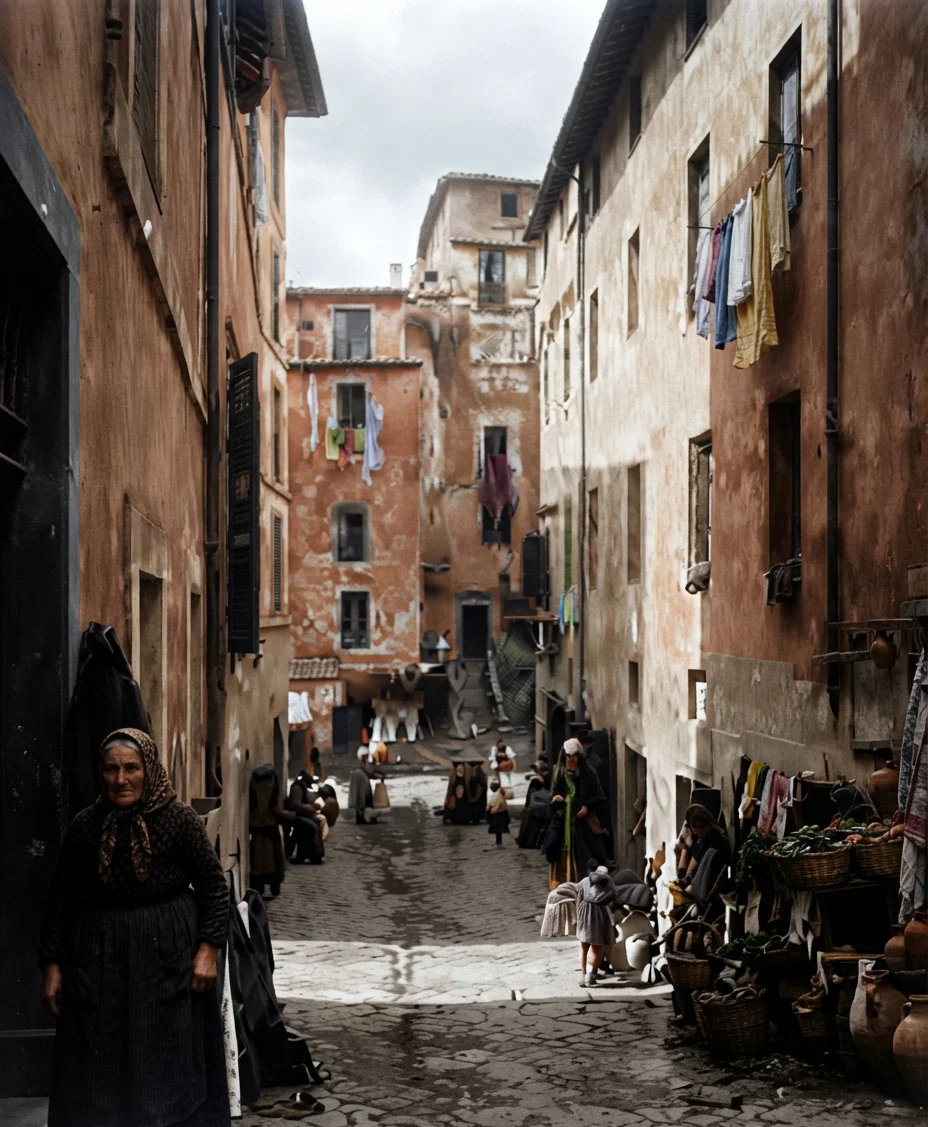
A Characteristic Scene of the Ghetto.
C. E. MILTON.