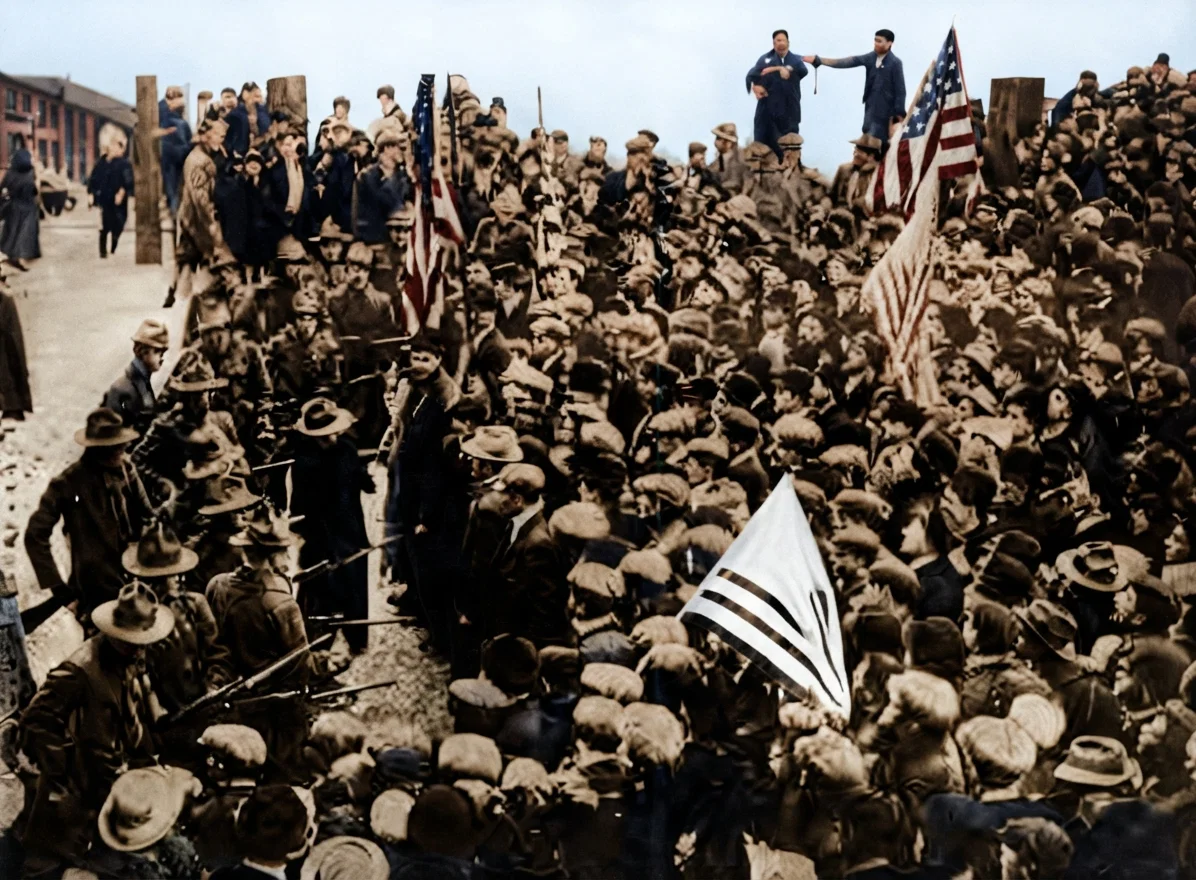
Turbulent Unrest of Labor—Tremendous Earnings of the Big Corporations
THE New York World of April 30 announced, through its news columns, that 25,000 women garment workers of New York were in a "lockout"—this in addition to the 5,000 on April 28, two days before.
The same paper announced that the marine engineers of New York City threatened a strike that would tie up the port.
In the same issue was also an account of the Westinghouse strike in Pittsburgh, which was still in progress.
Mention was also made of the strike in Alaska that had just been settled.
The World of May 1 announced that from 60,000 to 70,000 of the women garment workers of New York were either out on a strike or about to go out.
1,800,000 workers on strike or lockout throughout the United States.
The same paper, of the same date, also informed us that there were "1,800,000 workers on strike or lockout throughout the United States to-day."
An editorial in the World of May 1, under the caption, "May Day Unrest," stated:
"By custom, May 1 has been made the special date for labor parades and demonstrations. If labor is generally employed, contented, and prosperous, naturally the prospects are not good for a big holiday showing in the streets. If it is idle and in distress, inevitably it finds an outlet for its feelings, and marshals its forces under a common impulse to manifest its strength. . . . In this city, there is a growing tendency to look and prepare for labor disturbances with the advent of May. It is an epidemic to be counted on in advance. It is recognized as a sign of the period of year, like budding trees."
After thus speaking of the habitual May Day manifestations, the World added, however, that "this spring, labor has been in extraordinary demand. Many employers have complained of a shortage, and many classes of employees have benefited by larger earnings. Yet, in a number of trades and industries, to-day finds lockouts and strikes. It is a threatening situation, aggravated especially in the case of the cloak makers by the unreasonable attitude of the employers."
The World of May 2 continued to tell about the strikes, particularly in its own locality. It stated that "60,000 in the garment trade quit to-day." The same paper also informed us that "carpenters to the number of 10,000, and painters and decorators in as great number, went on strike yesterday, threatening the great majority of the building operations of the greater city."
We were also informed that "300 marine engineers went on strike, taking that number of tugs out of service in the harbor." Then there were also longshoremen that had gone on strike; and 2,000 jewelry workers returned to work, who had been out on strike twelve weeks.
In Cincinnati, 3,500 machinists struck. Three other Ohio cities had strikes on their hands, involving 3,400 machinists and carpenters; while in Cleveland, strikes involving 20,000 men were narrowly averted.
Speaking of the May Day labor celebrations in New York City, the World affirmed that they were both "orderly" and "impressive."
Incidentally, the World of the same date, May 2, spoke also of a strike in Shanghai, China.
As declared in the World editorial, "This spring, labor has been in extraordinary demand." Therefore lack of work is not the cause of this unrest; yet we must acknowledge that there has never been a time of such great unrest, in the history of the nation or of the world. Labor, generally speaking, is dissatisfied; and if we should inquire carefully for the cause, might we not find it in the fact that the laboring man of to-day quite generally is intelligent? He can at least read the papers, the tracts, and the pamphlets that are continually coming from the presses, discussing the situation in this world.
$240,000,000 This Year
WALL STREET is ever giving out facts in regard to the earnings of the big corporations, that are simply tremendous. We know of no other word to express it sufficiently. For instance, Wall Street informs us, "It is estimated that United States Steel may earn $240,000,000 this year, compared with the previous high record of $161,000,000 reached in 1907." On the same day, Wall Street affirms that "the present Du Pont company is earning $15,000,000 net a month, and it has $75,000,000 on deposit in banks."
On a later date, Wall Street says, "The industrial stocks have presented the most striking advance in an abnormal time,10due, of course, to the inclusion of one of the most active 'war' stocks, General motors."
In reference to one of the big automobile concerns, we are told that "dividends on this class of stock will be earned five times over." In other words, it gets five years' profits in one.
On this latter date, regarding the tremendous profits on United States Steel, it is declared that "from net earnings of $15,082,369 in the first quarter, Steel's earnings jumped to $53,580,796 in the last quarter, and it would not be surprising if net exceeded $60,000,000 in the quarter to end this month [March]." This same report also tells of United States Steel, that "since organization, the surplus available for dividends has averaged 18.9% annually on the preferred stock; and after deducting preferred dividends, the balance available for the common averaged 8% on that issue."
On a still later date, reports from Wall Street say of another lesser manufacturing establishment, "Profits in the March quarter are understood to have been approximately $2,250,000, or at the annual rate of 90% on the stock."
Enormous Profit from Speculation
SPEAKING in a speculative way concerning one of the big shipping industries, Wall Street reports indicate that if the war in Europe should suddenly terminate, the prospects for profits in the shape of "Industrial" would not be so promising, but "on the other hand, if the war should continue for a long time—and this supposition is a general one in the financial district—it is conceivable that the most fantastic estimate of Marine's value may fall short of the mark."
On the supposition that the war will continue, the report further states that after payment of the war tax, the amount still remaining would be "twelve times the preferred stock dividend requirements."
Continuing the facts that Wall Street gives on this last date, we find a report of the tremendous earnings of "United Fruit." Concerning this monopoly, the statement is made that "during the seven months to May 1, the net profits from all sources were three times as great as during the same period of the 1915 year. In specific figures, the contrast was $4,325,000 of net against $1,460,000 during the seven months of 1915. Here is an increase of better than $2,800,000, or practically 200%."
After giving these figures, representing such enormous profits, it is remarked that "the period of substantial profits is, of course, ahead." It would seem that the profits already gained were quite "substantial," yet we are informed that we may look for still greater things ahead.
Another paragraph from this report is quite significant: "The sugar situation alone would seem to promise an increase in net profits during the balance of the fiscal year. The company has sold six cargoes at 5 cents or better. The last two cargoes went at 5½ cents; and it is interesting to know, as measuring the remarkable earning capacity of sugar producers at this time, that the net profits on these two cargoes were slightly in excess of $525,000." From these figures, the conclusion is drawn that "on this basis, it would seem as if the minimum expectation on United Fruit shares this year would be between 23% and 25%."
Incites a Spirit of Anarchy
WE are told, on every hand, that the tremendous rise in the price of sugar is due to war conditions. But it would seem, from this report, that "United Fruit" is enjoying some rather handsome profits at the consumers' expense. The profits of these great concerns, that show so unmistakably the grasping greed of the men who are in control, are openly published from Wall Street and other great financial centers.
These reports go into the hands of the people, and the editors of socialistic and laboring men's papers are not slow to take them up. They send these great facts broadcast; and the man who is working for a few dollars a day, very quickly makes the contrast. He says: Here is a man who is in control, and whose very success depends upon my labor. I get a few dollars a day, and he gets his thousands a day. His yearly income mounts up into the millions. The laboring man says that it is not fair, and discontentment and the spirit of revolution and anarchy grow with indescribable activity.
There is no lack of men and women to argue the right and the wrong of these conditions from their various viewpoints. The capitalist thinks that he is justified in pursuing his course; the laboring man is just as sure that the money baron's whole plan of operations is wrong. But let those discussions be as they may, we know that the conditions are here. We know that these tremendous fortunes are being amassed at a rate which stands without a parallel in the history of the world, and he is blind who cannot see the preparations well advanced for the greatest political and social explosion this world has ever seen.
Labor is, indeed, in a state of ferment and unrest; and the most unpromising thing in connection with it is that it has much material out of which to build its arguments, and create public sentiment, and inflame the passions of the masses. With such conditions as are in the world, why should we not have unrest? What else could we expect? And with the determination manifested on both sides of the controversy, where is there any hope for a peaceable solution? God's word informs us that the last days will be made perilous because "men shall be lovers of self, lovers of money." 2 Tim. 3:2, A. R. V.
Oblivious to Their Approaching Doom
THE prophet Isaiah, describing the last days, says, "Their land is full of silver and gold, neither is there any end of their treasures; their land also is full of horses, neither is there any end of their chariots." Isa. 2:7, A. R. V. The prophet also speaks of the haughtiness of the people of that time, and their wanton wickedness; and when the climax is finally reached, God, being unable to endure it any longer, arises in His majesty, and "men shall go into the caves of the rocks, and into the holes of the earth, from before the terror of Jehovah, and from the glory of His majesty, when He ariseth to shake mightily the earth. In that day men shall cast away their idols of silver, and their idols of gold, which have been made for them to worship, to the moles and to the bats; to go into the caverns of the rocks, and into the clefts of the ragged rocks, from before the terror of Jehovah, and from the glory of His majesty, when He ariseth to shake mightily the earth." Isa. 2:19-21, A. R. V.
On one side, we see a comparatively small number of men so insanely absorbed, under the spell of greed, in amassing wealth, that they are oblivious to every danger signal that would warn them of their approaching doom. On the other hand, we see the innumerable host of the discontented masses ready to break forth throughout the world in tornadoes of violence and revolution. The divine Book tells us unmistakably that these are among the conditions that are to characterize the last days. Wise men and women will know what to do under the circumstances.