[By the late William Newton Glenn, formerly on the Editorial Staff of this Journal]
Liberty and the Declaration of Independence
THERE can be no true idea of liberty without a recognition of the equality of man. It is God's design that all men shall be free; for He gave His Son to die for that very purpose, and He "is no respecter of persons." "If the Son therefore shall make you free, ye shall be free indeed." John 8:36. But does not that refer to spiritual freedom, which any one may enjoy tho in bodily bondage to another? True; but the greater the degree of spiritual freedom among the people of any state, the more general will be the enjoyment of civil liberty. It is the Spirit of Christ that engenders a real respect for the rights of others, wherever and in whomsoever that sentiment may be found.
The Reformation that began in Luther's time indicated the solution of the problem of true civil liberty by proclaiming the doctrine of religious liberty. But the true idea of civil liberty did not develop into an actual governmental experiment until the Declaration of Independence was issued by representatives of the American Colonies of Great Britain. July 4, 1776, marked the beginning of a new order of things—"Novus Ordo Seclorum"—which was accomplished in the Revolution. The doctrine of that Declaration is thus expressed:
"We hold these truths to be self-evident; that all men are created equal; that they are endowed by their Creator with certain unalienable rights; that among these are life, liberty, and the pursuit of happiness. That to secure these rights governments are instituted among men, deriving their just powers from the consent of the governed; that when any form of government becomes destructive of these ends, it is the right of the people to alter or abolish it, and to institute a new government, laying its foundation on such principles, and organizing its powers in such form, as to them shall seem most likely to effect their safety and happiness."
One of the leading spirits in the framing and in the promulgation and establishment of the foregoing Declaration was Thomas Jefferson, who also enunciated the doctrine of "equal and exact justice to all men of whatever state or persuasion, religious or political."
Meaning of Equality
These are the basic principles upon which our Government is founded. Now if it is a fact that "all men are created equal," then no man or combination of men has a right to disturb this equality. In what does this equality exist? It is not in stature, nor in color, nor in intelligence, nor in disposition. However equal, or similar, these conditions might have been in all men had sin not entered to disarrange for the time the harmony of God's work in the earth, is not the question. Civil government is concerned with the best temporal good of man as he is. Then it is here and now that we hold, as self-evident truth, that "all men are created equal." So in the condition of man as he is here and now, there is but one point of view from which this God-designed equality is apparent, and that is in the matter of6rights. And here is the place where the framers of the Declaration stood when, in laying the foundation of this Government, they acknowledged as self-evident truth the proposition that “all men are endowed with certain unalienable rights.”
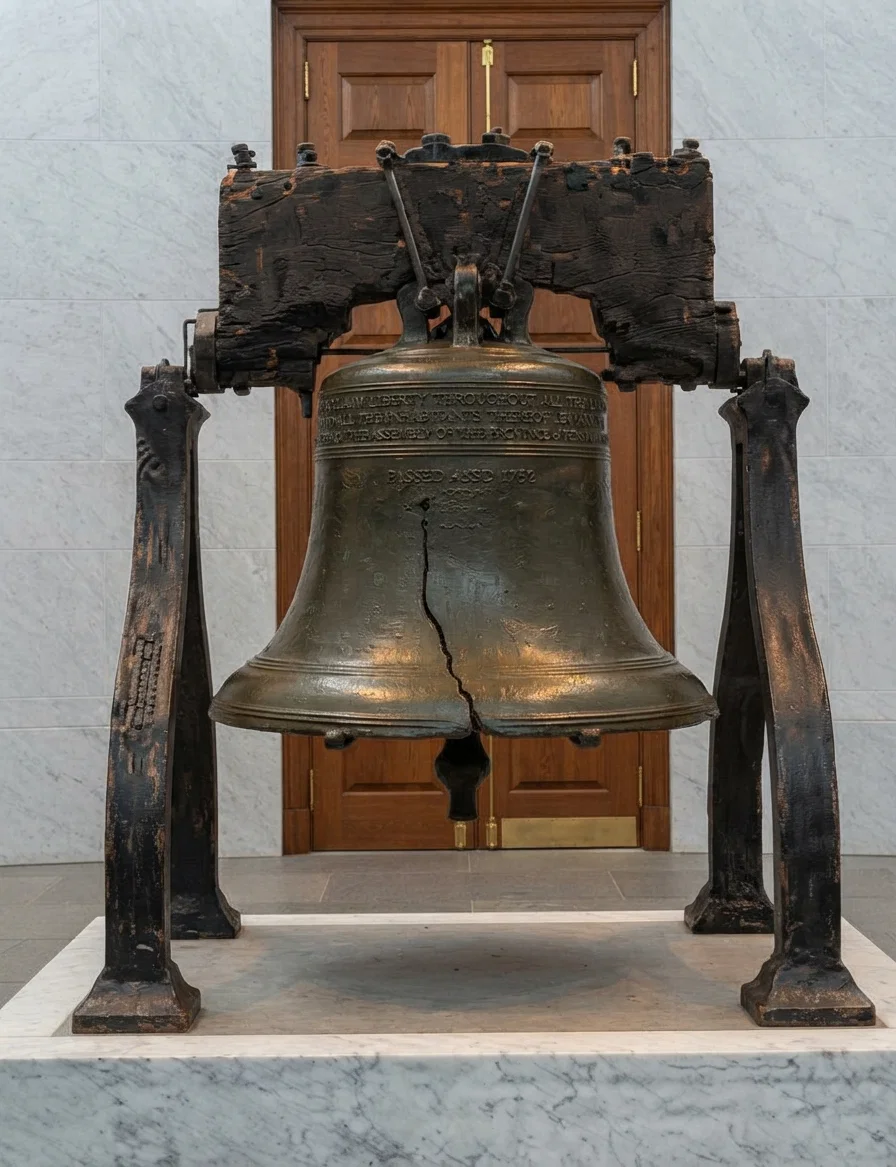
Liberty Bell, which rung out freedom to all the people of the world.
Not to Create, but to Secure
The government which they proposed to establish was not designed to create rights, but to “secure” the free exercise of the rights with which the Creator had already endowed them. The government to which the colonies were then subject was denying this exercise of rights; hence the colonists declared for “a new order of things”—a government having for its object to provide for the best good of all the people. The idea prevails to a great extent to-day that the government is designed to provide for the best good of the majority; but that is a perversion of the true spirit of government, for it ignores the rights of a part of the people. It is but a slight modification of the monarchical rule that government as established for the special benefit of rulers and their friends, be they ever so few in number.
The Individual
The particular feature of rights to which the Declaration pledges government security is included in “life, liberty, and the pursuit of happiness.” As the theory and the language of the Declaration guarantee such protection to “all men,” every individual citizen and every individual accepting the guarantee even temporarily, is under obligation to acknowledge and respect the right of every other individual. The Government is a compact of individuals for this purpose. In no other way can the rights of all be made secure in a selfish and consequently sinful world. For this reason, purpose, object, “the powers that be [civil government] are ordained of God.” Rom. 13:1. The obligation being mutual between individuals, the claim to security in what would ordinarily be deemed personal right is logically forfeited, or limited, when the individual fails to regard the rights of others. For instance, when a person’s actions become a menace to the lives and liberty of others (not when his “persuasion, religious or political,” is repugnant to them), it is the province and the duty of the government to restrain him, or to restrict his liberty of action (not of sentiment or conscience) to the extent that is necessary to the security of others in the exercise of their equal rights. “For rulers are not a terror to good works, but to the evil.” Verse 3.
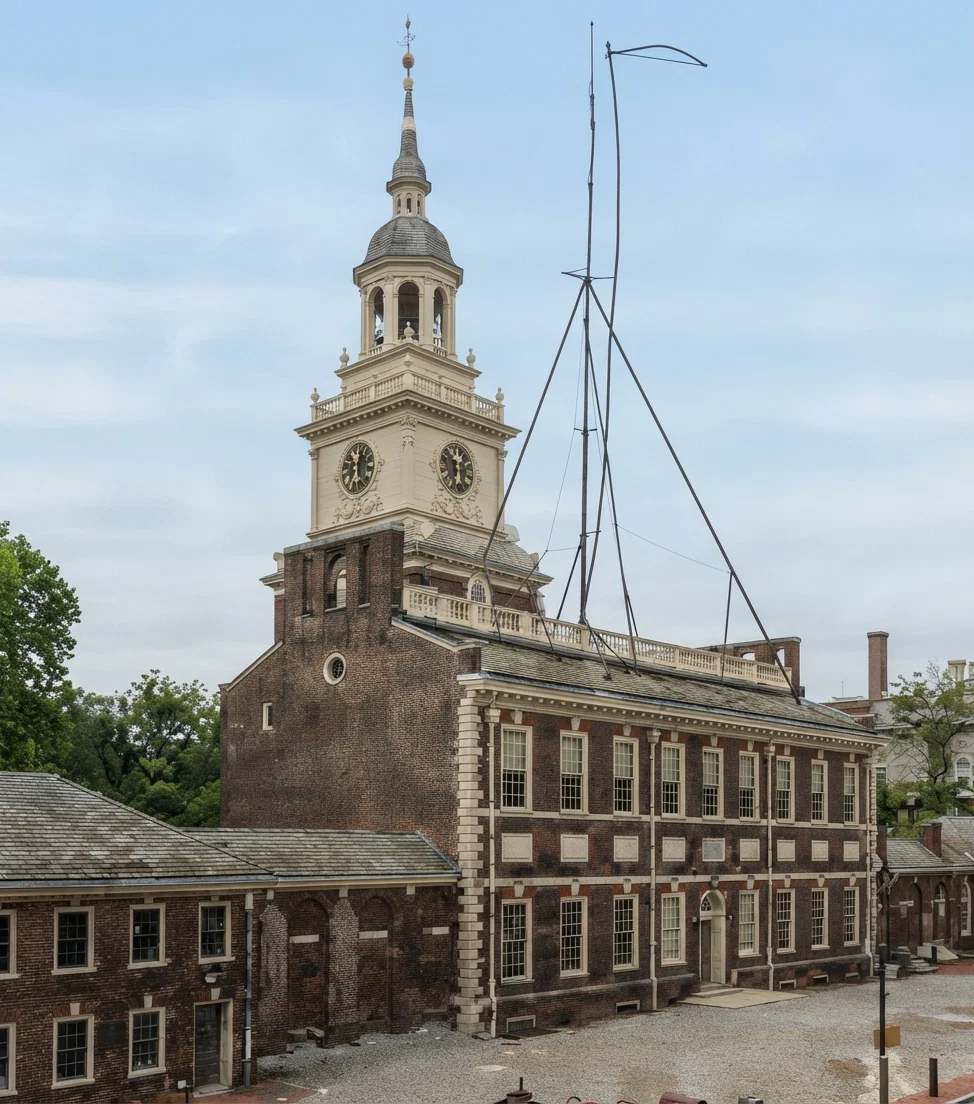
Independence Hall, where the Declaration was signed, July 4, 1776
Pursuit of Happiness
Perhaps in no sense was there a greater necessity for reformation in governmental function than in the protection of men in their right to the “pursuit of happiness.” And no element ever was so inclined to interfere with the free enjoyment of this right as the votaries of religion. Furthermore, this interference never has been carried to such an extreme as by those who have professed adherence to the Christian religion, this, too, in face of the basic Christian principle, “All things whatsoever ye would that men should do to you, do ye even so to them.”
Bartholdi's Statue of Liberty
It has been in the matter of the “pursuit of happiness” that the advocates of civil-law religion have ever deemed it their prerogative, through the machinery of government, to dictate bounds of action on the part of their fellow men. Religious zealots—whether Roman Catholic, professed Protestant, Greek Church, Mohammedan, or the generally recognized heathen of whatever name—have always deemed it essential to good government to restrain the non-religionist in his idea of pursuing happiness, and to compel him to acknowledge at least formally the essential importance of their religious dogmas. So extensively grounded had this idea become, that a government without an establishment of religion was indeed “a new order of things,” and in the Old World was deemed as near of kin to anarchy.
Many attempts have been made to establish government that would be void of tyranny, that would recognize the rights of all the people; but prior to A.D. 1776, all such attempts fell short, because some particular kind of religious faith was recognized in the civil law. The government, however liberal in other respects, would set up and endeavor to maintain at public expense some form of religion. And it has ever been a fact that the enforcement of the observance of religious creed by law has worked oppression and limitation of the exercise of civil rights by those who were conscientiously opposed to the state religion.
Witch House, where Roger Williams once lived, afterward used to try “witches” in
Gallows Hill, in Salem, Mass., where "witches" were hanged
The True Idea
But through the vista of history and experience by the light of true Gospel principle, there dawned the true idea of civil government—the complete separation of church and state, and the recognition of the equality of men. This was the perfect ideal as seen by the framers of the Declaration of Independence, and later by those who constructed and adopted the Constitution. That the ideal has not been fully put into practise is due to the innate selfishness and bigotry of individuals and classes who have been enabled to wield a certain degree of deteriorating influence. But the ideal was set up by our forefathers, in the providence of God, for the first time in the history of nations. And it is yet professedly held up in the letter of the Constitution, and in the formal heralding of the principles embodied in the Declaration of Independence.