“AND yet thou sayest thou hast seen Him — the Messiah!” exclaimed Martha, while an expression of impatience and incredulity passed like a shadow across her expressive face.
“Be patient, my sister,” entreated Lazarus calmly; “be not so soon troubled. If thou wilt wait patiently, we shall hear the experience of these our friends, and have a full understanding of the matter.”
“Yes, yes; we have seen Him,—the Anointed, the Messiah,—even so am I constrained to believe; tho when I think upon it, it seemeth so different from our teaching, that my poor heart almost doubteth,—for of a truth it is very strange.
“Yesterday morning we were about to return to Jericho, for the prophet had almost finished his discourse—and verily I have never before listened to such searching rebuke of sin, and such burning eloquence. We have heard Gamaliel, the learned doctor of the law, and have listened to the logic of the lawyers and the discussions of the high priests; but never before have such powerful, such convincing words fallen upon our ears. Before the discourse was finished, and before any of the people had arisen to depart, we noticed that their attention seemed to be riveted upon a Man who had suddenly appeared among them, having come apparently from the western side of the Jordan. The Man could not have been above thirty years of age. His hair was of the color of ripe filberts, and fell to the shoulders in softly curling tresses. His beard was of the same hue, and slightly parted in the center. His complexion was clear and fair as that of a child. But His eyes! how shall I describe them? They were more piercing than the eagle’s, more tender and gentle than a woman’s, and more loving than a mother’s as she gazes upon her babe! His tunic, or vest, of blue cloth reached nearly to the feet, and was girt about with a broad girdle. The cloak, or aba, of wool was very large, and covered the entire form. I beheld Him when first He approached, as did also many of the multitude.”
“Had He any attendant?” questioned Lazarus.
“None; He was alone; His garments were somewhat travel-stained, and His appearance as if He had come from afar.”
“One of the priests told me afterward, that He came from Nazareth of Galilee,” interrupted Machbor, “tho whether this be true, I know not.”
“He seated Himself,” continued Zilpha, “and quietly and reverently listened to the prophet till the close of the discourse. Then at once He began conversing earnestly with him. We heard not the first words, for His voice was low; but we plainly heard the reply of the Baptizer:
“‘I have need to be baptized of Thee; and comest Thou to me?’ The answer of the Stranger was plain and distinct; His voice had a gentle cadence like the sighing of the night wind among the treetops.
“‘Suffer it to be so now, for thus it becometh us to fulfil all righteousness.’
“Then,” continued Zilpha, “the Stranger divested Himself of His cloak, and together they entered the Jordan, which flowed at our very feet. All eyes were upon the Man as He walked up out of the water; for already He seemed unlike any other of the sons of men. Quietly throwing His garment about Him, He calmly knelt upon the bank, and offered up a prayer to Heaven, the like of which I have never heard from the lips of man! As He prayed, suddenly there appeared a dazzling light, brighter than the sun at noonday, which seemed to emanate from the zenith.”
“Could it not have been the bright shining of the sun?” questioned Simon, with a look of incredulity upon his face.
“Nay,” interrupted Machbor, “it was before the third hour of the day, and the sun had not yet approached his meridian.”
Magdalene sat with her dark eyes fixed upon the speaker as if entranced.
“And the light — the glory — pray what of the glory?” she questioned eagerly, never once turning her face from the speaker.
“The glory seemed to concentrate, taking the form of a beautiful dove, which lighted upon the bared head of the divine One, who still continued His devotions. At the same moment we heard a noise as of muffled thunder, tho the sky was clear. I looked to see the effect of this most sublime miracle upon the multitude. While I looked, from the dazzling sky pealed forth the words clear and distinct:
“‘Behold, this is My beloved Son, in whom I am well pleased. Hear ye Him!’
“Again I looked to see the effect upon the multitude. The eyes of some, but not of all, were directed upward, and upon every upturned countenance was a look of wonder and astonishment. Presently the voice died away, and the dove-like form seemed to return again to the dim and distant heavens. The Man arose from His devotions;
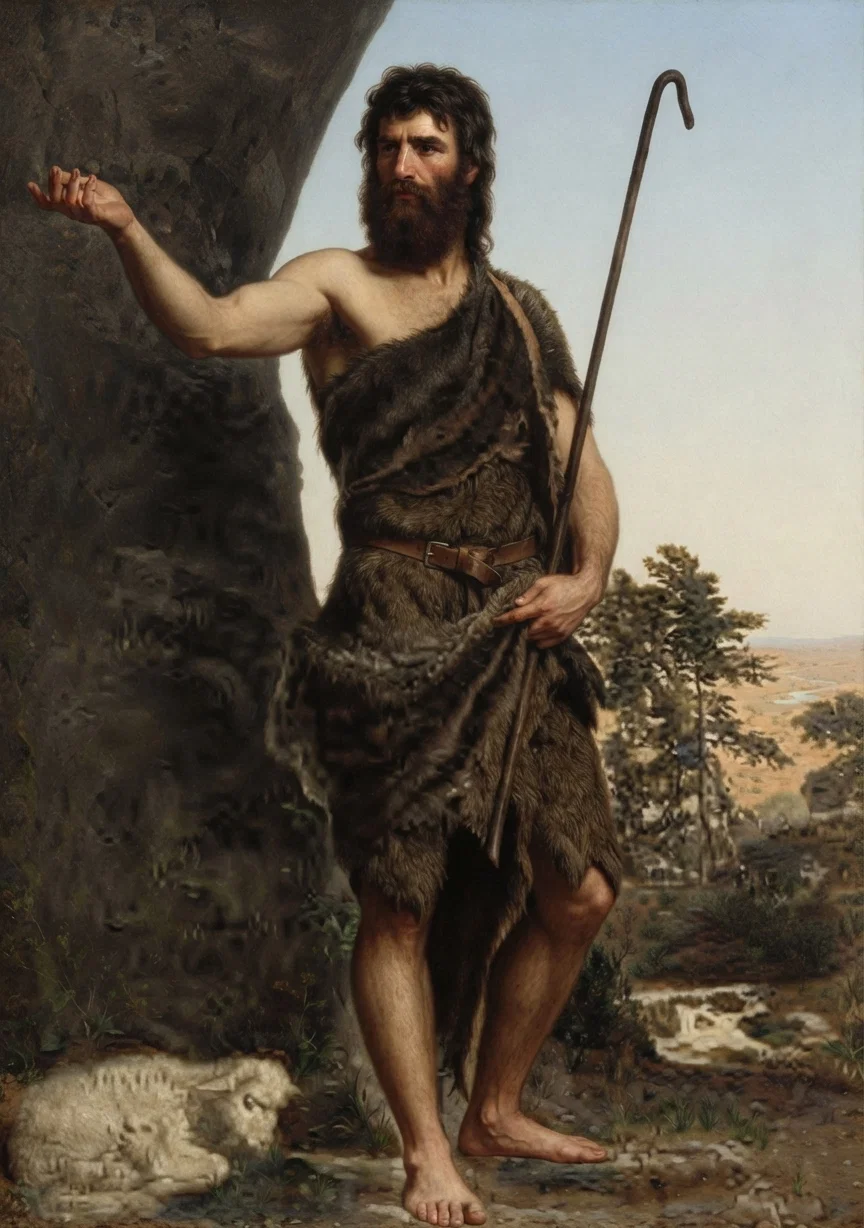
John the Baptizer, the Voice in the Wilderness
and while I looked, He had disappeared among the multitude, and was gone.”
Zilpha ceased speaking, and as if overcome by her remembrance of the wonderful scene, she turned her face appealingly toward her husband, indicating by a wave of her jeweled hand that she desired him to proceed with the narrative.
“Immediately there was a great commotion among the people,” he began, “but the trumpet tones of the prophet were heard above the din:
“‘I knew not this Man; but now do I know Him; and now perceive I that He is the Messiah, even He of whom I said unto you, the latchet of whose shoes I am not worthy to stoop down and unloose; for the God of Israel, who sent me to baptize with water, the same gave me a sign, saying, Upon whomsoever thou shalt see the Spirit descending and remaining upon Him, the same is He who baptizeth with the Holy Ghost. And I saw this, and now do I bear record that this is the Son of God.’
“Then, as I turned my head,” continued Machbor, “I saw one named Jazer, a scribe of Jerusalem; and because I knew the man aforetime, I said unto him, ‘What thinkest thou, Jazer? Surely this Man is the Messiah — the Anointed of God; now indeed hath Jehovah visited Israel, as He hath promised. What thinkest thou, Jazer?’ Then I saw that the fellow’s face was clouded by a thick frown.
“Verily,” he made answer, “verily thou art one of the foolish ones, and thy tongue betrayeth thee. What! art thou a ruler among the Jews, and knowest not that when Messiah cometh, He cometh as a mighty king to Jerusalem? Sawest thou the raiment of the Man? Indeed,” he continued with a sneer, “indeed He wore not the clothing of a king. And verily I have seen this face before. Almost a score of years ago, O Machbor, a foolish and impudent Lad presented Himself at the temple at Jerusalem, and essayed to argue with the learned doctors. I believe,” continued Jazer, “that He was driven from the holy place whose presence He had dishonored. I then learned from Shaphan, the rabbi, that it was one Jesus, of Nazareth, whose mother is called Mary, but whose father none knoweth. And this Fellow,—I remember His face well, despite His beard; I can not be mistaken,—this Fellow is Jesus of Nazareth,” he repeated, sneeringly.
“While he yet spake, the aged Rabbi Ben Israel — thou rememberest him, Simon,” continued Machbor, addressing his guest, who replied with a nod, “he of the long, white beard and the piercing eye. This Ben Israel arose from the trunk of a fallen sycamore where he had been sitting near us. ‘Why sayest thou, Jazer, that He was driven from the holy temple — the Lad of whom thou spakest? Dost thou forget that I, Ben Israel, was then present, almost a score of years ago? Of a truth thy memory is not as good as mine, albeit thy beard is not nearly so white.’ To this, Jazer replied not, but his ugly visage was drawn with a deep frown.
“Then good Ben Israel continued: ‘Thou sayest right, however, in that thou declarest this Man to be the same who, as a mere Lad, astonished all the doctors and lawyers of the temple with the wisdom of His logic. I wonder not at all that thou rememberest Him; for of a truth, Jazer, there is that about this face which stampeth itself upon the mind. But thy memory serveth thee false when thou sayest that He was driven from the temple — not so! His father and His mother called Him, — so said Bar-jona of Bethsaida.’
“‘His father!’ scornfully repeated Jazer; ‘He hath no father! Go ask Shaphan the rabbi of Nazareth if this fellow be not born of fornication! And now, behold, these men are cousins, and verily they are tricksters, and there is some connivance between them.’
“But,” continued Ben Israel, “the Baptizer saith plainly that he knoweth Him not, and verily Nazareth and Bethabara are far distant the one from the other. And thou knowest, Jazer, that neither the voice from heaven nor the amazing light can be the work of two men in this wilderness.” But Jazer the scribe made no answer, and at once pompously turned upon his heel and left us.
“Then,” continued the narrator, “our attention was attracted toward Jonathan, son of Annas the high priest, who sat supporting the head of his aged father in his arms. The face of Annas was ghastly, almost as white as the long, snowy beard which fell upon his bosom.
“Heardest thou the voice from heaven, Jonathan, my son?” he questioned, with ashen lips, “for behold the days are fulfilled,—the days spoken of by the prophet Daniel. Sawest thou the light? What said the voice? I understood not the words. And who is this Man?”
“Who the Man is I know not,” replied Jonathan, “yet heard I the words of the voice plainly, O my father.”
“I will tell thee the words,” interrupted a tall, dark man whom they called Judas, the son of Simon, of Kerioth, “I will tell thee the words, thou high priest, for they have burned themselves into the tablets of my heart: ‘This is My beloved Son,13in whom I am well pleased; hear ye Him.’” And now, verily,” continued the man Judas of Kerioth, “now do I begin to see the dawning of the coming glory of Israel, when the holy city, even Jerusalem, shall be the treasure-house of the whole earth, and Israel shall fatten upon the milk of the Gentiles!”