ANY change that we see in the Papacy is one of form and not of heart. I believe that from what I have already written that we are well persuaded of this fact, and for this reason the scope of the present article will be to round off and substantiate this thought.
I have already shown that the often-repeated maxim that the church never changes is easily susceptible of proof and is founded on fact. Therefore we can not expect the Papacy to change in its foundation principles, but only in its mode of applying them.
The Papacy persecutes, and this not because a Catholic is of different nature than other men; persecution is the logic of the principles he holds. One has but to know something of the inner workings of the Papacy and become somewhat intimately acquainted with the clergy to be thoroughly persuaded of the foregoing statement. For if the church had the power, there would not be a Protestant missionary in the city to-morrow. The truth of this statement can be verified very easily by looking into what the church did up until the very time when it lost its temporal dominion.
Not very long ago I met an American whose father was here in Rome from about 1860 and onward. This gentleman told me that in those days his father met an English clergyman who came to Rome for a tour of sight-seeing. The boat in which this minister had taken passage from New York to London was wrecked, and using this incident as a basis, he wrote a sermon of purely evangelical nature and in which no tinge of doctrinal controversy entered. He took with him to Rome several hundred copies of this sermon, thinking to distribute some of them. The very next day after he arrived, he made a visit to St. Peter's cathedral and incidently gave a copy of his sermon to the cabman. Likewise, while in the church, meeting with a very friendly abbot, he offered him a copy which was readily accepted. He then returned to the hotel where he was stopping. Early the next morning he was awakened by a heavy rap upon his door, and two policemen entered and inquired if he did not have some sermons in his baggage. He replied in the affirmative, and they immediately proceeded to take possession of them. They then told him that he would find his sermons when he arrived at Civita Vecchia, a town some miles distant from Rome, and he was ordered to leave the city that very afternoon; which he was obliged to do.
The Bible Considered the More Dangerous.
Another clergy man was returning from a tour to the Holy Land, about 1860, and stopped at Rome on his return trip. Before starting on his voyage he had provided himself with a revolver, as he had heard that things were not quite safe in Palestine. When he entered Rome the city official, while inspecting his baggage, found the revolver as well as a copy of the Bible. They told him that he might retain the revolver but the Bible they would be compelled to take from him, as he could not be allowed to enter the city with such a weapon.
The gentleman previously mentioned, whose father resided at Rome, told me that one day his father happened to be in a park here when he fell into a conversation with a gentleman who told him a number of things about the papal corruption. A short time afterwards this gentleman's father was saluted by an American archbishop whom he had incidently met in New York. The gentleman who had told him of the papal abuses seeing this, thought that he must have mistaken his man, and hurried up to him pale and trembling, and said that he owed him an apology for speaking so freely of the papal corruption for he had mistaken him for a Scotchman, a Protestant. He begged him to forget what he had told him and not to tell the authorities of their conversation. For, he added, if the papal authorities should find out that he had spoken of their abuses, he would be banished immediately from Rome and his business would be ruined. The other gentleman assured him that he need have no cause for alarm, for he was a strong Protestant and no one would be informed of the matter.
These are a few of the many instances of similar nature that might be given, but perhaps they may suffice to give us an idea of the spirit that actuated the Papacy up to the time that the temporal power was wrested from it. Nor has the Papacy changed in the principles which demand persecution in the short period of the last thirty years.
Some Recent Events
also give us an indication of the feeling of intolerance that exists and is ever waiting for an opportunity of venting itself. But a short time ago the city authorities refused to allow the Protestants the right of putting out posters to advertise their meetings. This privilege has always been conceded to them in the past from the time that Rome was open to evangelical work. In another city of Italy a minister was fined recently two hundred dollars for omitting to put a stamp on the sign advertising his meeting. Ordinarily such omissions are passed over or the fine given them is small, but in this case the punishment meted out showed the spirit that was back of it. These are but straws which show how the wind is blowing. An English Baptist minister who was born in Rome told me that he believed that the day is not far distant when the persecutions will be renewed in Rome.
A friend of mine recently interviewed a leading prelate in relation to the apparent changes that are taking place in the church. The prelate said:
The Papacy is such an institution that it never changes with the change of things and time. It is a mistake to say that the Papacy is losing its energy. It is more correct to say that the obstacles that confront it are greater than those of yesterday, and the past. The masses subtract from its influence by leaving the church because they are dominated by the spirit of rebellion which is the result of modern rationalism. But the times change and men are teachable and the nations are capable of being healed. The Papacy sees the time in which again its authority will be venerated and recognized. It does not hurry matters, but serenely and calmly awaits its time. For in the past other tempests have assailed the Papacy but it ever remained solid and immovable and then seemed stronger afterwards than before. Society progresses and the church follows it and stands near at hand to watch it and save it.
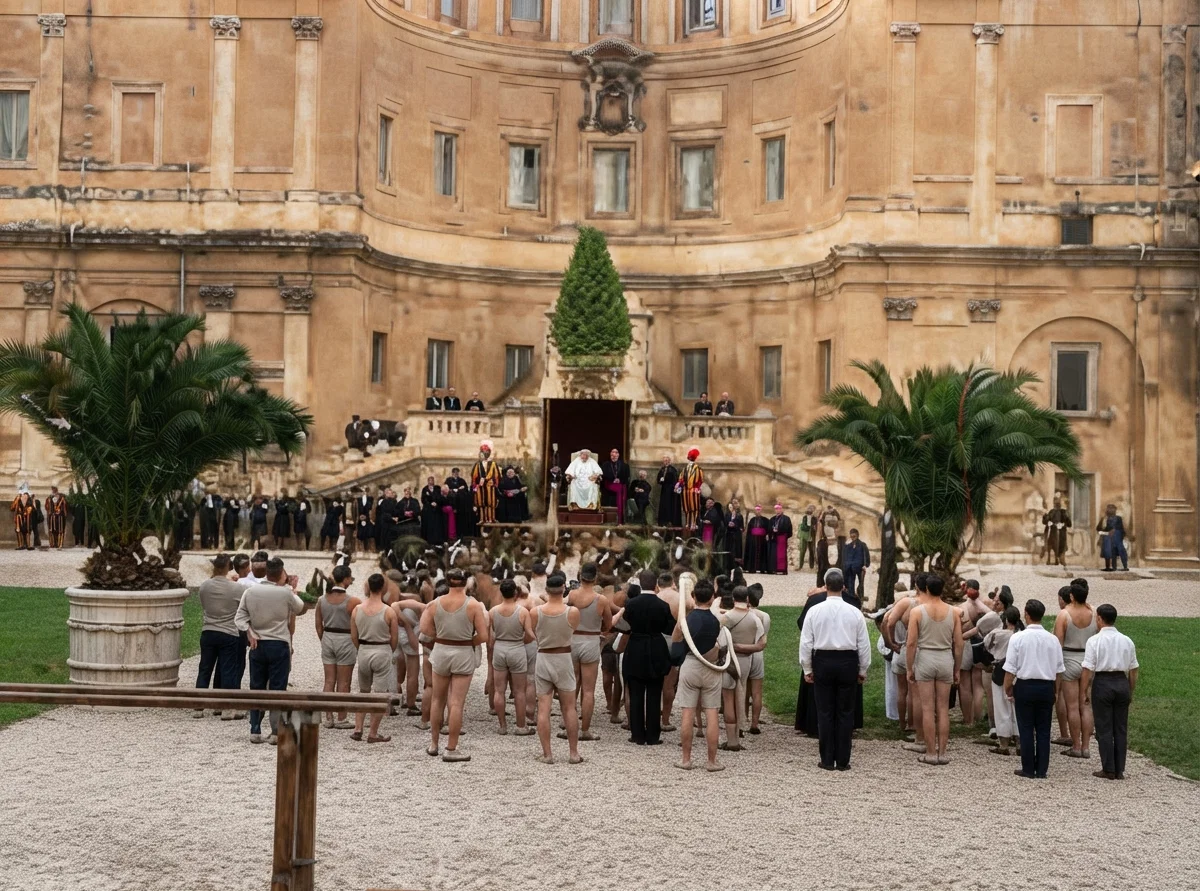
From a Photograph of Sports in the Vatican before the Pope, who is dressed in white in the center of the background.
Sports in the Vatican.
The prelate makes it plain that no real change in the Papacy is contemplated, but only a slight modification in its method in order to keep up with the progress of society. In fact, a short time ago the Catholics of the old school were almost scandalized by the new departure that was taken towards introducing into the Catholic societies a régime of gymnastics and out-door sports.
The pope took the initiative in this matter by inviting the young people's societies to give an athletic performance in his presence at the Vatican. The church had been accustomed in the past to frown upon anything that savored of athletic sports and therefore this new move caused a storm of comment from every side. And now the young priests can9be seen in the public parks playing football. Among other comments that appeared on the subject was a comic poem written by a prominent Italian poet. He was himself a student for the priesthood when a young man, and in his poem contrasts the dreary seminary life of the past with the present, and speaks thus of the innovations being introduced:
But now, my dear children, there is no more the sorrowful time of that ecclesiastical austerity, but the style of the modern seminarists is to come in short breeches to perform gymnastics. And all are now members of the Christian democracy. And soon we shall see the holy muscles* playing at football and in the wolf chase.
These changes have helped to strengthen the church's hold on the young men of the country. As I have said, the church is making some changes in form in order to keep in tune with the present conditions.
This question was put to a leading priest of Rome: "It seems that the Papacy has broken to some extent the iron bands that separated it from the world?" He answered:
It is a great mistake to say that there has been an iron band separating the church from society. The church is ever cautious, prudent, and watchful. It can not put itself in accord with errors, but it loves the erring and follows them near at hand. It watches for the times to ripen, and when they arrive at the point to offer good prospects for society, it blesses and sanctifies the progress and gives it new impulses and tries to make it more Christian. The modern society is easily offended and touchy, and it is necessary to use much indulgence in dealing with it.
It is evident from these statements that the church has the same attitude toward society as in the past, but is ever watching its opportunity to ingratiate itself into its good wishes and make it "more Christian," which means to make it more Catholic. The present policy of the church, therefore, is to try to lay aside to some extent the rod of iron of the past and use more indulgence until the times ripen. Its aims have not in the least changed, but it has modified to some extent its means of attaining them.
The Papacy and the Italian Parliament.
A prelate was asked the question, "Does the Papacy intend to reform the Italian Parliament?" He answered:
And why not? By reforming the Parliament the nation will be reformed. Because, "Regis ab exemplo totus componitur orbis" [to the example of the king the world conforms itself].
Its designs, therefore, upon the government remain the same, and it still sighs for the restoration of its lost power. For while recently the Papacy has accepted from the Italian Government the money for its Italian missions which it has refused since 1870, yet it has not even in this respect been willing to recognize itself as in any way obligated to the government. It accepts this money without in the least relinquishing its claim on Rome or renouncing its intention of again setting up its temporal dominion. For as one Catholic journal says, "Pius X., like Pius IX. and Leo XIII., strictly maintains the rights of the Holy See."
So that from whatever point of view one looks at the present attitude of the Papacy it is evident that it has not in the least changed its aims nor committed itself to a modification of its principles, but it has only varied its means of obtaining its object in conformity with the times.