Untitled article

7%

Pacific Press Publishing Company · Mountain View, California · Jul 15, 1908

FromSigns of the Times, Vol. 34, No. 29.

Read the full edition

The Beginning of the Inquisition in Portugal, No. 4
[The following article in four parts is not from some ancient tome written by some prejudiced Protestant; it is from the Illustracao Portugueza of June 18, 1906, a popular magazine of Lisbon, Portugal. We do not print it because we have aught of enmity or ill-feeling against one single Roman Catholic in this world. We have warm friends among them; we pray for them all. Many of them are Christians, far better than their creed. We publish the article to show a logical outworking and legitimate fruitage of the union of church and state. The members of the Roman Catholic Church are like other men and women by nature—neither better nor worse. If that church had not assumed to legislate and execute for God and demand that the state should submit to her creed, she would not have authorized the Inquisition. The Inquisition was but the logic of the church's claim and demand for power to punish heresy. Let all men take heed. Let those "Protestants" who are seeking religious legislation in behalf of Sunday learn the lesson. The translation of the article is not finished English; it has too much of the idiom of the Portuguese, but it does not misrepresent the original.]
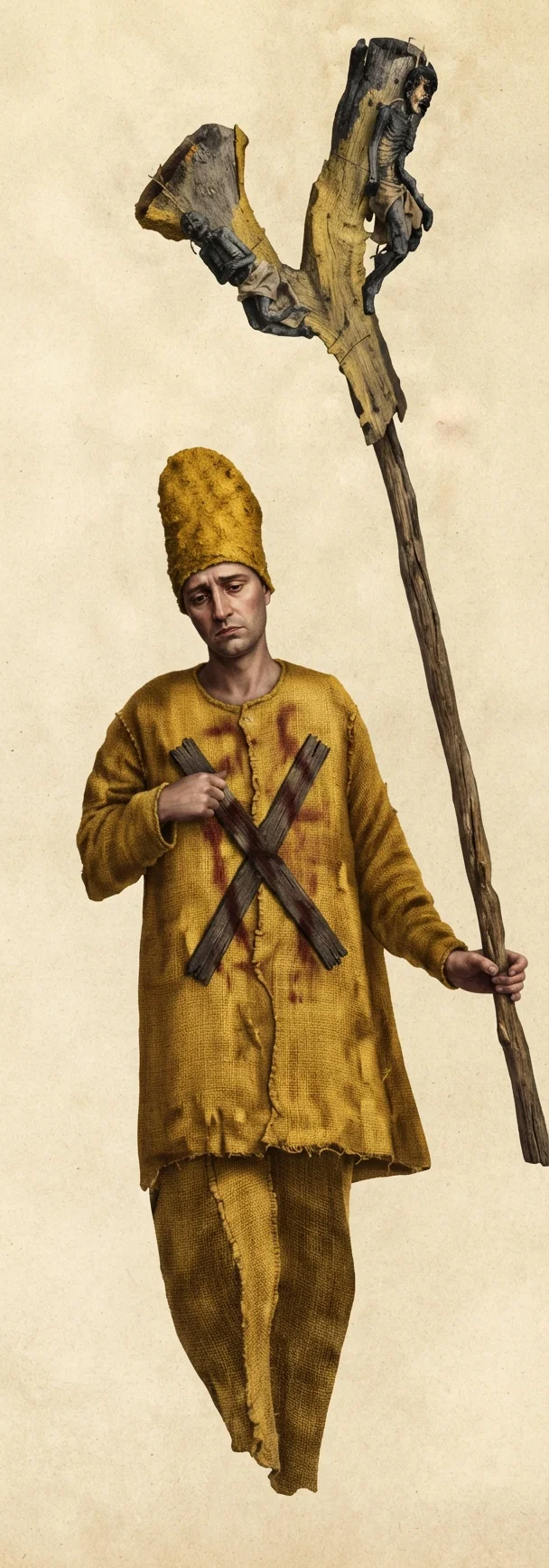
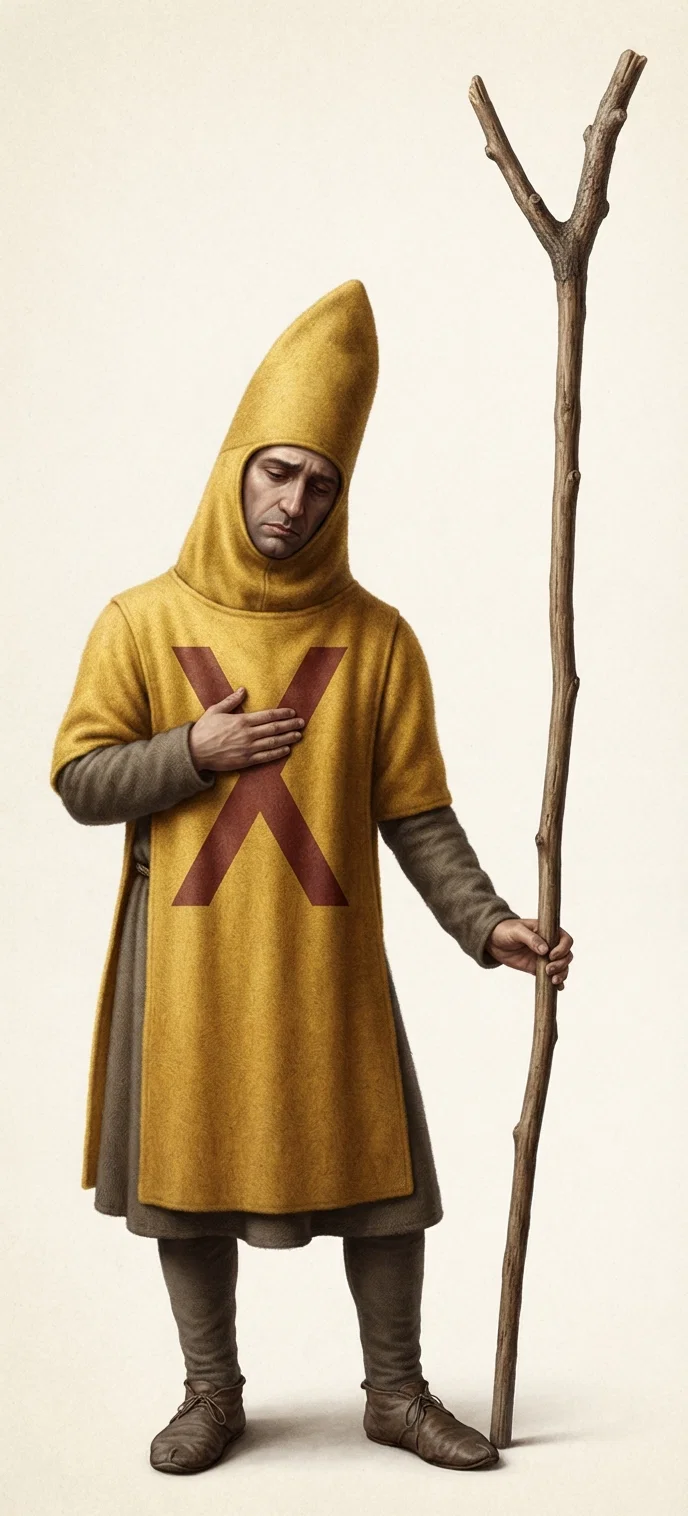
F the person confessed the crimes that he did not commit and asked reconciliation with the church, he saved himself from death when these crimes were not of formal heresy; he remained subject merely to infamy, confiscation of goods, inability to obtain employment in public charges, and appeared in the first auto de fe in a yellow garment with an aspa, or large X marked on the front if he was violent; with half aspa colored dark-red, or cross of St. Andrews if he was vehement; and without an X if he was light suspect.
This sambenito, or escapulario, was the penitential "habit" of the heretics, and differed from that of those who were reconciled or those released to the secular arm. These last, the relapses, the feigned confessed, impenitent negatives, and formal impenitents, appeared in the auto in corocha, or miter, and yellow sambenito with designs of flames of fire pointing downward, if the person was hanged, and burned after death; with flames ascending and figures of devils painted on the "habit" if the person was to be burned alive.
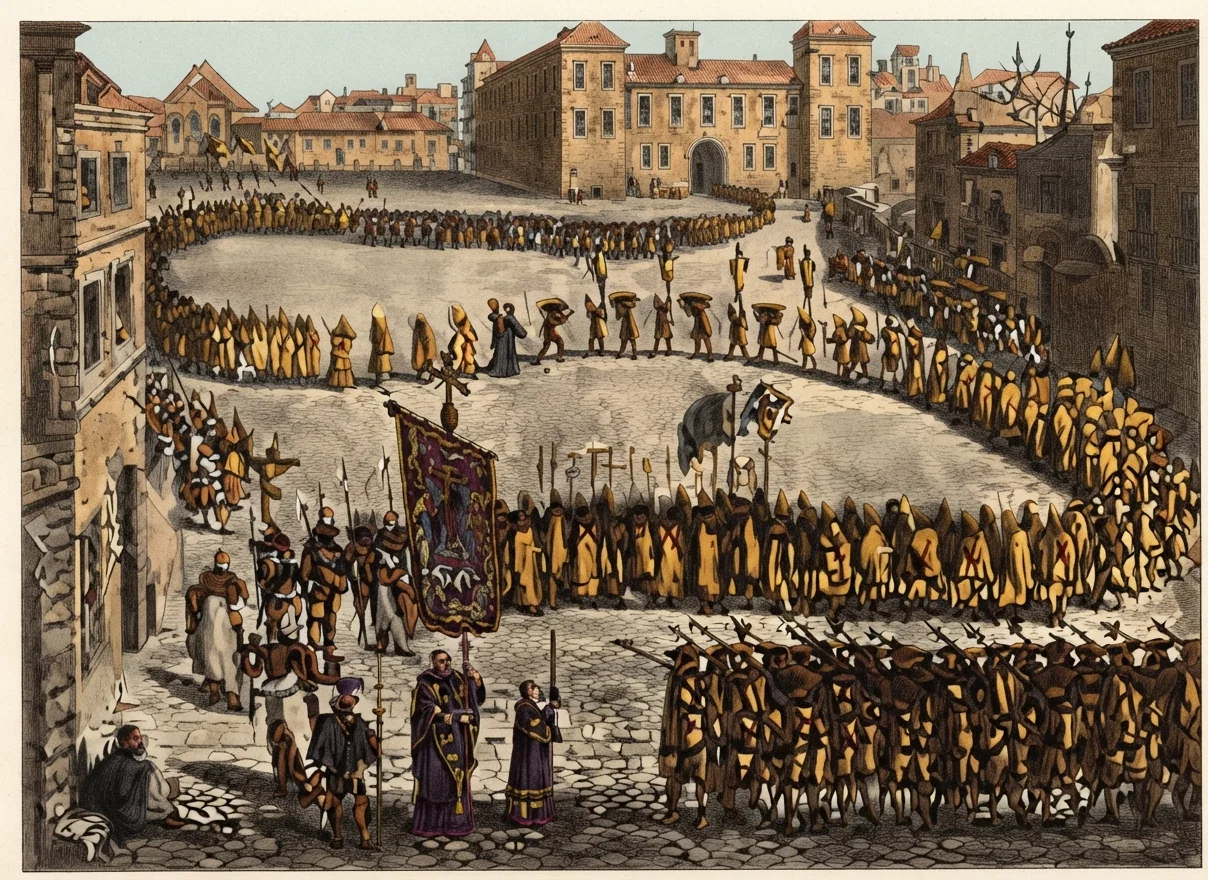
In any of these hypotheses, whether he was reconciled or released to the secular arm, the culprit walked barefoot and with lighted torch in his hand in the procession of the auto de fe. This mournful procession was made with the greatest pomp and display above everything in the sixteenth and seventeenth centuries.
In Lisbon the procession went out of the palace of the estaos, where was installed the tribunal of the Holy Office, and directed its way to the open space of the palace of the Ribeira, where frequently the platform was set up for the reading, by the solemn relator, of the summaries of the processes, in the presence of the king, inquisitor-mor, nobility, familiares, and ordinary judges who had to receive and order the released impenitents to be executed.
A Heretic Going to Die at the Stake.
The cortege was preceded by an escort of harquebusiers and halberdiers, who in the cremating act served to carry wood; following them were the Dominican monks, with raised cross—an enormous crucifix with a bloody and contorted image of Christ; immediately after went the standard of St. Domingos, red, with a figure of the Holy One with a flaming sword; after the standard another crucifix, covered with crepe; the familiares of the Holy Office in black and white, with their long mantles and crosses of the order bordered with gold; the attendants in cloaks and hoods; barefoot penitents in ecclesiastical tunics and corocha bound to the confessors; and last, closing the cortege, the statues of the absent fugitives condemned by the inquisition, and of the relapsed impenitents, or fictitious confessed, dead in prison or in the torture, whose bones, conveniently cleaned of all flesh, followed in small tumbas behind the effigies to be consumed in the fire.
Another View of the Pompous Procession of the "Auto de fe" from the Palace of Estaos in Lisbon.
It was the 20th of September, 1540, in Lisbon, in the square of the palace of the Ribeira, that the first regular auto de fe took place. D. John III and the Cardinal D. Henrique, then inquisitor-mor, assisted. Mass was said. The king, putting his hand upon the Gospels that the cardinal presented to him, purpled and trembling, swore to defend the faith and annihilate heresy. Then commenced the lugubrious ceremony.
The formal heretics and the repentant relapsed, with their yellow samarras, where the cross of St. Andrew opened its bloodied arms, were compassionately hanged, and their bodies thrown into the fire. The final impenitents, non-reconciled, tied to wooden posts upon immense fogueiras, which the soldiers kept stirred up with long pokers and lances, writhed and hoarsely screamed in the flames—to the manifest enjoyment of the king, inquisitors, monks, and people.
There was wind on this afternoon, and the smoke blew away from the sufferers, robbing them of the merciful asphyxia; the unfortunates already had their legs carbonized,—the iron ring that imprisoned them to the post was red-hot,—and still they cried and still they screamed, still they writhed and still they lived!
Finally everything was finished. The last ashes flew over the river Tagus; the last curious one dispersed; the night fell like a black pall upon the feasting city; and among the tapestries of the palace, after the solemn banquet, the king, a bloated and imbecile fanatic, illuminated with evangelical rejoicing, kissed the hand of the chief inquisitor, thanking him for the delight that the first regular slaughter of the new Christians was to the kingdom: "Very contented I was, brother and lord cardinal, for the first auto de fe that thou orderedst."
The Dress Turned Wrong Side Out, Worn by One Who Was Garroted First and Afterward Burned.