To the young child there is no pleasure quite equal to that of roaming thru the fields and woods, of taking a trip on a railway, of walking "down town" at evening, of taking a look at the varied animals in a menagerie, of visiting some center where machinery almost thinks and speaks, of turning footsteps toward the house of worship on a lovely Sabbath morning, indeed, of going anywhere or doing anything by the side of a manly, communicative father.
For the father, one half, probably, of life's changeful pathway lies behind him, among the lengthening gray shadows. Before the other it stretches out, and out, now over the flower-carpeted mesa, now up the billowy, green hills, limiting the view before him, now amid tempting orchards and gardens, laden with fruits ofttimes deceptive and destructive.
The one has studied a copious and many-hued lesson-book, with results as lasting as life. By the other, life's lesson-book has barely been opened.
The boy feels this difference distinctly. The broader knowledge, the larger experience, the wiser judgment, of the father draw him, awaken his confidence. The father has learned where are the dangers, the pitfalls and snares, the worse than wild beasts lying in wait for prey. Among them all he is a devoted guide and companion to his child—son or daughter.
And what stands at the doorway of all this care and caution?—It is parental love, which, to the end of life, makes childhood memories as fragrant as sweet violets. It is sympathy, too, welcome to young hearts long before the word mirrors to them the sweet fellow-feeling it expresses.
The father who deprives his children of his society because he is too busy to give time to them, because he dislikes to be annoyed, because he craves leisure, because he finds other company more agreeable, robs them of an inestimable natural right.
As well attempt to foretell the number of blossoms a plum-tree will put forth next year as to forecast the consequences—to children—of dereliction so unmanly. Some of these results, like first-ripe oranges, come early in the season. Others, like the blossoms of the poinsettia—Mexican Flame leaf—may not blaze forth until life's winter sets in. Certain of them may recur daily as does hunger.
Compared with a father of that type, the armed burglar who relieves a casket of its valuable jewels, or a trusted bank president who steals from depositors thru years of unquestioned confidence, were innocent men. Mere theft of money or of rich gems would seem but light criminality beside pillage so heartless.
It is subtracting moral support while the pliant twig of character is making woody fiber. It is depriving a child of that indefinable satisfaction which ever springs from being the companion of one older than himself. It is removing strong example—thru knowledge and experience—before steadiness and firmness of conduct have become the child's own habit.
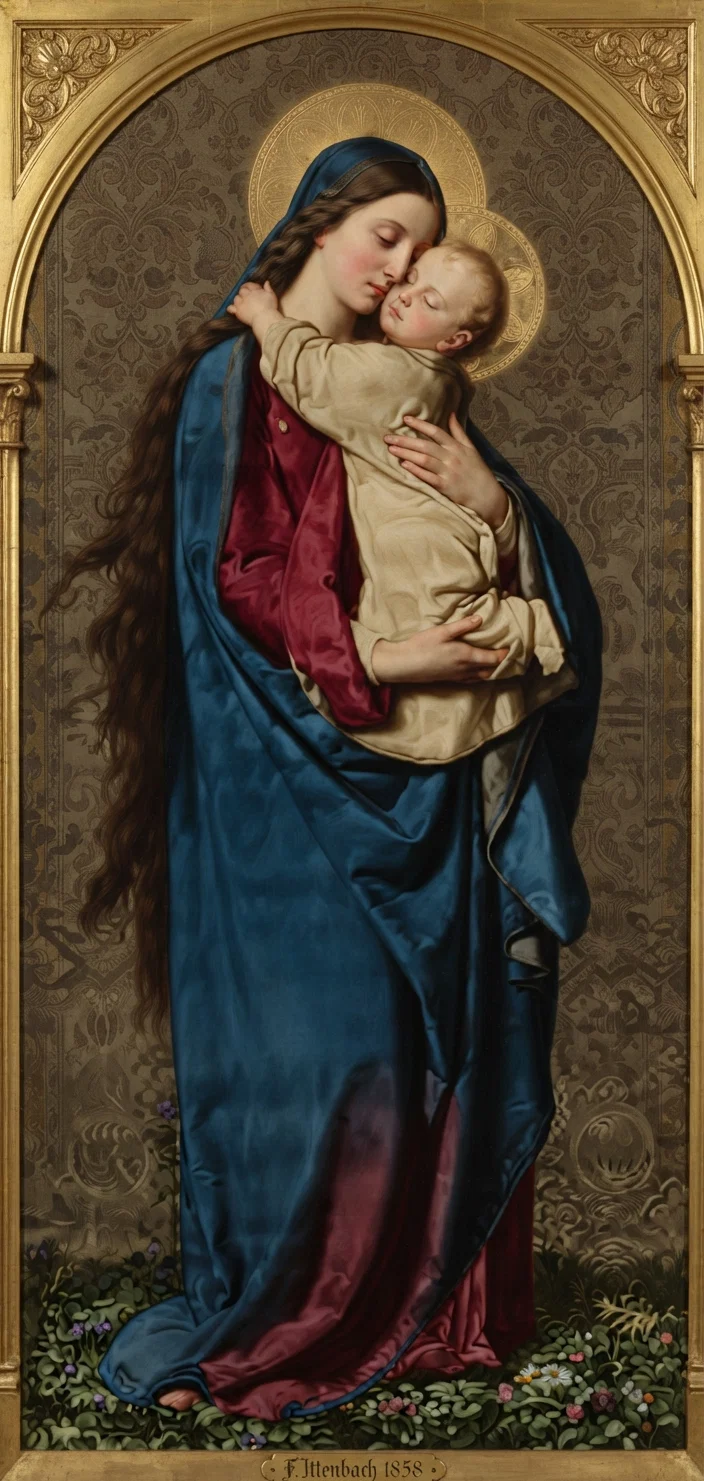
F. Ittenbach. Madonna and Child Representing Parental Love.
Many fathers omit these prized attentions to their children in their younger years, thinking them too infantile to appreciate such services, but fully intend to be more dutiful in that respect as the little ones become older. This is simply failing to sow seed in spring-time. Can a harvest follow?
Before such fathers are aware, their grave omission becomes a perilous fault. Their unwise course continues until their children have passed childhood and youth. Then, having lived in poverty of fellowship at home, they welcome a life out in the world, and, in some cases, will return to the old fireside only from a sense of duty, or because the mother, with larger foresight, has made herself doubly companionable, and thus draws them with a force stronger than that of the magnet.
Men are not as scarce as cherry blossoms in winter, who think that, having toiled all day in shop, factory, store, or bank, they are free to pass the evening at some hotel, saloon, club room, public reading-room, or at some place of amusement. And this they suppose they do "for the development of their social nature"! Scarcely an hour of the week—except those spent in eating and sleeping—is passed at their own fireside, the one place best adapted, in most instances, to the cultivation of one's social nature.
What is the outcome of such a course?—First, as to the man himself: He turns from the pure joy which should spring from his relationship to wife and children, to the dangerous alloy found in the tempting resorts; he turns away from fine gold to accept baser metal. Just as the hop-vine twines away from the sun, so he winds away from home, the very center, or should be, of social light and warmth.
Yes, and such men, grasping freedom from care for themselves, forge all the more closely strong fetters for their wives. Married life, even when rightly lived, brings burdens heavy enough for the shoulders in partnership. If one pair withdraw from under them, the greater becomes the weight upon the other.
Still more serious is a third aspect of the case: There are children in these homes. The very fact of their presence entails momentous responsibilities. They have set out upon a sea wide and subject to storms. Not one of them understands the art of vital navigation. Each one needs to be taught how to handle an oar or how to manipulate a sail; how to steer by the infallible compass, God's word; how to discern where lie the hidden rocks, and where the devouring whirlpools, and what to do to insure entrance to the haven of havens on life's final shore.
Dropping all figures and illustrations, let us inquire: Have not the children of a household an inherent right to all the help and companionship which the necessary occupations of the father will permit? Have they not a right to the happiness which his added presence makes complete?
The imparting to the young travelers of joy, sympathy, training, example, and support, is the labor and duty of two. It requires the total right influence of father and mother to guard and guide successfully son or daughter. Children are equally the treasure of husband and wife.