"Let the Revelation speak and tell what is truth. . . . Uplift Jesus as the center of all hope"
V. The Church in Ephesus
We begin this week the study of the internal or spiritual conditions of the church of God from the days of the apostle to the end, presented before us in the symbols of seven churches in Asia, characteristics of which, together with the names perhaps, were symbolical of the whole church throughout her career.
First, it is well to note that while the symbols are of individual bodies of believers, local in the apostle's day, they do not symbolize organizations, but conditions. There were no such hard and fast organizations in the apostolic times as have been developed by men in subsequent periods. The important thing in God's sight then and now and always was character and service, character in service for the salvation of souls and the glory of His name. Conditions in these simple organizations in Asia Minor were symbolical of different periods and conditions in the churches as a whole.
Then, too, we can not mark a definite time when one condition succeeded to another. Sometimes they telescope each other or overlap or are contemporaneous. The most that we can do is to indicate the approximate time when a condition began and could be said to be evident and prominent.
Some of these conditions apply to individual believers in all ages. This is indicated in the seven-times repeated exhortation, "He that hath an ear, let him hear what the Spirit saith unto the churches."
The promises to the overcomer are likewise to all overcomers, even as our Lord is to all what He reveals Himself to each; but the revelation of Himself and the promise to each church are especially fitting to the condition represented by the church named. For instance, all overcomers will eat of the Tree of Life, all will have the new name, all will reign with Christ; yet these promises are peculiarly appropriate to the class to which they are addressed. Keeping in mind the foregoing suggestions will help to our understanding of the messages to the churches.
The Answer of the Book
[The answers to the questions are from the American Revised Version. Omitting questions, and disregarding sometimes the capitals at the beginning and the period at the close on an answer, the text may be read continuously. In notes and comments both versions are used without designation.]
1. To whom is the first letter addressed?
"To the angel of the church in Ephesus."
2. Who sends the letter?
"These things saith He that holdeth the seven stars in His right hand, He that walketh in the midst of the seven golden candlesticks."
3. What words of approval does He speak to Ephesus?
"I know thy works, and thy toil and patience, and that thou canst not bear evil men, and didst try them that call themselves apostles, and they are not, and didst find them false; and thou hast patience and didst bear for My name's sake, and hast not grown weary."
4. What reproof does He bring to Ephesus?
"But I have this against thee, that thou didst leave thy first love."
5. What earnest admonition does He give?
"Remember therefore whence thou art fallen, and repent and do the first work."
6. What would be the consequence if the admonition were rejected?
"Or else I come to thee, and will move thy candlestick out of its place, except thou repent."
7. For what other thing did He commend Ephesus?
"But this thou hast, that thou hatest the works of the Nicolaitans, which I also hate."
8. What call does He make for attention?
"He that hath an ear, let him hear what the Spirit saith to the churches."
9. What is the promise to the overcomer?
"To him that overcometh, to him will I give to eat of the Tree of Life, which is in the Paradise of God."
Notes on the Text
1. To the angel.—The word "angel" means messenger, and is applied in other scriptures to men, but in the Revelation it invariably refers to a spirit being, whether good or evil. To God's heavenly messengers is given charge over things earthly. This is especially emphasized throughout this book. We see no reason, then, why the message from the Son of God to the churches may not be addressed to the angel over the particular church addressed, he representing that church with her ministers. "Ephesus."—The city of Ephesus was one of the largest and most important in Asia Minor. Here was the great Temple of Diana, or Artemis, one of the seven ancient wonders of the world, marvelous in its richness and structure. In this city was raised a strong church of God. See Acts 19. It is not the church of Ephesus, but in Ephesus; literally "to the Ephesian assembly." The name denotes "desirable," and fittingly symbolizes the first stage of the Christian church, down to about the year 100, when love began to wax cold.
2. The Sender of the letter is our Lord, holding the seven stars (the angels, 1:20) and walking among the candlesticks (the churches). He thus shows His care and knowledge of His people. And He who knows and cares is always ready to help.
3. "I know thy works."—A wonderful assurance, whatever may come, if the soul is true to God; but a fearful thing to the soul unfaithful. God knows our works, our motives. That early church did not have an easy time. Her course was marked by toil which demanded patient endurance. She was true to God. She knew His Word, and by that Word could weigh the hollow, false impostors and reject them. Let the church hold ever to the sinful, sinning soul as long as she can help him and her own faith hold dominant; but when he will not be helped, when he would lead others astray, let the church find him false and reject him. The same apostle through whom God gave the Revelation and who was minister of the local church at Ephesus writes: "If any one cometh unto you, and bringeth not this teaching, receive him not into your house, and give him no greeting: for he that giveth him greeting partaketh in his evil works." 2 John 10, 11. It may well be believed that our ultra Higher Critics would have found cold welcome at Ephesus. That early church proved true to God, bore the cross for Christ's sake, and did not grow weary of her burden. Happy indeed is that church who can receive such approval from the Master.7
PATMOS
4. "Somewhat against."—O, it is an awful thing for the Perfect One to have aught against us; because however slight it is, it will stand. He seeks our justification, not our condemnation, and He can not condemn unless eternal justice and righteousness demand it. He does not condemn because we are unlovable, because He does not like us, because of our height or color or social condition, because of any whim or prejudice; but solely and always because we identify ourselves with sin, and it would as truly prove our destruction to justify as it would to condemn. It is a sad thing to lose one's first love, ardent, warm, tender, impulsive yet constant, solicitous, anxious for the work of God, unselfishly, joyfully sacrificing for others' salvation. The first love ought to be preserved for deeper, truer, sweeter experience. To lose or leave one's first love, is to lose all joy in Christian life.
5. "Remember, . . . repent, . . . do."—There is but one way to regain that first love, and that is the Master's way. Remember where you wandered from the way, turn again to the Wronged One, and do the first works. How did you do at first?—You went as a poor, wretched, fallen sinner, confessing your sin and pleading for your cleansing. He heard you, welcomed you, forgave the sin, bestowed upon you the Spirit of adoption, and smiled upon you; and there was born within your heart the new, sweet, first love of the soul to its Saviour. Would you have that love restored?—Do the first works.
6. "Or else."—There is but one alternative. To return is to live. To fail to do the first works is to admit some rival in your heart to Jesus Christ. Then you can give no light to the souls in darkness, your candlestick becomes useless. You let the light die out, and the Master must remove the dead candlestick, and put in its place one which holds the burning, shining light of His Gospel. Even so it was with that early church. Falling in her first apostolic love and zeal, philosophy and formality took the place of life and religious zeal, and the candlestick was removed. A persecution came upon the church, and the true souls in Ephesus passed to Smyrna.
7. "The Nicolaitans."—An immoral, corrupt sect said by some to have sprung from Nicolas (Acts 6: 5), one of the seven deacons, who apostatized. Some say that it was based upon a wrong conception of his too liberal teaching. Others hold that the sect were followers of another Nicolas. Generally, however, it is held that their teaching was corrupting, making no distinction between meats offered to idols and clean meats, and permitting a plurality of wives. God hated these deeds of the flesh which doomed to death the doer; so also did Ephesus.
8. The Spirit.—The letters to the churches are from Jesus Christ, but they are inspired and pressed home by His Spirit. Do not slight His Spirit's teaching.
9. The Tree of Life.—It is first mentioned in Gen. 2: 9, a tree in the midst of the Garden of God, perpetuating life by its wonderful fruit. When man sinned he was barred from the garden and tree, because God would not perpetuate sin. Gen. 3: 24. That Garden of Eden planted of God, it is not unreasonable to believe, was removed from the earth till that time when all God's creation shall be redeemed from sin, and the curse forever removed. Then will the Tree of Life again be upon the earth, and to it all God's children shall have access. Rev. 22: 1, 2. (See also 2 Esdras 7: 26.) That tree is a fitting symbol of Jesus Christ and the Word of God, even as His children are called "trees of righteousness." Isa. 61: 3. The overcomers in Ephesus, who have by faith fed on Christ, shall be actual partakers of the Tree of Life. The promise is the pledge of a universe free from sin.
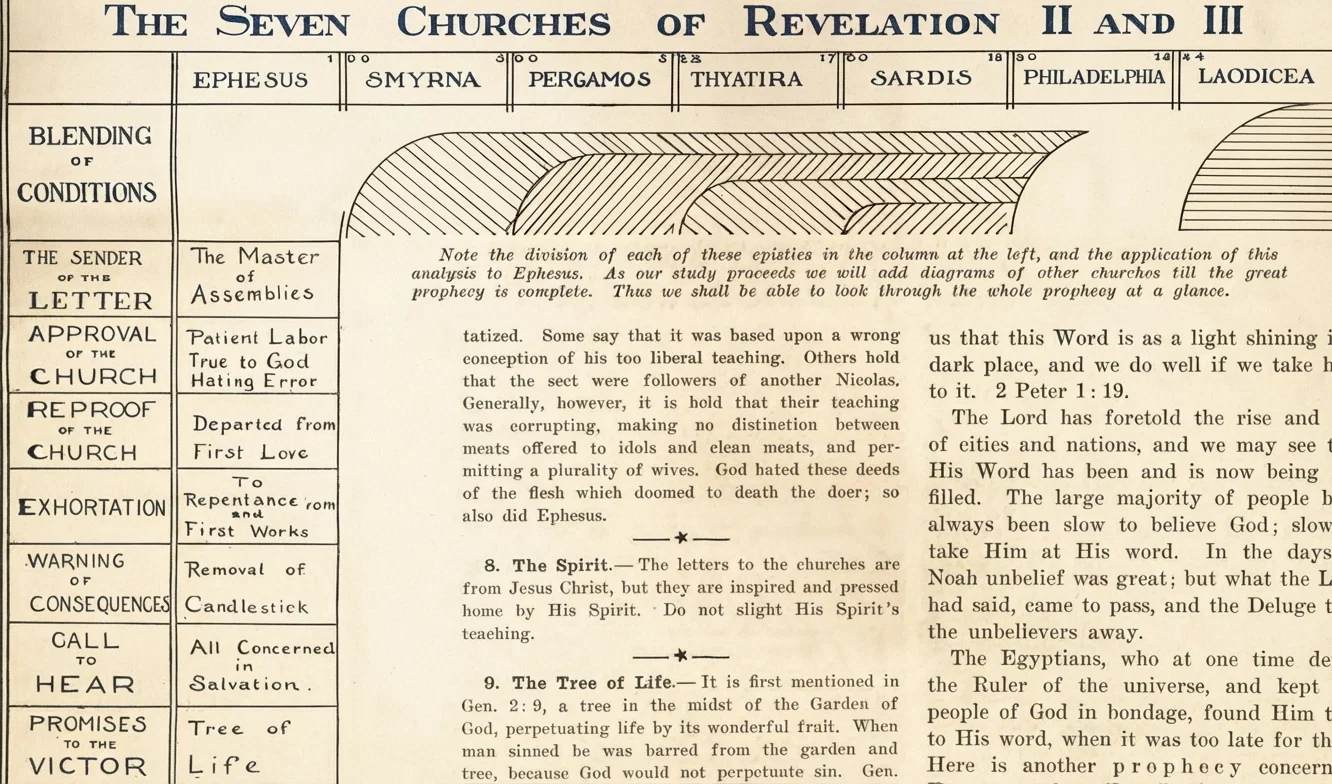
Note the division of each of these epistles in the column at the left, and the application of this analysis to Ephesus. As our study proceeds we will add diagrams of other churches till the great prophecy is complete. Thus we shall be able to look through the whole prophecy at a glance.