Man's Sin and Saviour

9%

Pacific Press Publishing Association · Mountain View, California · Aug 23, 1910

FromSigns of the Times, Vol. 37, No. 33.

Read the full edition

Man's Sin and Saviour

By E. J. Hibbard

VII. The Sanctuary a Type of Actual Things to Come
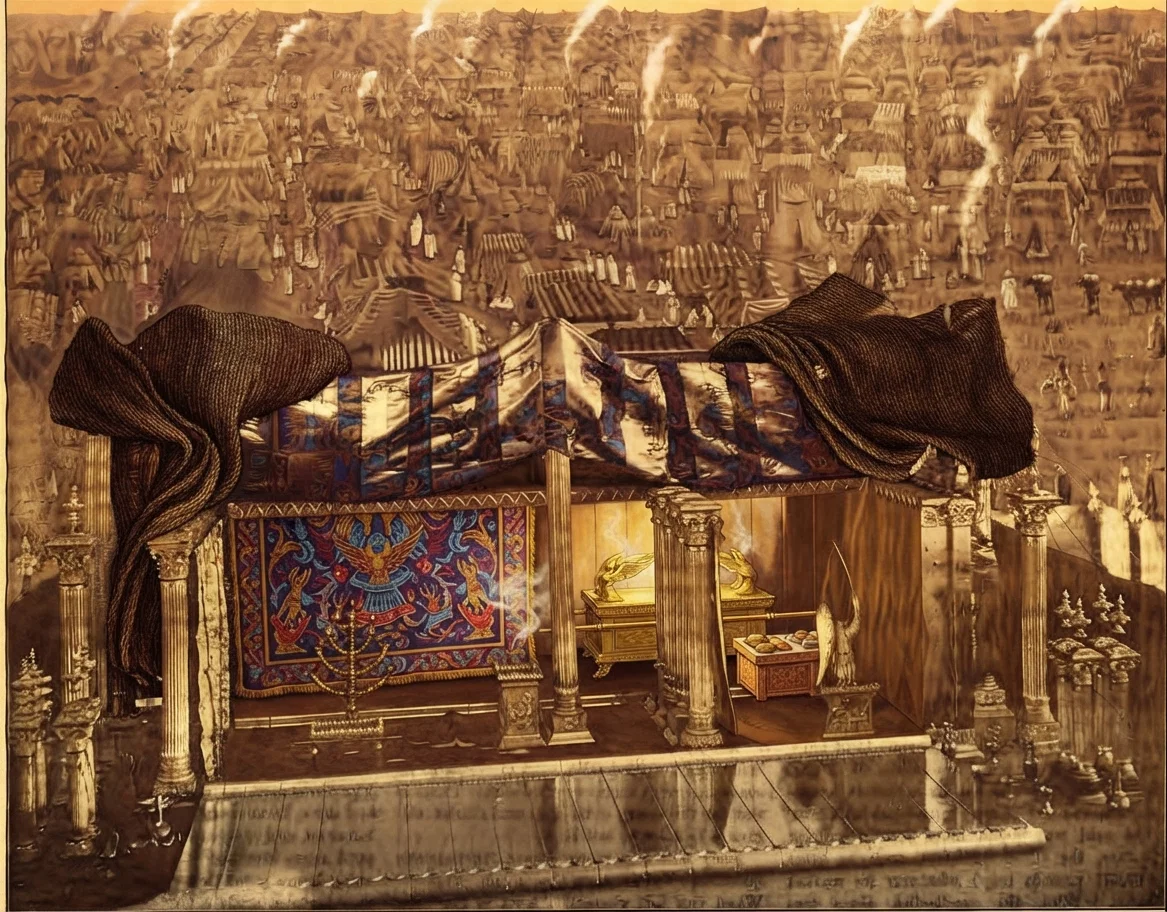
"According to all that I show thee, after the pattern of the tabernacle, and the pattern of all the instruments thereof, even so shall ye make it." Ex. 25:9. "And look that thou make them after their pattern, which was showed thee in the mount." Verse 40. "And thou shalt rear up the tabernacle according to the fashion thereof which was showed thee in the mount." Ex. 26:30.
THE SANCTUARY UNCOVERED, SHOWING FURNITURE, WITH TENTS OF ISRAEL IN BACKGROUND
It is here definitely and repeatedly demanded by Jehovah, that the tabernacle to be erected under the hand of Moses, and "all the instruments thereof," be made according to a "pattern." And that "pattern," we gather from other scriptures, is a real tabernacle, and an enduring, having its location in the heavens. For "we have such an high priest, who is set on the right hand of the throne of the Majesty in the heavens; a minister of the sanctuary, and of the true tabernacle, which the Lord pitched, and not man. . . . For if He were on earth, He should not be a priest, seeing that there are priests that offer gifts according to the law: who serve unto the example and shadow of heavenly things, as Moses was admonished of God when he was about to make the tabernacle: for, See, saith He, that thou make all things according to the pattern showed to thee in the mount." Heb. 8:1-5.
From these plain statements we glean that the sanctuary and priesthood ordained of God through Moses, were an exact pattern or shadow of the heavenly sanctuary and the priesthood of Christ. This in itself fills the matter, at once, with the most profound interest. But the details of these comparisons we reserve for future studies.Tho the sanctuary on earth was but about forty-five feet long, fifteen wide, and its height only equal to its breadth, yet on the inside, by means of the mirrored reflections, like that of any room set with mirrors on all sides, the expanse thereof was infinite, a fit symbol of the "greater and more perfect tabernacle, not made with hands." Heb. 9:11. In fact, instruments like those of the earthly sanctuary, such as the ark of the covenant, or testament, the seven lamps of fire, the incense, etc., have all been in the temple in heaven, and the record is left for our perusal and enlightenment. See Rev. 11:19; 4:5; and 8:3, 4.

The Ark of the Covenant

It is worthy of more than passing notice that, after the command had been given Moses to ask for a voluntary offering from the children of Israel, that material might be gathered for the tabernacle, the pattern of the true, and after the fashion had been first mentioned, the very first thing asked for in the whole elaborate affair, was the ark of the covenant. And more space is given to the details of this than of any other one thing. This account is found in Exodus 25, verses 10 to 22. Twice, also, in this account we read: "And thou shalt put into the ark the testimony which I shall give thee." Verses 16 and 21. The "mercy-seat" covering the ark shows that grace is offered the sinner before justice is exacted. The cherubim covering the ark are symbols of the real and living ones who stand continually in His presence and are often sent on errands of mercy, as was Gabriel to Daniel, to Zacharias, and to the virgin Mary. "And the angel answering said unto him [Zacharias], I am Gabriel, that stand in the presence of God." Luke 1:19. These few references are sufficient to indicate that the whole sanctuary service centered in, and radiated from, the ark of the testament, its contents and covering.

Continued in the Temple

This first sanctuary was supplanted by the magnificent temple built by Solomon; and this, in turn, by the one erected after the return from Babylonish captivity. But one and all of these, besides being a shadow of the heavenly sanctuary and ministry of Christ, were also shadows of His life on earth, His ministry and sacrifice here. This is doubtless what He meant when, after He had purged the temple of its traffickers, during the first Passover after His ministry began, and the people asked Him, saying, "What sign showest Thou unto us, that Thou doest these things? Jesus answered and said unto them, Destroy this temple, and in three days I will raise it up. Then said the Jews, Forty and six years was this temple in building, and wilt Thou rear it up in three days? But He spake of the temple of His body." John 2:18-21. As the first tabernacle was covered, outside, with badgers' skins, and was plain and unostentatious, so of Him it is written, "He hath no form for comeliness; and when we shall see Him, there is no beauty that we should desire Him." Isa. 53:2. But the beauty of Christ was within; and even so was it true of the tabernacle. It may be of interest, since the Israelites offered willingly the materials needed for the tabernacle in the wilderness, to know something of the value of their gifts, as money is now valued. The amounts of gold, silver, and brass are given in Ex. 38:24-29. The total weight of the three metals, avoirdupois, was more than ten and one half tons. The gold was worth more than a million dollars, the silver $225,000, and the brass (10,277 pounds troy) whatever its market value. Why, the candlestick alone was beaten from an entire talent of gold, and contained over $35,000 worth of the precious metal. This willing offering makes it plain that the Israelites of that age, whatever their defects, were at least generous toward the God of heaven whenever He made a request of them. And this is a state of mind rarely found, as God's professed worshipers average in this our day. A consideration of the sacrificial offerings will be subject-matter for our next.