Shiloh: the Man of Sorrows

3%

Pacific Press Publishing Association · Mountain View, California · Aug 23, 1910

FromSigns of the Times, Vol. 37, No. 33.

Read the full edition

Shiloh: the Man of Sorrows

Chapter XXV.—Rejected by His Own
ABOUT three days after this occurrence at Nazareth, Bar-jona the fisherman was at home in Bethsaida, and with his customary enthusiasm, he related the strange experiences. The members of his family, Sylvanus, Esther, and Perpetua his wife, gathered about him to listen. Matthias was also present; for having followed the Master as far as Nazareth, he had thence proceeded to Bethsaida, to visit his parents.
Over this otherwise happy family, always rested a shadow. Poor Heber lived and wandered a wild, demented outcast. But we will listen to the tale of Bar-jona.
"I had not intended to visit Nazareth," he began; "but after the Master had departed thither, I followed Him. On the day before the Sabbath, the preparation day, at about the tenth hour, I reached Nazareth. On the principal street of the village I found many people assembled, to whom Shaphan the rabbi and his son Tubal were speaking, that they might turn the hearts of the people from the Master, whom they called the 'Pretender,' by speaking lightly of those miracles which He hath already done. But on the morrow—the Sabbath day—the synagog was crowded with an anxious and inquiring multitude; for most of the people understood plainly that Shaphan the rabbi was bitterly opposed to the new Teacher, and in truth they wondered what the outcome would be, for they knew of His presence in the village, and expected that He would be at the synagog on the Sabbath.
"Now, Rabbi Shaphan, the possessed of a bitter and ungenerous disposition, hath great influence over the people, for he hath a learned and eloquent tongue. When the third hour of the day had come, Rabbi Shaphan took his place. The congregation stood with solemn faces toward Jerusalem. The customary eighteen prayers were recited, and the responses faithfully echoed in their proper places by the worshipers. The first lesson of the day, on the law, was given. Then the minister of the synagog, standing by the side of Shaphan the rabbi, at his suggestion, handed the roll of the prophet Isaiah to the Master; and verily," continued Bar-jona, "I have never seen the face of the Man so like unto the face of a god."
"What read He, my son?" questioned Sylvanus; "for of a truth the prophet Isaiah hath written many words concerning the Messiah. What read He?"
"Thou rememberest the place, my father, where it is written, 'The Spirit of the Lord God is upon Me; because He hath anointed Me to preach good tidings unto the poor; He hath sent Me to bind up the broken-hearted, to proclaim release unto the captives, and the opening of the prison to them that are bound, and to proclaim the acceptable year of the Lord.'"
The face of the old man Sylvanus lighted up with a deep joy as Bar-jona repeated the words of the prophet.
"Ah, my son, let us rejoice and be glad in the Lord; for, behold, we know how that John the Baptizer hath been shut in the prison-house at Tiberias, by Herod Antipas. Now of a truth this Jesus of Nazareth, the Shiloh for whom Israel hath long waited, will go to Tiberias and fetch thence the prophet; and thus will He open the prison to them that be bound."
"Even thus I have thought, my father," responded Bar-jona, "for the Man is very great, and His ways are marvelous. Verily, I have thought that He must soon go up to Jerusalem and take the throne of David—but already He speaketh words which I know not, and which I can not understand;" and the speaker bowed his face in his hands and paused a moment, as if trying vainly to recall some spoken word of his Master.
"Come, come, Bar-jona, thou art a dreamer!" exclaimed Perpetua. "Verily we wait to hear thy words concerning that which befell at Nazareth.
"As soon as the Master had finished reading these words," resumed Bar-jona, "He sat down; for even thus ye know that it is the custom among us when one would teach in the synagog. The words of the Man were marvelously gracious, and even Shaphan seemed at first constrained to listen unto Him.
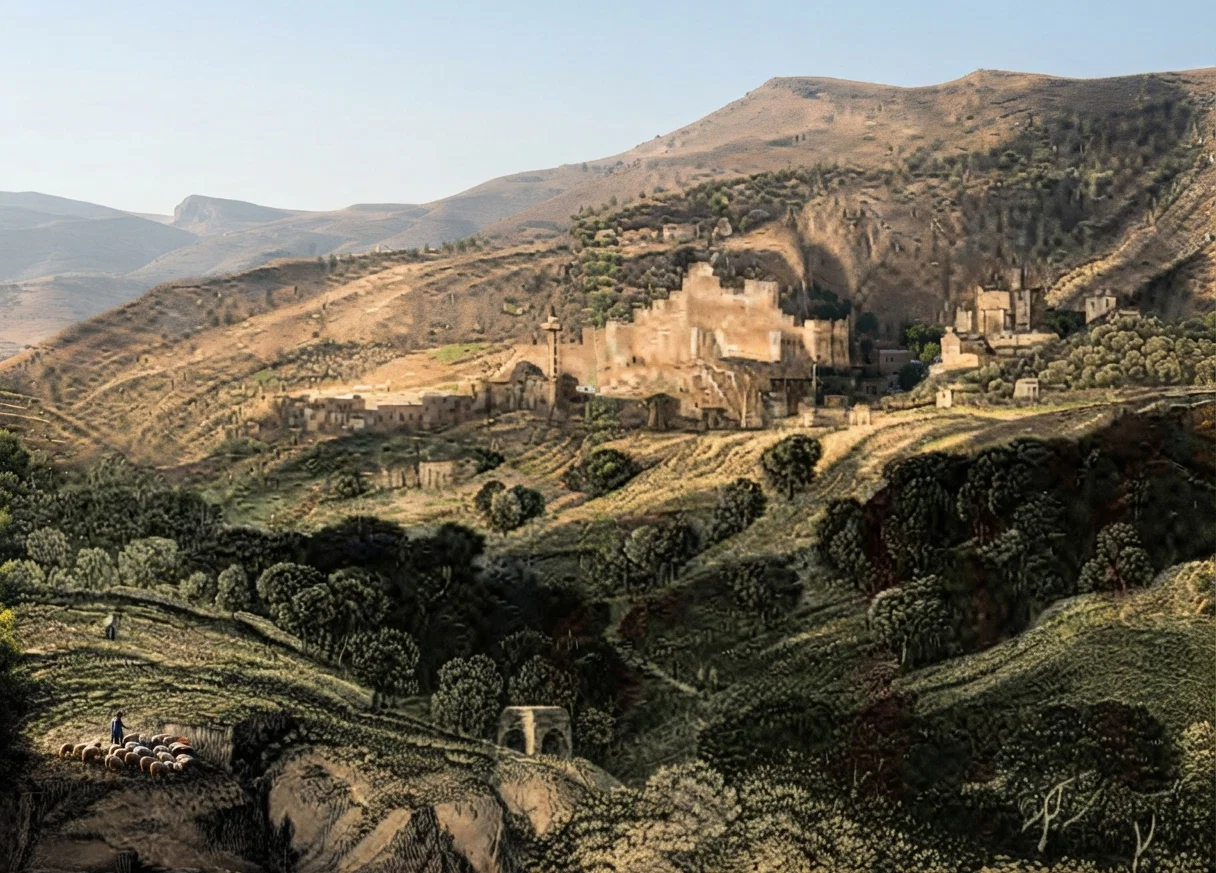
Nazareth, from a steel-engraving by F. Finden with drawing by A. W. Colcott
"'This day is this scripture fulfilled in your ears!' declared the Master; and verily He seemeth to be able to read the secret thoughts of the heart; for He said unto the people: 'Ye will surely say unto Me this proverb: Physician, heal Thyself. Whatsoever Thou hast done in Capernaum, do here in Thine own city.'
"And when He had said this, each man looked into the eyes of his neighbor astonished,—for even thus had he thought. But the Man continued speaking to the people: 'Elijah the prophet was not sent to any of the widows of Israel, but unto a woman who was a Gentile. Neither were any of the lepers of Israel healed, tho there were many; but Naaman, the Syrian, he was cleansed.'
"Even thus said the Master; and indeed I understood not His words, for it was as if Jehovah favored others also as well as the seed of Abraham. Even as I listened to His words, I myself was sorely perplexed thereby;" and Bar-jona glanced inquiringly at Sylvanus.
The old man had listened intently, but for a full minute none made answer. Then Sylvanus replied, while his voice shook with the intensity of his feeling:
"There be many things, Bar-jona, which as yet neither thou nor I may understand. But verily the Almighty doeth well, tho His ways be hid in clouds and darkness. Truly the seed of Abraham be the chosen people,—but if Israel choose not the Lord, then must He raise up unto Himself another people. But even as He is infinite and we be finite, how can we understand His full counsel? But what did the people, my son?"
"What did they? As soon as the Man had thus said, a loud, shrill cry filled the synagog from the one end even unto the other:
"'The Man blasphemeth!' I turned and looked upon the face of Shaphan the rabbi; for behold, it was his voice, and his countenance was like unto that of a demon. The usually yellow, parchment-like face was purple with rage, and the sunken eyes glared horribly. At once Tubal, his son, took up the cry, which was echoed by a band of men whom I had seen in close conversation with the rabbi and his son the evening before. One of these men I especially recognized. Dost thou remember, father Sylvanus, the day when we were with Simeon the prophet, and he died, that there was a man named Demas, whom the high priest had sent to spy and to listen to the words of Simeon in his own house?"
"Yes, and verily the fellow followed us and railed upon us even till we came to the gate of the city,—more than a score and a half years ago."
"Yet I knew the man,—the same cowardly eye and blatant manner,—the spy Demas. This man and his fellows took up the cry of Shaphan and his son. In a moment of time it was as if the synagog were filled with demons. Almost every mouth cried out against the Nazarene.
"'To the cliff with Him—to the cliff!' screamed Shaphan, and the words were echoed by the excited multitude: 'To the cliff with Him! to the cliff with the Blasphemer!'
"A thrill of horror almost stopped the beating of my heart. I looked to find a friendly face in the multitude, but verily I found none save a few women with wild eyes and horrified faces, and a man named Uriah. In a moment the rabble was upon Him. The infuriated rabbi and his son, together with the man Demas, were in the lead. Quick as thought their murderous hands were upon Him. My father, before I knew what I did, my fingers were at the throat of the foremost—the ruffian Demas. Behind me hurried Uriah, he of the kindly eyes. I know not what I might have done, had not the eye of the Master arrested me. He spake no word. But in that glance I read pity and forbearance and love unspeakable, infinite—and this for the hardened mob which sought His life. Verily I saw the shining forth of an almighty power.
"When I saw this, my hands fell helpless at my side, and I heard the man Uriah, who was close behind me, cry: 'Verily, thy Master is the Son of the Eternal God—why should we protect Him? Of a truth the Almighty will protect His own!'
"By this time the crowd had reached the highest point of the cliff, and were about to hurl the Nazarene downward. I knew this must be certain death,and turned me about, for verily it seemed that I must put forth my strength to save my Master; but when again I turned my startled eyes toward Him, behold, He was gone!
"I called His name: 'Master, Master!' fearing that He had been slain by the mob. But the look of astonishment and baffled rage upon the faces of the rabble, told me that their Victim had escaped them, and that the words of the man Uriah had come to pass; for indeed the Almighty had preserved His Anointed.
"For He, passing through the midst of them, went His way."
(To be continued)