A Leper Hospital

10%

Pacific Press Publishing Association · Mountain View, California · Aug 23, 1910

FromSigns of the Times, Vol. 37, No. 33.

Read the full edition

A Leper Hospital

WHILE visiting our recently opened mission station at Pakhoi in the very southern part of the province of Kwangtung, which is itself in the southern tier of provinces of this empire, I had the privilege of visiting a leper hospital. This is the first hospital of the kind I ever visited. There may be others in China maintained by foreigners, but this is the only one I have known of, and I am sure there is no institution of the kind maintained by the Chinese, notwithstanding the fact that there are a great many of that unfortunate class.
Pakhoi is a small city, or more properly, a village. It has no wall about it, and all such cities in China are accounted as mere villages, tho in some cases their inhabitants may number hundreds of thousands. But what is still more to its disadvantage, Pakhoi is a rather poor place, resting on poor soil, and hence has little traffic by sea. Fishing is one of the main means of living, and it may be due to this fact that there are many lepers in that place, since it is held by some that the free eating of salt fish tends to leprosy. It should be said, however, that the lepers that are in the hospital are from a considerable circle of country around.
The hospital is under the management of the Church Missionary Society, tho the funds that are used in its support are largely from private sources. From a humanitarian point of view I never saw any enterprise that appealed to me as this one did. If any living or dying member of this sin-cursed earth needs friends and succor, the leper is surely of all men that one. The slightest acquaintance with this devouring death is sufficient to excite the sympathies of the most callous, and one can easily understand how the Saviour's heart was touched when He said in response to the leper's plea for help, "I will; be thou made clean."
The unfortunate inmates of this hospital number about one hundred fifty. Of that number about one hundred are men and boys, and the rest are women and girls. The sexes are of course segregated, and no communication with the rest of the mission is allowed. The houses and quarters that have been provided for these unfortunate beings, are models of sanitation, light, and ventilation. Everything is on the ground floor, and the floors are of cement, so making it a simple matter to clean and disinfect. All the furnishings are the most simple and plain, and yet admirably adapted to the needs of the patients. Well-ordered lawns, made cheerful and bright with a considerable variety of plants and flowers, that are kept by the lepers themselves, have been provided for both the men and the women. In addition to this there is attached to both the men's and the women's wards a considerable garden for the raising of vegetables. In this way the patients are afforded the much-needed exercise; and working in the open in the midst of the fresh growing things of nature, their minds are given soothing relief. They furthermore have the pleasure of eating of the fruit of their own toil.
Different lines of work have been introduced that employ the hands and minds of the patients and at the same time contribute to the support of the institution. The men make baskets, brooms, tubs, and books. A considerable volume of literature in the Cantonese Romanized is issued from this press. The women make lace and the like. All these articles are thoroly sterilized before they are exposed for sale. All the patients are taught to read, and a considerable time is spent in the study of the elements of knowledge, tho the Word of Truth is given the first place, and I was pleased to see them respond heartily to a few remarks I made about the great salvation provided for us in the sacrifice of our Saviour. Some, I was told, are very earnest and zealous in teaching to others the way of life.
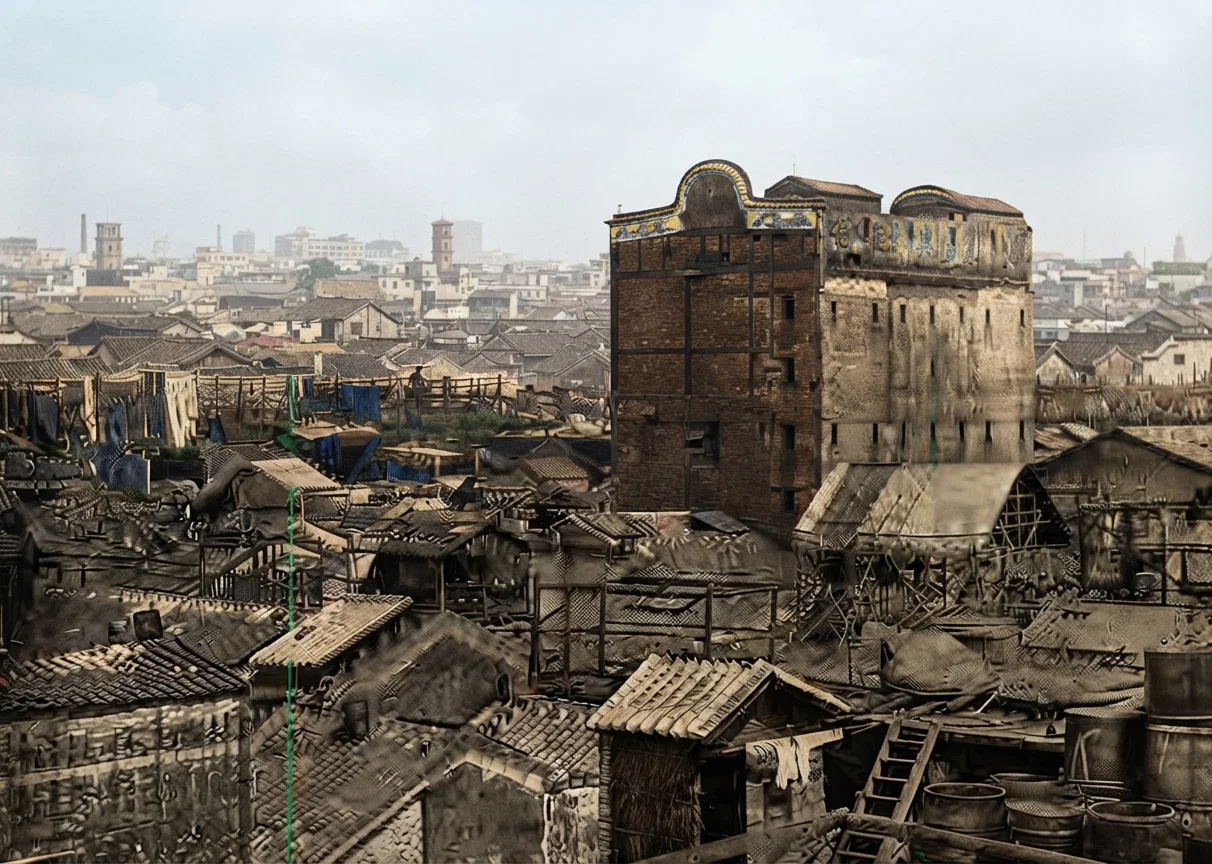
A View in Canton, China. The tall building is a Chinese pawn-shop, an entirely respectable concern, everywhere noticeable by its height. Beyond to the left are dye-houses with racks on roofs for drying clothes.
Are any of them ever cured? To this question the physician in charge, who has had considerable experience in that line, replied that he never knew of a case under his care, and further that he had never heard of a case. The general tendency of the disease is constantly downward, tho there are intermittent periods when the progress of the disease seems to be arrested, but this is only seemingly so, for, once the favorable period is past, the patient sinks lower than he was at any previous time. Usually the disease lays hold of the extremities, the hands and the feet; but in some instances it begins in the throat, a more vital part of the body. Oftentimes the hands or the feet must be amputated, which in a measure stays the progress of the disease. The patients are quite willing to part with their members in order thus to gain a little advantage in the battle with their relentless foe. They even make their own wooden legs, and it excites admiration to see how well these serve the objects of the lost members. In most cases the hands are affected, and it is pitiful to see the patients laboring with a fixed determination to make those distorted and oftentimes half consumed fingers do their appointed work. This is especially true of the women who make lace.
Strange as it may seem, these poor, miserable creatures seemed to be cheerful and content with their lot. The patience of the Chinese is proverbial, yet it is difficult to understand how people in such a plight can be anything like hopeful. The awful ravages of that relentless disease it would seem must crush the spirit of any human being. Socially they are the very dregs of the race, and must be counted as the outcasts even by those who would minister spiritual and physical benefit to them. They are held by a disease that not only fills their own lives, but overflows to all who may come into contact with them. But thanks be to God, they have access to the Lord and Saviour Jesus Christ, and there they can have the very same great blessing that the sacrifice of Christ has made common to all mankind. In this respect they are on a common footing with all of us, and what a glad privilege to be the possessors and the bearers of this so great salvation.
J. N. ANDERSON.