IN 1898 the late John Clark Ridpath, the historian, thus expressed himself regarding what he called the "Universal Monarchy," or the "Invisible Empire:"
"Not a nation in the world is exempt from the dominion of the Universal Monarchy. The political autonomy of every one has been surrendered, openly or covertly, to the will of a ruler whom none have seen, but before whom every state and principality, every republic, and kingdom, and empire, bends a supple knee. . . .
"More than twenty thousand millions of war debt resting upon the nations of the world! . . . Twenty thousand million of debt, and every dollar of it owned by the Invisible Empire! The interest at four per cent amounts to eight hundred millions of dollars a year. And it is intended that this principal and this interest account shall run forever. While civilization continues — as long as mankind shall be organized into nations — so long will this intolerable incubus rest day and night on the labor of the world. Under the horrid nightmare every working man in every country under the sun becomes and remains a slave. It is needless to say that such a debt will absorb the entire property of the world. It will drink the ocean dry. It will suck up, at the rate of eight hundred millions a year, the whole wealth of mankind, and then demand another planet to satisfy the vacuum in its infernal maw."
Matters have not improved since Mr. Ridpath penned the above. The power of wealth has increased by great leaps and bounds, and the destinies of nations are still held by the Universal Monarchy. It is no longer the Invisible Empire, it is coming out more and more in the open. When men like the late E. H. Harriman, the living John D. Rockefeller, John Pierpont Morgan, H. C. Frick, and others hold within their grip the very necessities and commodities of life in the greatest republic and the greatest country in the world, what folly it is to talk of freedom! Of course in a way men are free; in another way they may be free altho bound within the innermost cell of the mightiest prison on earth — free in Jesus Christ. But that country can not be called free which is held by a few plutocrats who are drawing their wealth from the masses.
In the last month a new money trust was formed, headed by John Pierpont Morgan. It includes among its strong men George F. Baker of the board of directors of the First National Bank, New York City; James Stillman, chairman of the board of directors of the National City Bank; William Rockefeller, vice-president of the Standard Oil Company; Henry C. Frick, capitalist; and William K. Vanderbilt, the representative of his family interests. The wealthy Guggenheim family, vastly rich in power in the mining and smelting world, are allied to both Standard Oil and Morgan interests. And it is also reported that James J. Hill, of the great Northwestern Railroad group, has close relations with the houses of Morgan and Baker, for Mr. Hill is a director of Mr. Baker's bank.
Then, too, the great Harriman estate is in friendly alliance with the trust. The Morgan house has control, through stock companies, of the following trust companies: Bankers, Equitable, Mercantile and Guarantee, and the Liberty National Bank. The three largest banks and the three largest insurance companies in the country are included in the trust as allies. They alone, we are told, furnish combined monetary assets amounting to more than one billion, five hundred million.
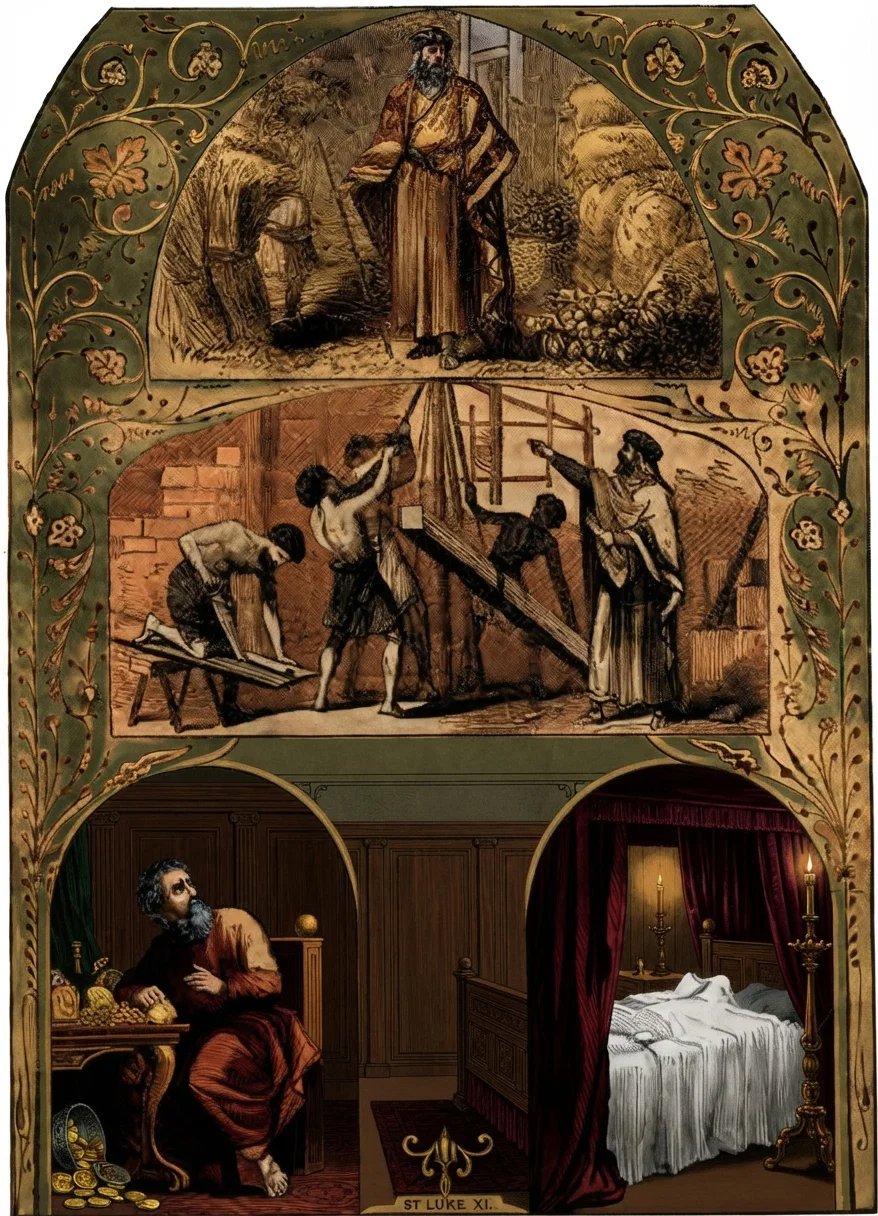
ST LUKE XII.
The New York "World" says that the system of interlocking boards of directors furnishes a remarkable exhibit of community interest, dominating not only financial institutions, but industrial corporations and great railway companies; and then we are given the boards of directors of the Steel Trust, the National City Bank, Farmers' Loan and Trust Company, the great railway concerns, and the American Telephone and Telegraph Company, etc.
The above paper also says: "The chain of financial control is being forged. Each main link has its own connections and dependencies, extending indirectly into every aggregation of capital in the country. Many of them operate independently in their own particular spheres; but like the musicians in an orchestra, when it comes to the ensemble they look to the one leader, the central figure of America's finance — J. P. Morgan."
The amount of this combined capital is astounding. It is impossible, unless one thinks in big figures, as do these great capitalists, to consider it at all. Its vast power if used together is incalculable. No government on earth could stand against it. Of course it is admitted that the vast sum of money is not in actual possession of the money trust, but the tremendous power of the few who control that trust lies in the fact that they are able to sway, to influence, to direct the use of it at opportune or critical times so that the very hints they may give and the lines of policy which they follow would so indicate to other controllers of wealth the course to be followed, that they would have an ever-increasing army of financiers in their wake.
The "World" thus summarizes what such a trust as that could do:
"It could call $200,000,000 of loans overnight, and ruin any adversary.
"It could reduce credits to such a degree as to cause extreme money stringency and great commercial distress.
"It could tie up the cash holdings of New York banks by demanding certificates of checks for enormous amounts.
"It could deplete bank reserves in New York by causing shipments of cash to any part of the country.
"It could make the money rate of interest almost what it chose, from two per cent to one hundred per cent on call loans.
"It could cripple the financial operations of the Government by refusing to purchase any bond issue.
"It could dictate the financial operations of great railway systems and expanding industrial corporations.
"It could and does dictate the terms and executions of every company promotion that is important enough to be financed in Wall Street."
This money trust is unincorporated, unofficered; yet it is tremendously concrete in its operation, and directed by one man — Morgan, with a half dozen capable aids.
It is not before the public as a capitalist company; and yet it commands unlimited capital. It is the most powerful organization in America, and hence in the world.
Right upon the heels of that comes the news that J. P. Morgan accomplished another of his tremendous coups on January 4 by merging three trust companies into one of the greatest banking institutions in the country, a $200,000,000 asset concern, to be known as the Guarantee Trust Company. The companies consolidated are the Morton Trust Company, the Fifth Avenue Trust Company, and the Guarantee Trust Company.
The Springfield "Republican" thinks that the trust may not be so dangerous, altho it might; but the great danger exists in one man's having so much power. It says, December 23, 1909:
"The greater danger, the fundamental one, to be disturbed about, is the existence of the towering individual fortune which gives to the one almost the power of an Oriental despot over the welfare of millions of his fellow citizens. No man is good enough or great enough to be entrusted with power of any such magnitude; and no republic or democracy is strong enough to endure him forever, if he were good enough or great enough to be so entrusted. The way to deal with such a money power as is described by the World, is to effect such reforms in taxation and for the abolition of monopolizing privilege as will make the acquisition of fortunes so great as these, practically impossible."
But can the remedy ever be applied? Lord Weiby, of England, was former secretary of the British treasury. He was asked for a message for the new year by the New York "World." He sees signs of steady progress in America, but he says this:11
"If you ask me if Mr. Pierpont Morgan's new money trust will help you by prudent exercise of the power, I shall ask you in reply, Is Mr. Morgan going to be acknowledged as the virtual and perpetual head of the American state? Of all countries I should have thought that a republic would have been the last to rely upon the extraordinary wealth of one man to preserve its banking system and maintain its credit. I should be sorry to think that the great state of the West is now going to allow it."
Thus an eminent stranger looks upon the dangers to America from colossal wealth; but when the colossal wealth of each of a dozen different men is combined, what evil can they not do if by doing it they can augment their own fortunes?
One of the first moves of the money trust to show its power, we are told, is an ultimatum to President Taft on the one hundred million dollars of Panama Canal bonds, and perhaps the forcing of Secretary McVeagh out of the cabinet.
Another striking fact which seems to have connection with the money power is the recent ultimatum to Japan. In other words, Japan is told that she must not meddle with the Chinese sovereignty in Manchuria, that she may not hold dominion over the railway properties in that Chinese province; and the statement by Secretary Knox intimates that the moneyed powers of the United States, Great Britain, France, and Germany are at the bottom of the decision and are assuming guardianship of the territorial rights of China.
One of the reasons why the monetary powers feel able to place this check on Japan, is the fact that the little island empire is almost bankrupt. At least her own papers indicate that this is the case. The "KoKumin," of Tokyo, says:
"Since the termination of the late war, Japan has paid and will still have to pay upward of one hundred million yen [fifty million dollars] each year in principal and interest. The present financial interest in Japan really represents that of Great Britain a generation ago; but since then the latter has made good all her debts, but the heavy debts of Japan are more than the nation can endure."
The "Hochi," of Tokyo, says:
"At no period in her history has the financial condition of Japan been so depressed as it is at present. Since the conclusion of peace with Russia five years ago, the finances of the empire have been going from bad to worse, and not a single new industrial enterprise has been started. Most of the population are groaning under the increased price of the commodities of life, and are clamoring for a reduction in taxation. The men of capital keep their money idle, and shrink from investing it in commercial enterprises. Should Japan remain in such a state a few years longer, the fate of the empire is sealed."
The "Nippon," of Tokyo, another prominent journal, after saying that some people thought industry would revive in Japan by the close of 1909, continued:
"Contrary to expectations, however, things have turned out just the contrary, and at this moment there is no prospect of business being restored to its former status. . . . Thus the condition of Japan really resembles that of a sick person whose recovery is almost beyond hope."
And this was just what John Clark Ridpath pointed out years ago. It was the determination of the Invisible Empire to involve every nation in the world in debt, controlling these nations by their debts and the amount of interest upon them. There were debts to the amount of twenty billion dollars in 1898.
"The World Almanac" for 1909 gives as the debts of the nations outside of the United States, more than $36,548,000,000; of the General Government of the United States, more than $2,500,000,000; and the public debt of the states, cities, and minor civil divisions in this country in 1902 at $1,864,000,000. Think of it! Think of the vast amount of interest upon this debt, that is eating right into the very heart of civilization! And while these debts are increasing, prices of commodities and necessaries of life are increasing. Wages, too, have increased to some extent, but not to the extent that the cost of living is increasing.
Of course there will be legislation. Men will legislate, and endeavor to check the power of such enormous interests; but they will find it utterly impossible to do it. Yet there will be an end, and God's Word has foretold that end. It has not only foretold the end, but it has given the very conditions which we see in the world to-day as an evidence of the times in which we are living. In the 5th chapter of the epistle by James is a solemn warning to rich men: "Go to now, ye rich men, weep and howl for your miseries that shall come upon you." And then the apostle gives the reason for this,— their riches are corrupted, and their garments are moth-eaten, their gold and silver are cankered, and the mighty hoard itself shall be a witness against them, and shall eat their flesh as it were fire. "Ye have heaped treasure together FOR THE LAST DAYS." He tells us, too, that this vast wealth is piled up regardless of the sufferings of the poor. Just the other day the steel kings met for a supper. It was a secret affair. One hundred dollars a plate was the price. That one hundred dollars a plate would have given four hundred men a good supper.
Not long ago, a bishop, as quoted in the New York "Christian Advocate," told us that the ministers in his diocese averaged only about $240. The cost of three individual plates would have been a welcome additional income to many of the pastors in this diocese. So the apostle James tells us, "Ye have lived in pleasure on the earth, and been wanton; ye have nourished your hearts, as in a day of slaughter." This condition he tells us is in "the last days." He does not advise revolution, or rebellion, or anarchy — nothing of this kind — that is foreign to Christianity. He does present the awful picture of misery and crime and wickedness; but his admonition is, "Be patient therefore, brethren, unto the coming of the Lord."
God notes all the sufferings of the poor. He tells us in this same epistle that He has chosen the poor, rich in faith, and heirs of the kingdom which He has promised,— the kingdom in which righteousness shall rule, justice shall reign, love shall abide. But He faithfully warns the rich in this world, not simply through the apostle James, but through the prophets Amos and Habakkuk, that if these things continue, the time will come when the poor and the oppressed will rise up with such rage and madness in their hearts that the very palaces themselves will be broken open, the wealthy who reside in them will be slain, and their riches scattered.
It is not our purpose to point out political remedies. Worldly-wise men can not agree regarding the remedies; and if perchance they do agree regarding the treatment of the case, there is failure in its application, so that the conditions grow worse instead of better. The prosperity is at the top and not at the bottom strata of society. It is far greater riches coming to the wealthy; it is more pinching poverty coming to the poor. All this sets class against class; and yet all these are the heralds of the coming of that kingdom in which there shall be no injustice, in which God shall be honored by every one, and every soul will find his highest pleasure in ministering to every other soul. To that we point our readers; and the one who trusts in the Lord Jesus Christ, the Heir of the kingdom and the Saviour in time of trouble, is richer than the wealthiest of earth's money kings. And while he may not sway so much power for a little time, his sphere of influence reaches out beyond this world, and takes in all the glories of eternity.