PIONEERS IN RHODESIA

3%

Pacific Press Publishing Association · Mountain View, California · Nov 17, 1914

FromSigns of the Times, Vol. 41, No. 45.

Read the full edition

PIONEERS IN RHODESIA

MORE DESIRABLE THAN SOLDIERS

—DELIVERED FROM THE REBELLION—

RAINED ON MISSION FARM ONLY
By Ross C. Porter
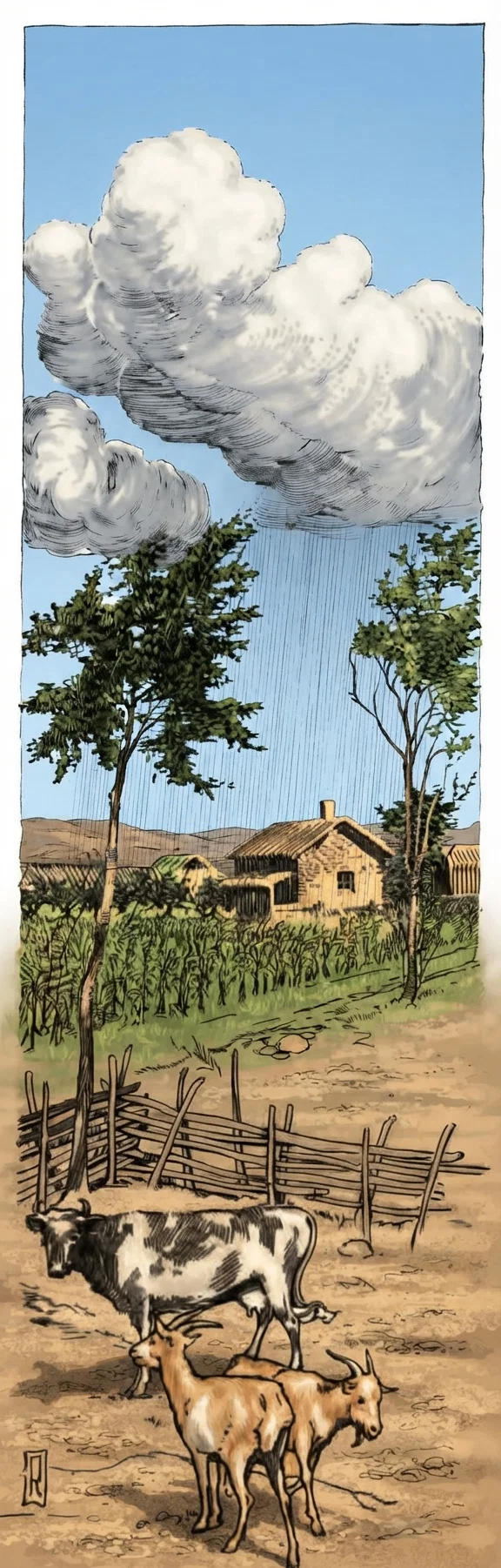
A cloud had hovered over the mission farm for four hours.
IN this article, we have another one of those intensely interesting experiences that came under the observation of Elder Porter when he was pioneering in Africa. He is now in charge of the Asiatic Division of our work. EDITOR.
IN 1894 we began mission operations near Bulawayo. Wild game abounded. The country territory was untilled, wild, and uninhabited except by the native Africans. They were chafing under the restraint of British rule, and waiting an excuse for a further uprising. Fevers were common, and medical attendance was scarce. The procuring of proper food was one of the greatest perplexities to the foreigner.
All mail that reached the government post-office, with the exception of letters, was thrown in a pile on the floor, in a room that was open to the public. Each person had to sort out his papers from the pile; and at the end of the month, all unclaimed papers were dumped into the back yard and burned.

BETTER THAN SOLDIERS FOR THE NATIVES

Providentially, when the late Hon. Cecil Rhodes, Africa's greatest statesman, learned that we were about to open mission work among the Matabele tribe, he secured for us a donation of twelve thousand acres of land, in order that we might conduct our mission on the industrial training plan. In presenting the gift, he said he had learned that missionaries were better than soldiers to keep peace among the natives, and they were much less expensive.
Soon the Matabele rebellion made it necessary for all missionary efforts to be suspended for a time, and all foreigners were urged to flee into Bulawayo for safety. After a fruitless search for rooms in which to live, the three mission families were forced to live in the ox wagon. One family occupied the front end, another the rear, and the third the space on the ground beneath the wagon.

FACING A FAMINE

After five months, the food supply in the city ran short. Prices for necessities were as follows: flour, $37.50 a hundredweight; corn, $25.00 a hundredweight; sugar, 62 cents a pound; eggs, $6.25 a dozen; cabbage and cauliflower, $3.00 to $7.50 a head; butter, $3.00 a pound; canned fruit, $2.50 a quart; with other prices in proportion.
As money ran low, our missionaries decided to risk making weekly visits to the mission farm to have food brought in by the friendly natives. On one of these night trips of thirty-five miles, a gentleman requested the missionary to ride his horse and leave it with the natives, as he could not afford to feed it in town. While passing a range of hills, he was impressed that danger was near. He even heard the still small voice saying, "You are in danger." Putting spurs to his horse, he galloped hastily to a fort near, and put up for the night. While there, he learned that a band of rebels passed the place where he heard the warning voice, about three minutes after he had passed it.

ESCAPED DETECTION AND WERE PRESERVED

Upon another occasion, when one of the missionaries had loaded five donkeys with produce and started on his return journey, the natives keeping up a constant talking, he decided to ride on ahead in order to escape detection if the noise, which he was unable to quiet, should attract the rebels.
When about five miles from town, in the midst of the greatest danger, his donkey, being separated from his mates, began to bray, and regardless of all efforts to quiet him, kept it up until almost to the city. When making later excursions, the missionaries decided to go on foot rather than risk detection in this way. During the ten weeks that these weekly visits were made through the territory under rebel control, they escaped detection, and were enabled in this way to supply themselves with suitable food, thus preserving their health until peace was restored.

A SHINING LIGHT RESCUED FROM THE FAMINE

Famine followed the war, and hundreds of natives starved to death. Children were killed to prevent their starvation. One baby boy was found on the veld by the side of the dead body of his mother. Two other children with fractured skulls were found hidden in a hole near. With this little boy, who is now one of our most efficient Bible teachers in the Solusi Mission, and twenty-nine other famine-stricken children, rescued from death by our missionaries, our mission work began in Rhodesia. Until then, the warnings and the penalties previously given and inflicted, before the British government took control, caused the people to fear to send their children to the mission school. The famine experience was providentially the key that opened the hearts of the Matabele, and from that time they were eager to have their children attend the school.

CONQUERING DIFFICULTIES

The pioneers in mission work had everything to learn. They were in a strange land, among a people of strange customs and a strange language. Their first task was to master the language. Even then they knew little of their undertaking. They had come to bring to the heathen a saving knowledge of the gospel, and to this work they addressed themselves, with too little regard to the care they should take of their own health. This was not on account of carelessness, but the result of a strong burden for a specific work, and is often witnessed in connection with the beginning of great enterprises.
With no suitable home in which to live, their exposure while laying the foundation of their work, the desperate struggle with fevers, their weary watchings between life and death, the burial of companions under the shade of Rhodesia's forest trees, the loneliness that followed, caused by their separation from home friends and loved ones in this hour of their bereavement, were among the experiences of our pioneer missionaries in Rhodesia.

CREATING AN OASIS IN THE DESERT

Their faith was unwavering. Undaunted by adversities, they pressed on. In time the heathen land where their mission station was located, was changed to an oasis. From a barren waste of sand there sprang into life hundreds of acres of cultivated fields of corn, fruit, and garden vegetables in abundance. Modern dwelling-houses replaced native huts, which were, in the beginning, the only available quarters for our missionaries. Beautiful lawns gave to the place an air of Western civilization. School buildings grew with the increase of attendance. A brick chapel to accommodate two hundred native worshipers indicated the influence of the gospel instruction on the students that were regular occupants of the homes of the boarding-school, and other natives in the vicinity.
Work five hours a day by each student was part of the regular curriculum. In this way all received a thorough industrial training, and paid their board and tuition while in school.
Calls for outstations came in from the native kraals for a distance of seventy-five miles from the main station. These outstations were established, and continue with marked success.
During an hour appointed for social worship, I have seen one hundred intelligent, well-dressed natives arise and give testimony to the saving power of the gospel. From six to ten were on their feet at once from the beginning of the service to the close, awaiting an opportunity to testify their appreciation of what the gospel had done for them.

RAINED ON BUT ONE FARM

After twenty years of experience, the Solusi Mission staff decided to undertake to make their mission, with its outschools, entirely self-supporting. This would requirethat $5,500 annually be produced from their industrial farming and dairy. Then intervened one of those tests of faith which are not new in Christian experience. One of the worst droughts of many years set in. Fields were drying up, grass was withering, and cattle were dying of starvation. Apparently the plan of the missionaries was destined to defeat, unless in God's providence these conditions were overruled.
The superintendent of the mission placed the situation before the South African Mission Board, and solicited their united prayers for rain. Prayers were offered, and the following week the superintendent wrote that a most wonderful thing had happened. A cloud had hovered over the mission farm for four hours, giving a regular downpour of rain, while none had fallen on the adjoining farms.
A skeptical neighbor whose farm joined the mission, and who witnessed the exhibition, said it was clearly evident that God wished to indicate His special favor for the work of our mission. Later, the same year, after another special season of prayer for rain, there came a good rain upon the mission farm, and also upon the farms adjoining it. That year the grain commissioner reported that the Solusi Mission furnished more grain for the market than was furnished by thirty farmers combined, operating farms in that section.
The effect of these experiences was soon apparent. Farmers who had hitherto refused to have mission schools opened on their farms, made calls for them, saying, "We are convinced that the Lord favors your mission work by giving you rain in time of drought, while others have none." In all these experiences, it is easy to trace the hand of God leading in the onward march of His last-day message in its mission to lighten the earth with His glory before His second advent.
R. C. P.