The Twenty-First International Eucharistic Congress of the Catholic Church
By C. M. Snow
At Montreal, Canada, September 6 to 11
By C. M. Snow, Editor of "Liberty"
Congress Opened
(Continued from last week)
THE opening of the congress on the evening of the 6th was a spectacular event. The formal opening to the papal legate took place in St. James Cathedral, a church which is an exact reproduction of St. Peter's in Rome, with the exception that it is only one half the size. This cathedral is a work of art in architecture within, and was most beautifully illuminated. Every niche where the most beautiful flowers could be placed was thus decorated. The hundreds of electric lights, the tall flickering candles, the nodding roses, lilies, and chrysanthemums, and the gorgeous apparel of cardinals, archbishops, bishops, priests, and altar boys, made up a scene such as is seldom witnessed in this world. All were designed to impress one with the glory of the Church of Rome and the importance of the eucharist.
With much ceremony the legate was led to the altar and given his place. A chamberlain read the letter of the pope appointing Cardinal Vincenzo Vannutelli as the legate to represent him at the congress. Following the reading of this letter, the cardinal spoke for three quarters of an hour, extolling the sacrament of the eucharist, and depicting what the acceptance of the dogma would do for the world.
The Papal Letter
The pope, in his letter of appointment to Cardinal Vannutelli, had declared that "by this public manifestation, the eucharistic bread, unhampered by space and division, will bind together the lands which the seas divide, stimulate distant nations to vindicate and proclaim the glory of God the Saviour, and to honor with due loyalty and submission the center of Christian unity, to wit, Christ's vicar on earth." This, therefore, gave the key-note to the cardinal legate's address. So he declared:
"Europe extends her hand to America; and this continent, in her sublime fervor, unites with the Old World to exalt together the greatest of the sacraments, under the supreme direction and with the encouragement of the supreme pastor of the church. . . . Why is it proper to celebrate, more especially here in Montreal, these first sittings of the Eucharist Congress which can be called international because it unites, for the first time, the Old and the New World in solemn praise of the eucharist?"
The answer given by the cardinal was that, in the earliest history of Canada, the eucharistic sacrament occupied a prominent part.
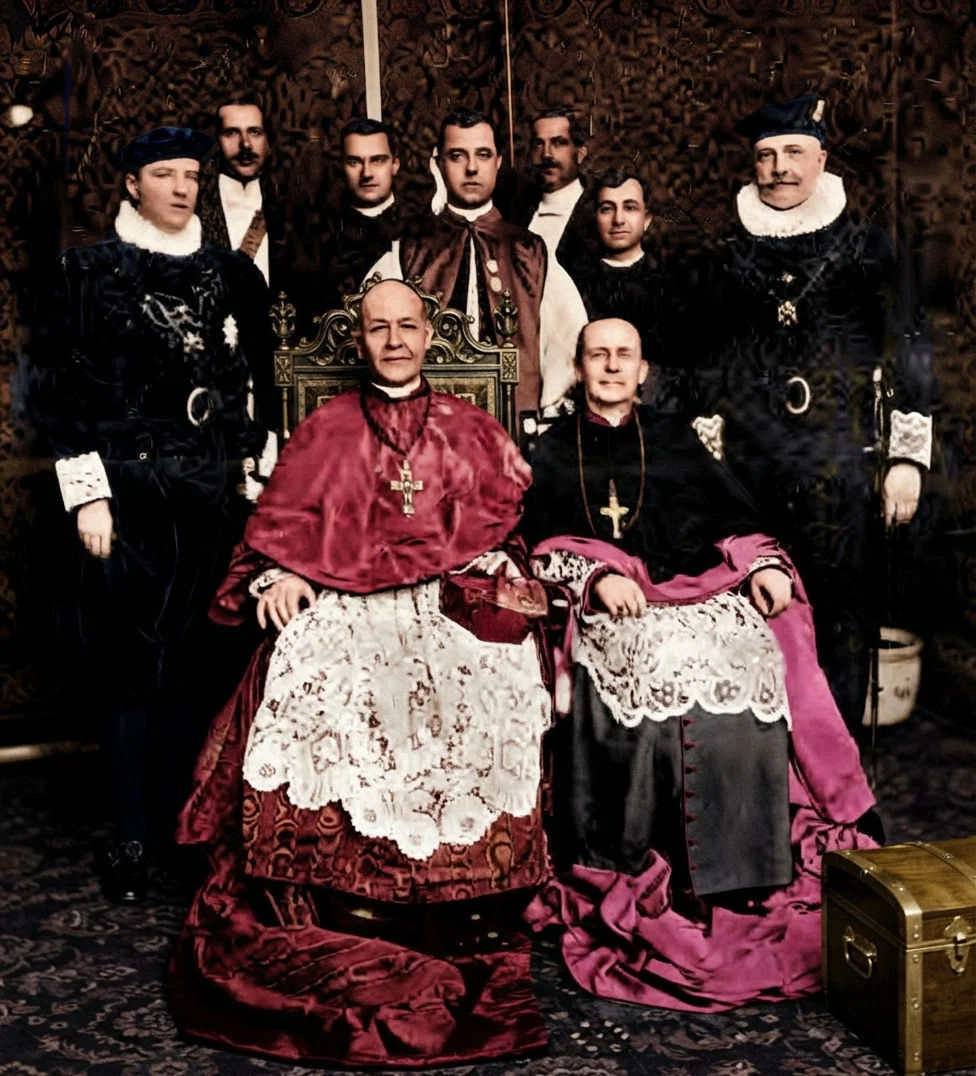
The papal legate with his guard of honor, and the organizer of the congress on his left
But the idea of the Roman Church is, as the two sentences from the legate's address indicate, that the whole world is to be brought into the Catholic fold through the sacrament of the eucharist. In that idolatrous practise the world is to bow to the feet of "the universal pastor," the pope. The High Church of England, as Father Vaughan declared, has already recognized the eucharist as a true sacrifice; and the whole purpose of these congresses is to impress upon the people the absolute necessity of the eucharist in the plan of redemption.
The Purpose of That Church
to dominate the earth was plainly declared by the pope's legate in these words:
"The day upon which He [God] permitted the discovery of America, God said to His church, as He had said to His divine Son: 'I will give thee as a heritage all the nations of the earth; I will give thee all the innumerable populations of these immense regions, and they will be added to those thou already possessest.'"
He prophesied that Canada would become the cradle of a great Christian civilization, the dioceses of which would multiply with great rapidity; and then continued:
"Scarcely two centuries and a half will have passed away [since the settlement of Canada] before Catholic North America will see all these flourishing dioceses attached to the ancient hierarchy of the churches of the Old World. Then the universal pastor, taking directly under his charge these new and immense spiritual domains, will show to an astonished universe the Old and New World realizing before the human race the universality of the church foreshadowed by our Saviour and His apostles."
Weakening Protestantism—Back to Rome
The archbishop of Montreal, in his reply to the legate's address, touched upon the same theme when acquainting the legate with the "extraordinary good-will with which our separated brethren greeted the news of our congress." After mentioning the different ways in which this sentiment had been expressed, he asked: "Is this the awakening foretold by many? Is it a step towards doctrinal unity? Are the old-time days returning? This is God's secret. . . . The civic authorities, as you have seen, have spared nothing to accord a worthy reception to the representative of the holy see. You will receive a no less respectful welcome from our federal and provincial governments."
At the close of the reception the Catholic clergy came up to the legate's throne, bowed the knee before him, and kissed his ring. There was much of this ceremony throughout the congress, the high dignitaries of the church sitting upon the rostrum and receiving this knee-bending and osculatory adoration from the priests and prelates of less degree.
The wide-awake Roman priest can not fail to see the narrowing of the gulf between weakening Protestantism (so-called) and alert, militant Catholicism; and the homage paid the dignitaries of the Eucharistic Congress by civil officials in every capacity could not but convince these ecclesiastics that Rome is winning her way in the New World with tremendous rapidity; and upon America they are depending as a chief factor in leading the11tions of the Old World back to the feet of the Roman pontiff.
One of the most impressive scenes of the whole Eucharistic Congress was the procession of Catholic children from the church of Notre Dame to the St. James Cathedral to receive the papal blessing at the hands of the cardinal legate. There were between 25,000 and 30,000 of these Catholic school children in line. Those of the girls who had been confirmed during the present year wore their long confirmation veils of some white material that fell nearly to their feet on all sides. There seemed to be several thousand of these. Every child carried or wore some sort of papal emblem, most of them carried the papal or pontifical flag. The girls came first in platoons and by schools with their black-robed and rosary-bearing teachers; and these were followed by the boys similarly disposed and accompanied by their priest teachers. One could not prevent the reflection that from the natural increase alone, there were represented here for the next generation one hundred thousand Catholics.
The Coming Generation
As these passed in platoons before the gorgeous throne of the papal legate, his hand was waved over them in conference of the papal blessing. Here was the Catholicism of the next generation, educated in all the superstition of that church, and banded to do its bidding, no matter what the task appointed. Four days previous to this procession, Father Vaughan of England had declared that "anything like race suicide can not even be mentioned in a Catholic town." His declaration struck the writer as very apt in this special connection. He predicted that if the present conditions continue, Protestantism will die out and Catholicism take its place through the simple matter of the large birth-rate in Catholic families and the diminishing size of Protestant families.
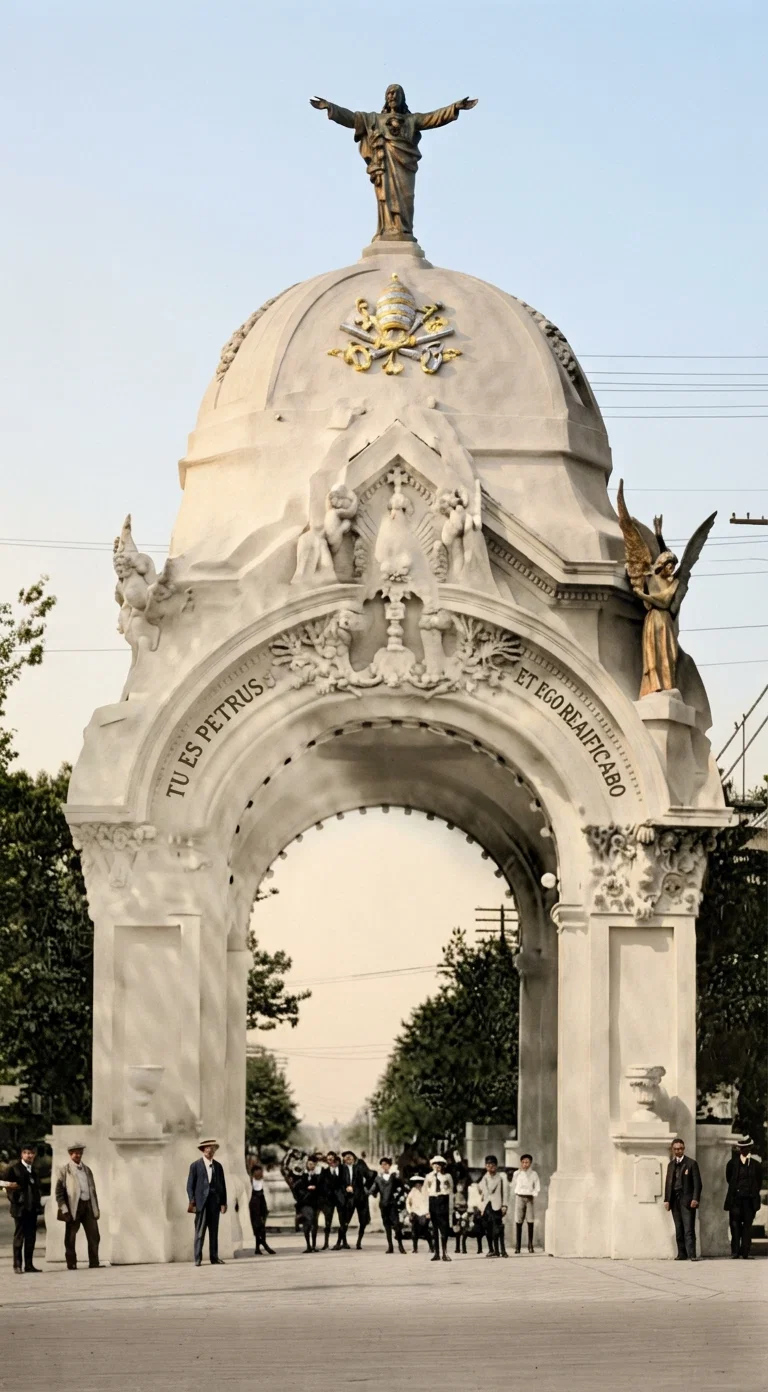
The gorgeous repository in Fletcher's Field where open-air mass was celebrated, and to which the papal legate bore the "sacred host" on the great day of the procession.
Viewing this procession of children to the throne of the papal legate, the gorgeous apparel of the legate and the cardinals and bishops who occupied the throne with him, this text of Scripture came forcibly to the writer's mind: "I sit a queen, and am no widow, and shall in no wise see mourning. Therefore in one day shall her plagues come, death, and mourning, and famine; and she shall be utterly burned with fire; for strong is the Lord God who judged her." Rev. 18:7, 8. And the time draweth on apace.
Again and again was heard at this congress the declaration that North America is THE CATHOLIC CHURCH'S HERITAGE, and that through the medium of the eucharist the Old and the New World were to be united under the sway of the Papacy.
All the work of the week in council meetings for the priests and in open meetings for the general public, was leading up to the great demonstration of Sunday.
The Eucharistic Procession
in which the papal legate would march through the streets under a gorgeous palachin, bearing the monstrance containing the "host." To make this the most wonderful procession in the history of North America, no expense was spared. Large buildings were beautifully illuminated for the evening display after the procession, buildings public and private were lavishly decorated with flags and bunting, and the streets along which the procession was to march were studded with beautiful arches and hundreds of pillars from which flags of different colors were flying. The procession started about half past one, and darkness had shut down over the city before the legate with the "host" had reached the Repository in Fletcher's Field where the eucharistic ceremony took place.
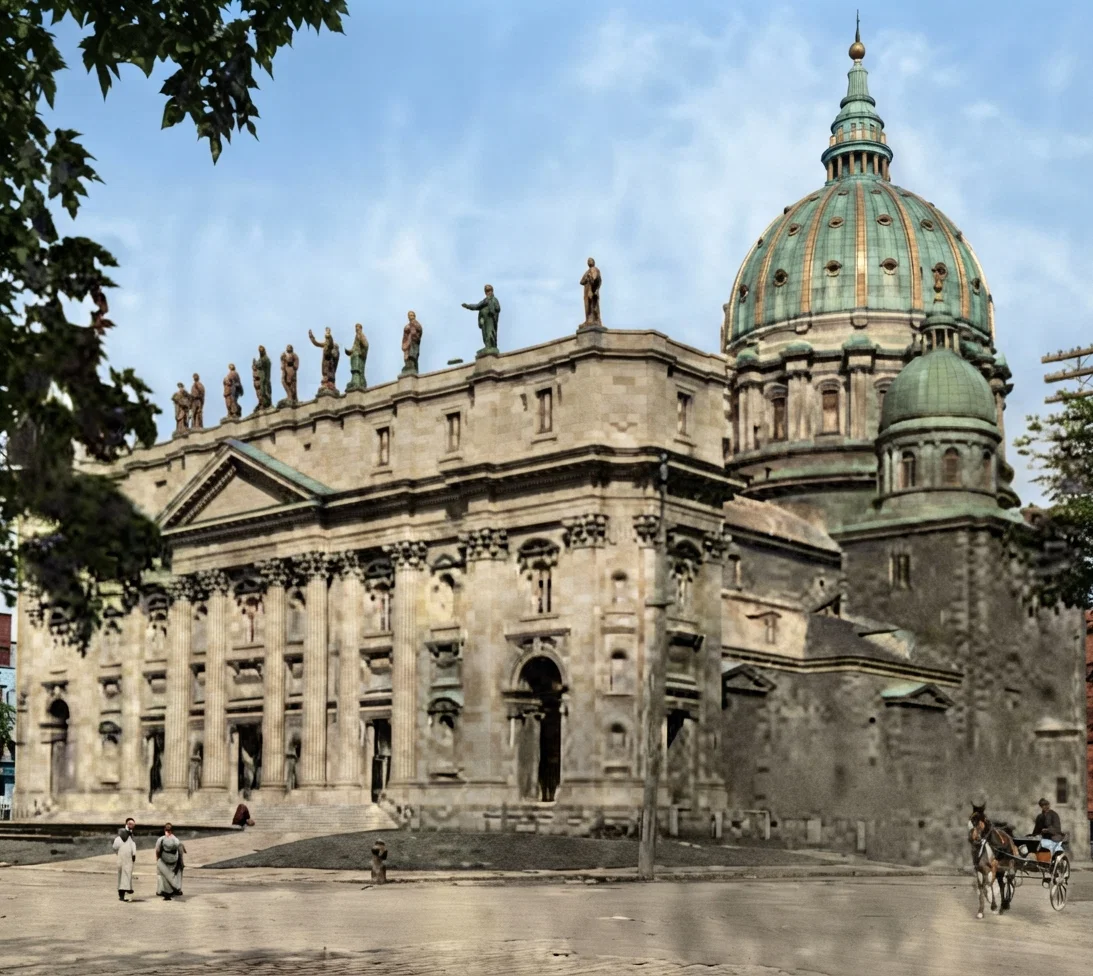
St. James Cathedral, where the official opening reception to the papal legate was held
It was a cosmopolitan parade, gorgeous and motley. It included English, Irish, French, Italians, Poles, Syrians, Lithuanians, Chinese, Indians, and even the governor of the STATE OF RHODE ISLAND with his staff in uniform. This latter seemed a veritable paradox and against nature. The procession included thousands of priests in their robes of office, altar boys by the hundreds, and Catholic men's societies from various portions of Canada and the United States, all with banners and many of them with bands. The legate with the "host" marched near the rear of the procession, attended by cardinals, archbishops, and chamberlains, and surrounded by a guard of honor from the survivors of the Zouaves who had fought for the pope in Italy. The Sixty-fifth Canadian Regiment also took part in the procession, the [sic] plainly informed by the officials at Ottawa that their participation in a procession of this nature was strictly illegal. Following the cardinals, marched all the dignitaries of the municipal and provincial governments, adding the prestige of their position to the glorification of the papal dogma of the eucharist.
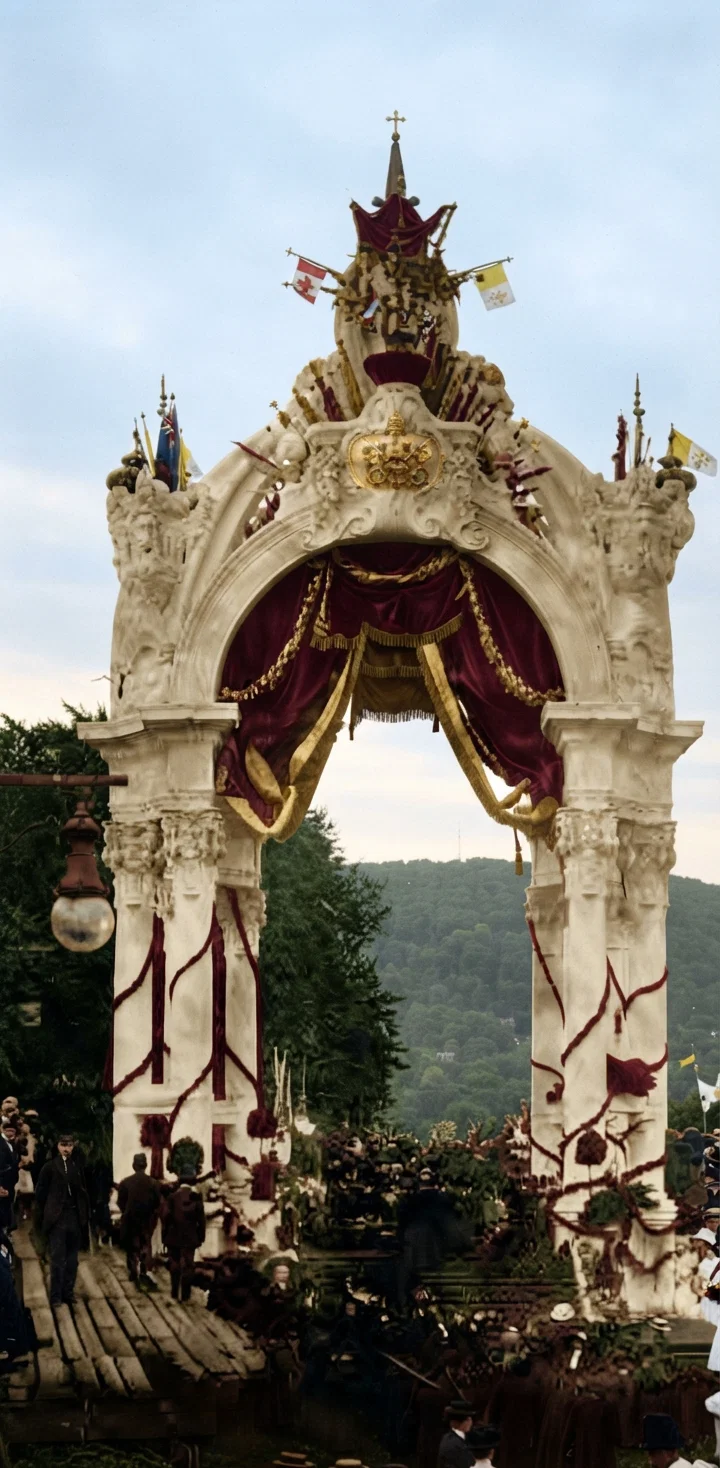
One of the expensive temporary triumphal arches under which the eucharistic procession marched
All along the route of the procession flower-boys were strewing roses in front of the cardinal legate, and the path from the street to the Repository was a veritable bed of cut flowers. Over this only the legate with the "host" and the immediate attendants passed.
Following the mass at the Repository in Fletcher's Field, the papal legate bore the "host" to the "Hotel Dieu" nunnery, where it is to remain.
This ended the congress, the most successful ever held, and a powerful testimony to
The Might and Influence of the Church of Rome
No one could attend that congress without being convinced that he was in the presence of the most ingenious and mightiest single organization that exists in this world at the present time; an organization which has apparently turned the very purposes of the Almighty upside down, and made idols out of the most sacred symbols of our Lord's passion; an organization which looks only to the accomplishment of its purpose, and permits no consideration of human rights to stand in its way. This is the power with which this generation has to deal from this moment on; and the indications are that Protestantism (so-called) has so emasculated itself with its Higher Criticism, Evolution, and New Theology, that it has no power to enter the contest with any hope of success. Rome sees her advantage, and is pressing it. We are rapidly entering the time when "all the world" will "wonder" after that power. It is indeed a time for individual heart-work, and for the proclamation of the last message given by God to this world to warn this generation against that power which robes itself in gorgeous apparel and traffics in the souls of men.