The Outlook for War

4%

Pacific Press Publishing Association · Mountain View, California · Jul 5, 1910

FromSigns of the Times, Vol. 37, No. 26.

Read the full edition

The Outlook for War

Japan and America

THERE are several military men in the world of more or less prominence who believe that there lies before America a fearful war with Japan. Among these is Admiral Fournier of France. He declares that "American interests in Asia are hostile to the Japanese. Japan has at present no means of retaining her empire excepting by diplomatic skill or the victories of war. This is especially the case in regions which the United States can control commercially only by supporting China and maintaining the rule of the open door."
This eminent naval authority summarizes complications as follows: "The naval forces of the United States will some day far excel those of Japan, and will probably equal those of England, in spite of the latter's efforts to maintain the maritime supremacy. Japan, therefore, will be obliged to call upon her English ally for help. If, on the other hand, the United States should combine with the Triple Alliance of Germany, Austria, and Italy, France would be compelled to unite her forces with England and Japan."
Of course he does not profess to know just how forces may line up in the great future war, but he is sure that sooner or later it will come.
Several prominent men in America, like General Bell, Ex-Secretary Shaw, Mr. Jacob Schiff, Senator Newlands, and others, contend that there is danger of war with Japan, and great danger. They feel, too, that it is imminent. If Japan should strike now, she would at least win temporary victories, and would gain advantages which it would take America many years to overcome. This, however, the Japanese papers almost in toto deny. They go on to say that they have never talked war with America; that they are friendly with America, and in all their diplomatic dealings with America there is not a single case in which they have assumed an aggressive attitude, and on the contrary they have invariably been in the position of a defendant.
The Osaka "Asahi," in an able editorial, after the remarks which we have stated in substance, says:
"During the past few years we have had to defend our legitimate rights against the aggressive diplomacy of America. Beyond that we have never said a word about her activities."
"Americans seem to be haunted by the idea that Japan is determined to dominate the Pacific; and inasmuch as they can not tolerate such an ambition, they think they must deal a crushing blow at us before we become too powerful. Whether Japan cherishes so great an aspiration it is unnecessary to discuss; but if she does, it will be entirely commercial and absolutely peaceful, which no nation need fear. We of course hazard no prophecy that American interests will never conflict with ours; but we believe that any controversy arising out of such conflicts can be and ought to be disposed of in an amicable manner by mutual restraint, tolerance, and concession."
Another Japanese paper says that Japan need not be disturbed by the spasmodic alarm of the Americans who predict an American-Japanese war, and counsels the nation to be patient with such a demonstrative people as we are, declaring that in the race of nations the most patient is the ultimate winner. This we gather from "The Literary Digest" of April 30. The "Asahi" goes on to say:
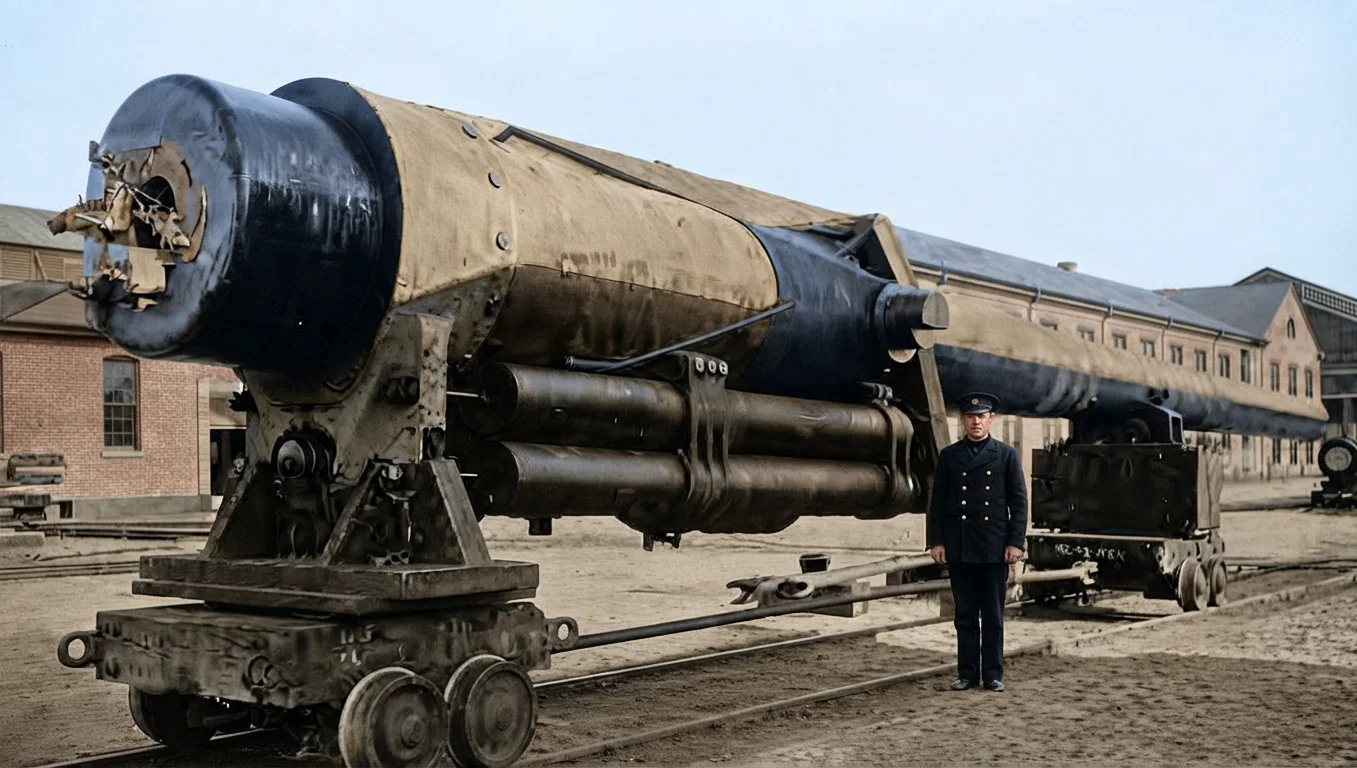
Monster 14-inch Gun at Washington Navy Yard. One year was required to complete it. It shoots a projectile weighing 1,400 pounds with a velocity of 3,600 foot-seconds, representing a muzzle energy of 65,600 foot-tons. The new Dreadnoughts will be fitted with these monsters of destruction. (Photo Copyright Clinedinst, Washington, D. C.)
"Let the Americans do all the talking they want. As for ourselves, we will go on with our own work, which is no other than the cultivation of the arts of peace."

Another paper says:

"We have sincere admiration for the pride of the American nation; but the constant indiscreet display of that national trait may, we fear, become annoying to its neighbors. Patriotism without modesty is liable to become arrogant provincialism. We ourselves have not been free from this undesirable tendency. Permit us to venture on giving a hint that America be more careful in criticizing the affairs of the Far East. She should inquire into the real conditions and aspirations of our country, and, above all, conform, in conducting her foreign affairs, to the methods, formalities, and proprieties commonly followed by other powers."
And that is splendid advice. Another paper feels equally the importance of giving instruction to America:
"The insulation and independence of America have developed a type of candor which is extremely unconventional. This characteristic is not without its admirable features; but when carried too far it often entails unexpected regrettable results. In our own country the common dictates of modesty would require of men of Mr. Schiff's or Ex-Secretary Shaw's prominence and influence great circumspection, when criticizing the acts of a nation with which their country maintains the relation of an unwritten alliance."
Now all this is good, and on the face of it ought to be taken for what Japan says; and yet if constant irritation is kept up, it will be difficult to tell what may grow out of it. This we do know, that God's Word has predicted universal war, and the constant tendency to emphasize war preparation is sure sooner or later to bring about the very thing which men now seem so eager to repudiate. The great war preparation that is going on will certainly not make for peace. An extra big battle-ship will stir up the same spirit in another power, and so the increase will go on until the nations can bear it no longer, and then will come the break.

America

The new program for the United States Navy as outlined by the House Committee on Naval Affairs, according to the Washington correspondent of the New York "Herald," is as follows: two battle-ships of a design similar to those heretofore constructed, costing about eleven million dollars each; two fleet colliers at one million each; one repair ship to cost one million dollars; four submarines to cost about five hundred thousand dollars each. The battle-ships, according to the provisions of the bill, will have to be as large as twenty-six thousand tons, but the maximum weight is not fixed. Each ship will be armed with ten 14-inch guns. Tonnage will be as large as will be necessary to carry this number of guns; that will be in the neighborhood of twenty-seven thousand. But beyond that there is talk of a thirty-two thousand ton battle-ship costing eighteen million dollars, with broadside batteries of 14-inch guns.
There are strong men who are against this naval program. Some of these men, like Representative Tawney, sees national bankruptcy in the endless expenditure. Others, like the New York "World," count it false economy. "How foolish," that journal says, "to squander eighteen million dollars for one battleship, when there is already in existence a five thousand dollar flying machine capable of carrying enough brains, brawn, grit, and nitro-glycerin to send it to the bottom in an instant."
The misuse of funds is shown in what "The Independent" calls a "significant pamphlet" issued by the New York Peace Society, in which it is shown that the cost of one battleship would establish fifty manual training schools teaching the rudiments of a trade to seventy-five thousand people a year; or would buy the White Mountain forest reserve, containing 250,000 acres; or would build a macadam road between New York and Chicago; or would build and equip forty eight-story Y. M. C. A. buildings, etc., whilethe cost of the two new super-Dreadnoughts that Secretary Meyer wants would be sufficient to dredge the proposed six-foot channel in the Mississippi River from St. Paul to New Orleans, or would practically wipe out tuberculosis from New York City.

Our Latest Battleship

launched is the Florida; not a Dreadnought, but a super-Dreadnought. "The Literary Digest" tells us that when it was launched it floated within a few hundred yards of a replica of the little Half Moon in which Hudson sailed into the New York Bay three hundred years ago; and the picture brought home the development of naval architecture during three centuries, and threw into relief by comparison the tremendous powers of destruction leashed in a modern battle-ship. The New York "Herald" declared that if the Florida were "turned loose in the days of the Invincible Armada, the Florida could have eaten her way through all the navies of the world from that day until the development of the steel-clad ship, even if all had been massed against her in one Titanic battle." "The Literary Digest" remarks, "The fleet of Nelson would have melted away under the secondary battery of sixteen 5-inch guns, while a single broadside from her main battery of ten 12-inch rifles would have carried away any single battle fleet ever gathered together in the days of wooden fighting ships."
The Utah is a sister ship to the Florida. These are the largest units now in the navy; but two others, the next two to be launched, are the Wyoming and Arkansas, with main batteries of twelve 12-inch guns, and displacement of twenty-six thousand tons; and these again we are told are to be eclipsed by the two fighting monsters armed, rumor has it, with 14-inch guns to be authorized by Congress at this session. The British Colossus is more than twenty feet longer than the Florida, but with a little lighter armor.
All this and much more might to told of the tremendous preparation for war. Even men of the world feel that Armageddon lies before. The Scripture of truth points it out as certainty. All this preparation for war is not of God nor is it making for peace. The real incentive to war is told us in the book of the Revelation,—three unclean spirits that are out in all the world stirring up the souls of men to the great war of God the Almighty. The only peace in which humanity can hope is that which comes through the life and righteousness of Jesus Christ.