I N an article on "Pinching the Pocket-book," in the July "Cosmopolitan," Mr. Hutchins Hapgood shows that the class which suffers most in rising prices for the commodities of life is the salaried class, forming about one eighth of all the wage-earners. Many of these have known little or no change in salary. Among these are clerks, ministers, journalists, teachers, and college professors.
For instance, the 65,700 general office clerks in the United States received an average wage of $2.18 a day in 1897, and $2.20 a day in 1907, while the cost of living had increased from 25 to 30 per cent.
The condition of teachers is pronounced "deplorable." A thoroly prepared, postgraduate teacher in a university (the estimate is based on one hundred of the best paying in America) at the age of twenty-eight may hope to receive a salary of $1,250 a year; at thirty-one, a salary of $1,750; at thirty-three, a salary of $2,250; and at thirty-five, when the successful teacher is supposed to become a professor, a salary of $2,500, the average of the men who reach the top. The average of the majority is much lower. "There are, for instance, a few institutions which pay annual salaries of $200 to $339, to FULL professors; and there are thirty-one institutions which pay to FULL professors salaries of from $400 to $599. At the extreme top is one institution—and one only—that pays an average salary to full professors of $5,000 a year." The same is true of bank clerks.
In many cases children's education is sacrificed, and the children are forced to become wage-earners. Mr. Hapgood declares that "the editor who receives $5,000 a year salary can no longer save a cent, and he sees with terror that his growing children will soon need more money for their education than he can possibly afford." And he well asks what effect these pinched salaries must have upon the mind of clerk, editor, minister, and teacher.
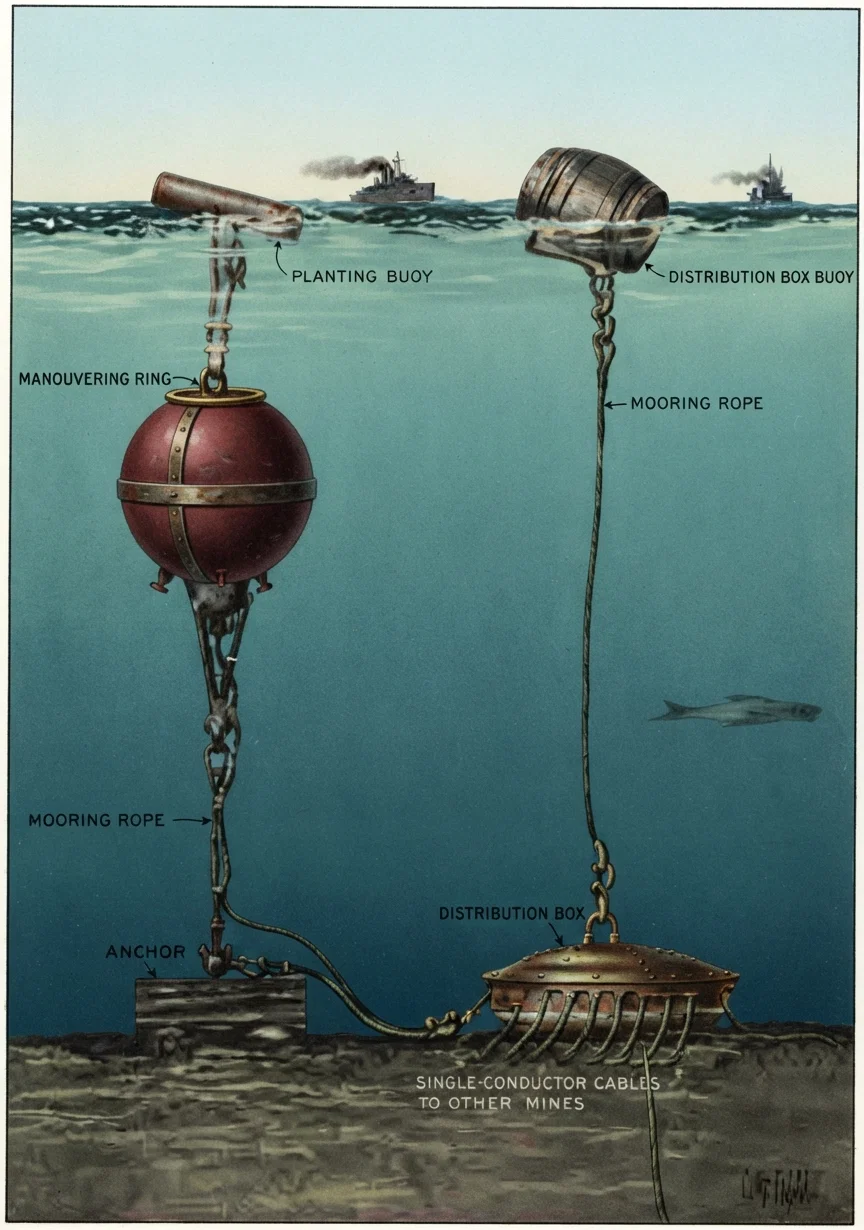
A Complete Submarine Mine. The buoy above at the left shows where the mine is planted. The sphere is the mine. Charged with 100 lbs. of nitroglycerin it costs $500. Exploded under a battleship it would sink it. Groups of these are planted across channels to keep out the enemy. They are controlled from the shore and are therefore harmless to known friendly ships. The submarine mining is said to be a great triumph of electrical engineering, the operations of which are kept secret. (From the "Scientific American.")
Mr. Kirby talks of the "Labor Trust's" relation to higher prices. George Lewis, editor of the "Financier," shows how many are working for less than nothing, and the debts to the retailers are piling up. "The average yearly earnings of wage-workers at the present is about $500;" and it has been found by different official investigations that it costs to maintain a family of five from $750 to $800 a year. Mr. Lewis concludes: "There is no question that the debt of the wage-earners is now being shouldered by the retail dealers." We opine that many are living by pinching economy below the income.
Yet in the same issue Mr. Gage Tarbell, a capitalist, treats of the "Riot of Extravagance," and declares that "the general extravagance of the age has much to do with the present high cost of living. The country is suffering from too much politics, too much legislation, too much graft, too much unnecessary expense of every kind." The general air of extravagance, it is rightly said, breeds a general spirit of unrest, the values of services are affected, and inferior labor is the result, with higher prices on the products of labor. "The Increase in Women's Clothes Bills" is another pointed article, by J. J. Goldman, an expert.
But there is no definite relief promised the consumer. On and on the thing must go till a break comes in a financial crisis or a revolution. These among other conditions are signs of the end. The relief to the average salaried worker lies largely in new adjustments, in new plans of economy, in the elimination of extravagance, in simple, economical living, in placing ourselves under the guidance of God.