[The following article in four parts is not from some ancient tome written by some prejudiced Protestant; it is from the Ilustracao Portugueza of June 18, 1906, a popular magazine of Lisbon, Portugal. We do not print it because we have aught of enmity or ill-feeling against one single Roman Catholic in this world. We have warm friends among them; we pray for them all. Many of them are Christians, far better than their creed. We publish the article to show a logical outworking and legitimate fruitage of the union of church and state. The members of the Roman Catholic Church are like other men and women by nature—neither better nor worse. If that church had not assumed to legislate and execute for God and demand that the state should submit to her creed, she would not have authorized the Inquisition. The Inquisition was but the logic of the church's claim and demand for power to punish heresy. Let all men take heed. Let those "Protestants" who are seeking religious legislation in behalf of Sunday learn the lesson. The translation of the article is not finished English; it has too much of the idiom of the Portuguese, but it does not misrepresent the original.]
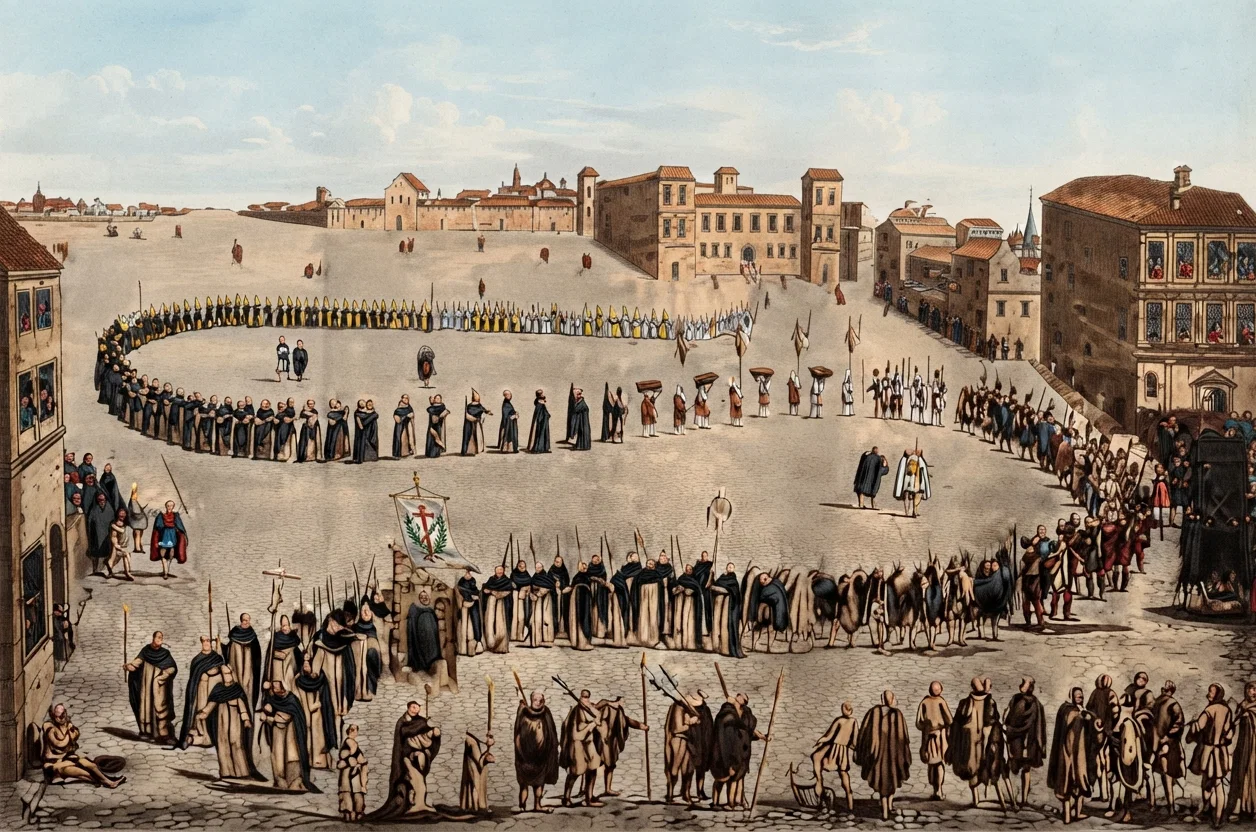
A Procession of Dominicans Going to a Burning in the Palace of Estaos, at Rocio.
I T was on the twenty-third of March, 1536, that the bull of Paul III, establishing definitely the tribunal of the Holy Inquisition, arrived. It is a celebrated date.
The people and the monks, especially the monks, to whom the divisions of Jewish merchants, learned men, money-lenders, jewelers, and doctors, were a provocation and a constant blasphemy, rejoiced and ran thru the streets in great crowds, the "habits" caught up, the rosaries hanging down, the faces purpled and apoplectic. The king, an apathetic imbecile, also bloated and sickly, wrapped in a monk's gray dress with cardinal's cap, surrounded by Dominicans, bishops, parasites, and doctors, praised God in the auditorium of the palace, convinced above everything of his prestige with the Roman ecclesiastical tribunal and of the unquestionable excellence of his ambassadors. The great dream of D. John III was finally attained. The bull of the Holy Father named four inquisitors in Portugal—the bishops of Coimbra, Lamego, Ceuta, and a doctor of theology, freely chosen by the king,—and it gave them together with the judge of the diocese the authority to proceed against heretics.
From here a few months, D. Diogo da Silva, bishop of Ceuta and confessor of the king, was named chief of the inquisitors; he was our friar Thomas de Torquemada. On the death of the bishop, the brother of the king, the Cardinal D. Henrique, ascended the supreme chair, another purplod imbecile that obtained six votes for pope on the death of Paul III, who in the end of life fed himself on woman's milk and who at eighty years thought of having a son as heir to the crown; he was our D. Diogo Deza. Finally the archbishop of Lisbon, D. George d'Almeida, a subtle, intelligent, crooked, and hypocritical prelate, succeeded the Cardinal D. Henrique in the discharge of the horrid office; this was our Cardinal Cisneros. These three men, after Philip II, later the entire people, succeeded in rooting among us, as an institution both sacred and unmovable, the greatest monstrosity that could nurse itself in the bosom of an authoritative, centralized, and Cæsaristic regime.
The Holy Inquisition became as indispensable to the spirit of the people in the sixteenth and seventeenth centuries as the processions, bull-fights, or national games. It was not only the fanaticism of a king to impose it; it was to every soul popular to demand it, in a frightful, inexplainable, collective hallucination, in riots and slaughter, thru the churches and public squares, in the eloquent pulpits of Saint Domingos and in the plebeian benches of the Courts of Torres Novas. It was the hatred of the Jew, of his chest-hoarded gold, of his goldsmith's jewels, of his medical science, of his infinite, absorbing, infiltrating, and dominating power. The flames of the human sacrifices arose; in the stuffy, subterranean chambers were erected polés and potros; filed thru the open squares the processions of yellow carochas and lighted torches, while the miter of the inquisitor and the long gowns of the clergy crossed corridors of the old inquisitorial palace in the dark and silence, and the sounds of breaking bones arose from the aspas; the flesh crackled while tied to the post of the fogueiras—the imbecile multitude raised its hands to heaven, thanking God for being allowed to exterminate the heretics, and it, itself without feeling, without perceiving, was peopling the gloomy dungeons of the Inquisition, and multiplying the endless sentences of the relators of the Holy Office.
An animated Spanish historian who exhibited the delirium of statistician and the most desirable good humor, had the patience to make an account of the victims of the first inquisitor of Castella, friar Thomas de Torquemada, during the eighteen years of his inquisitorial ministry: 10,220 died in the flames; 6,870 were burned in effigy, being absent by death; 91,321 he punished with infamy, confiscation of goods, perpetual imprisonment, and incapability of any employment as a penitent; all of these three classes compose 114,401 families lost forever! When only one inquisitor in Spain realized such devastation in the short period of eighteen years, calculate how many millions of victims would not have been made by the sixty inquisitors in Portugal during three centuries!
"But Portugal had what it asked, and had what it merited."