An Open Letter

3%

Pacific Press Publishing Association · Mountain View, California · Aug 22, 1916

FromSigns of the Times, Vol. 43, No. 33.

Read the full edition

An Open Letter

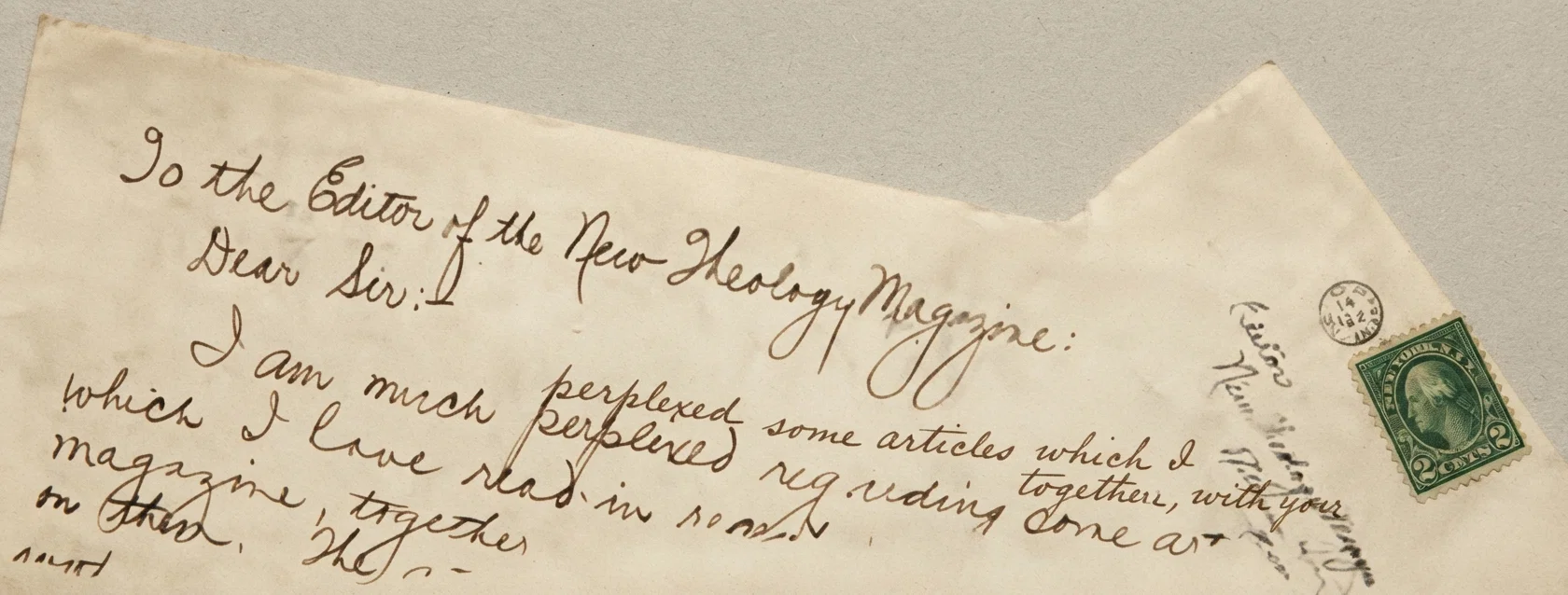
To the Editor of the "New Theology Magazine":
Dear Sir: I am much perplexed regarding some articles which I have read in recent numbers of your magazine, together with your editorials commenting on them. The articles I refer to have been dealing with the earlier parts of the Bible, and especially with such topics as the creation, the Flood, and miracles in general. The customary teachings of modern science are said to render it impossible for us any longer to accept these Bible records in the older sense as real historical accounts of actual facts, and we are told that they must be understood as merely pretty stories surviving from a more ignorant and more credulous age.
Your comments on these articles accept these new views as to the Bible stories; but nevertheless you claim that the value of these Bible narratives is in no way diminished by these discoveries of modern science, but that we now have even clearer views of their transcendent beauty as stories with profound moral significance, of permanent value in the ethical and cultural training of the race.
These comments on the articles puzzle me. I can well understand the attitude of the older generation of scientists who utterly repudiated any idea of divine inspiration as attaching to records dealing with the early history of our race, which they believed to be palpably untrue, and contradicted by the discoveries of science; but I am quite perplexed at your attitude regarding these questions. You seem to believe all that Huxley and Spencer and Haeckel have ever said concerning the mistakes of the Bible in these matters of science; yet you say, in the very next breath, that you continue to have the same high opinion of the ethical character of the Bible, and the same faith and confidence in the God of the Bible, that you have always had.
As I have thought over the matter, I have concluded that your experience in this matter must be very much like some childhood experiences of my own; and with your permission, I shall narrate a few of them, hoping that they may throw some light on the present situation regarding these larger matters of science and religion mentioned above.

Found Him in a Rosebush(?)

I HAD the dearest and best of mothers. She endeared herself to me as a child by supplying my every need, and I used to go to her with all my childish questions and troubles.
I distinctly remember how my mind used to dwell on the great problems of life, among which was, "Where did I come from?" One day, I ventured to ask my mother about it. "Oh," she replied, smiling, "I found you in a rosebush; and I think the fairies must have put you there, for you were all wrapped up so warm and snug, and you seemed to have just come down from above." A little while later, I learned the facts of life and its origin from some older children; and at first, I was much perplexed to know why mother had not told me the truth in the matter, instead of telling such a fable, especially when the truth would have been just as good to tell as the story. But I concluded that she must have had some reason for doing as she did, and I tried not to let any little thing like this come in between me and my perfect confidence in my mother.
Frequently she would entertain me and the other children for hours by describing a beautiful house she was having built for us just across the river. The country over there, she said, was far nicer than where we lived. The woods, and the green fields, the flowers, and the songs of the birds, were ever so much better than anything we had ever known of, and the place was, in fact, a perfect paradise. And each of us was to have a house of his own when we grew up — if we were good.
This led me to think more critically about the house we were then living in. It was a small house, but pretty good and comfortable, with a good cement foundation, brick walls, heavy slate roof, and all beautifully decorated inside. I asked her who built it. "Oh, I built it," she said; "and it took us just six days." She went on to describe in detail just what was done each day, what a large crowd of men she had working at it, and how, on the sixth day, the family had moved in, and the house was just as nice and comfortable as could be desired.

Putting Confidence in Fables

Of course, this was very interesting; and as I knew that mother could build such a nice house so easily, I felt sure that the one across the river must be a beauty indeed, for she assured me that she was taking the greatest pains with it. But when I mentioned the matter to my teacher, he said: "Why, my dear boy, the thing is absurd.
That house of yours could never have been built in six days." And he went on to describe, with much detail, how contrary to all the principles of architecture such a hurried piece of work must be.
"Your mother must have meant six months, instead of six days. But never mind," he added, as he saw that I looked disappointed over what he had told me. "Your mother only wanted to impress upon your mind very strongly the fact that she was the one who had built the house, that she owned it, and that you children should always look to her for whatever you might need. She had no thought of giving you lessons in carpentry and brickmaking." He went on with a broad smile: "Of course your mother built the house; there is no doubt at all about that. You have a very remarkable mother; and it is quite right that you should put the utmost confidence in what she says, if you are careful only to understand her statements in the right way."
I also had my full share of childish troubles and fears. I was always very much afraid of two neighbor children, Adam and Eva Black. I asked mother what made them so bad. "Well," she said, "they used to be very good, just dear little children. But one day, about six years ago, they were out in the orchard eating green apples, which their mother had warned them against, when they were both bitten by a big, poisonous snake, and nearly died. From that time, they seem to have become perfect little imps for devilry."

Helped by the Snake Bite

ONE day at school, I happened to mention to my teacher what mother had told me. "Well," he said, "that is certainly a good joke. Why, Eva and Adam are ever so much better than they used to be. If you had been here eight or ten years ago, you might well have been afraid of them. They were more like baboons than human beings. I guess that snake bite — if they ever had one — must have helped them a lot; for they are certainly much better than they were, and they are steadily improving."
Once when I ran to mother in fear of these dreadful children, she told me not to be afraid, for she knew how to quiet them and make them behave. "Once they came into the yard," she said, "and made so much trouble that I just turned the water hose on them and nearly drowned them." This encouraged me very much, until I happened to mention it to the Black children, telling them they had better let me alone. But they only laughed, and said it was all only a made-up story. "Your mother has no water hose," they declared, "and she never had any. You just go and look." I did look, and found no hose, nor was there any place where one could be attached to our water pipe. I was much puzzled at this, and hardly knew what to think of the situation; but I concluded that mother had told me this story to cheer me up a bit.
Once the river was running very high, and I was afraid to go for water; but she told me not to fear, for she would watch me, and see that I did not get drowned. "Once your brother Lazarus fell in, and was under the water four hours, before I found him and got him out. But I had no trouble in bringing him around all right." This encouraged me, and I went for the water. Afterwards I told the doctor about it, for I was always proud of what mother could do. "My dear child," said the wise old man, "don't you know that it is quite impossible to restore to life a person who has been under water for one hour, to say nothing of four? Your mother only wanted to teach you that she would look after you, that was all."
Like most boys, I did not always care to go to school, and one day I had actually planned to run away. But mother found it out somehow, and she talked to me so seriously that I had to give up the idea. She told me how much I would lose by not going to school, and what a bad habit truancy is.
"Your brother Jonah played truant one day, and started to run away — to Spain. But soon after he started, a big eagle caught him, and carried him away to its nest, where it kept him for three days. He was a very frightened little boy when I found him," she continued; "and the next day, he went to school all right." This put a stop to my plans for running away, although I afterwards found out, in the geography class, that there were no eagles in this part of the country at all, and that besides, no living eagle could possibly carry off a big boy like Jonah. But then, the story accomplished a very useful purpose with me, and I thought it was only a small matter.

"White Lies" to Impress Truth

I THINK I could recall one or two dozen stories like these that mother used to tell me to impress uponmy mind some good moral lesson. But I can assure you that she never told me any such "white lie" without some good moral truth as a lesson behind it; for I would have you know, my dear sir, that my mother was an example of perfect truthfulness, and was very careful to train her children in absolute veracity, as well as in all other virtues.

AN OPEN LETTER

(Continued from page 5)
But one day I was sick, very sick, so sick that I could not walk. As I lay in my bed in my little room on the third floor, thinking about the beautiful home that mother had so often promised me, I noticed a smell of smoke; and as I looked toward the bedroom door, I could see dense clouds of smoke pouring in around the door and over the transom. The sharp crackling of flames could be distinctly heard coming from the hallway, growing ever louder minute by minute. In my helpless condition, with no one near me, I began to call loudly for help. Soon I heard mother's voice in the yard below. "All right, Georgie! Don't be afraid. I am going to bring you down the fire escape." Oh, how thankful I was to hear my mother's voice again, and that she was coming to save me! But — horror of horrors! — my next thought was, There is no fire escape! Our house had always been regarded as fireproof, and a fire escape had not been thought necessary.
As I lay there, feverishly listening to the steady roar of the flames, watching them as they crept under the smoking door and licked up the varnished wainscoting and the paper hangings on the wall, with the smoke now grown thick almost to the point of suffocation, my thoughts naturally called up the stories mother had told me — stories to encourage my trust and confidence in her and her motherly care — which I had afterwards found out were only stories, and quite impossible of accomplishment. And as I thought of these, and realized that the means by which she now promised to save me had no existence, and knew that in a very few minutes I would be past all possible help, do you wonder, sir, can you blame me, that I almost cursed my mother in my heart, as I began with feverish haste to tie the bedclothes together for a rope and to grope my trembling way toward the open window?
My allegory has become too plain, and cannot be carried further. But I believe that the above is in no way an exaggerated view of the kind of God the current pseudo criticism and pseudo science would make the God of the Bible to be.
In conclusion, my dear sir, I must say regarding these alleged disclosures of dishonesty on the part of the Bible writers, or of cruelty and incompetence on the part of the One who made the world, that any one who asserts that these disclosures make no difference in our opinion of the value of the Bible and our regard for the God of the Bible, must either be a fool himself or think all his readers are fools.
Yours for honesty and truth, GEORGE MCCREADY PRICE.