Man's Sin and Saviour

3%

Pacific Press Publishing Association · Mountain View, California · Aug 16, 1910

FromSigns of the Times, Vol. 37, No. 32.

Read the full edition

Man's Sin and Saviour

By E. J. Hibbard

VI. The Sanctuary, an Object-Lesson

HAD our ancestors lived in the midst of the most degraded forms of idolatry from the year 1694 A.D. to the present, and had we with them been liberated from slavery to the nation that had enforced such religion upon us; and had that deliverance come but yesterday,—then should we be prepared to understand the condition of the Israelites the year they were rescued from Egyptian bondage, civil and spiritual. Surrounded by idolatry, superstition, and sin, two hundred and fifteen years, what havoc had it wrought!
It will be remembered that the idolatry of Egypt was not confined to image worship, for the Egyptians worshiped all nature, from the sun and its supposed attributes of reproduction, to the lowest animals and insects which fill the earth or air. And in the ten plagues with which God persuaded Pharaoh and the people that they should let Israel go, He humbled the gods of Egypt as well. The River Nile; the frogs; lice; swarms of flies; a very grievous murrain upon their sacred bulls and other cattle; "a boil breaking forth with blains upon man, and upon beast, throughout all the land of Egypt;" "hail, such as had not been in Egypt since the foundation thereof;" locusts; darkness; death of all the first-born, both of man and beast,—these showed that the God of the Hebrew slave controlled everything that the Egyptian worshiped, and did with it whatsoever He chose. Thus Egypt lay desolate, her people bereft, her gods powerless; for they were no gods at all.
And away from idolatry, as well as out of Egypt, God would lead His people. To accomplish either, and especially the former, God must dwell among them and be their God indeed. It would take no small amount of training to correct the errors of Egypt and remove the impress caused by two centuries of contact with idolatry and sin. And this matter was too important and critical to hope for its accomplishment in any ordinary way.
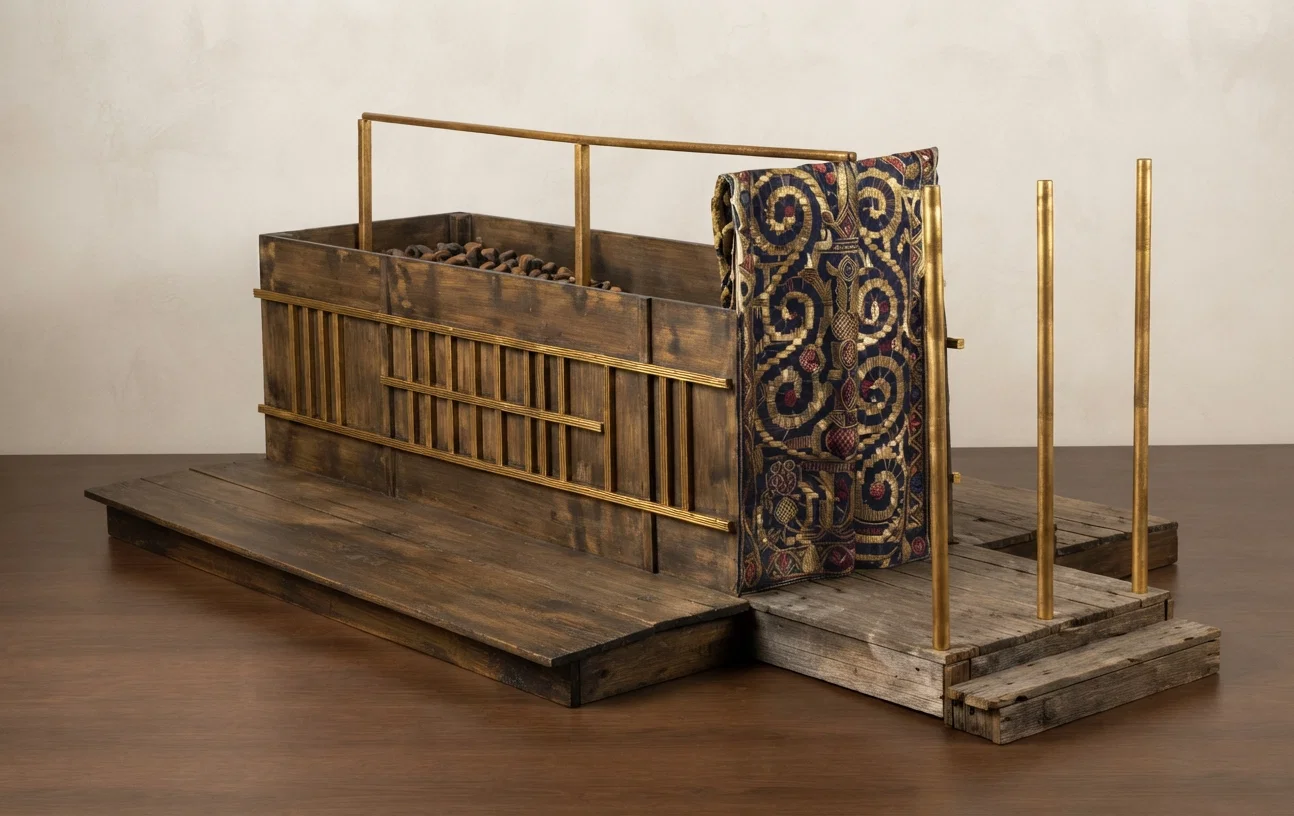
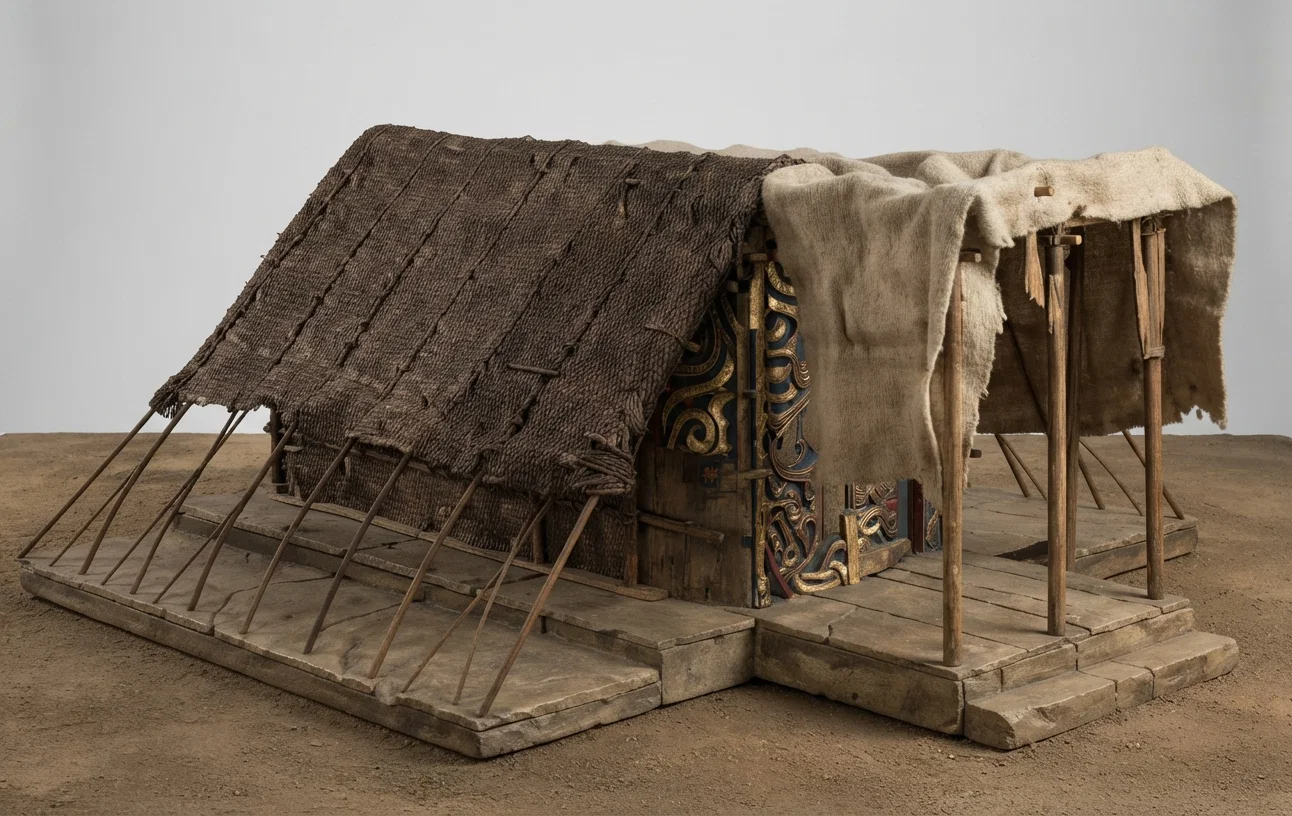
The Erection of the Tabernacle. Second stage. From "The Tabernacle—Its History and Structure," by Caldecott.
In the pillar of cloud by day, and the pillar of fire by night, their Deliverer led them in person. He it was who opened for them the Red Sea, that they might go through "dry-shod." At His command, the waters returned, destroying the Egyptian host. He was the Branch, the Rock, and the Bread from heaven, who satisfied their hunger and allayed their thirst, from the day they left the flesh-pots of Egypt until they ate the new "parched corn" in the promised land.
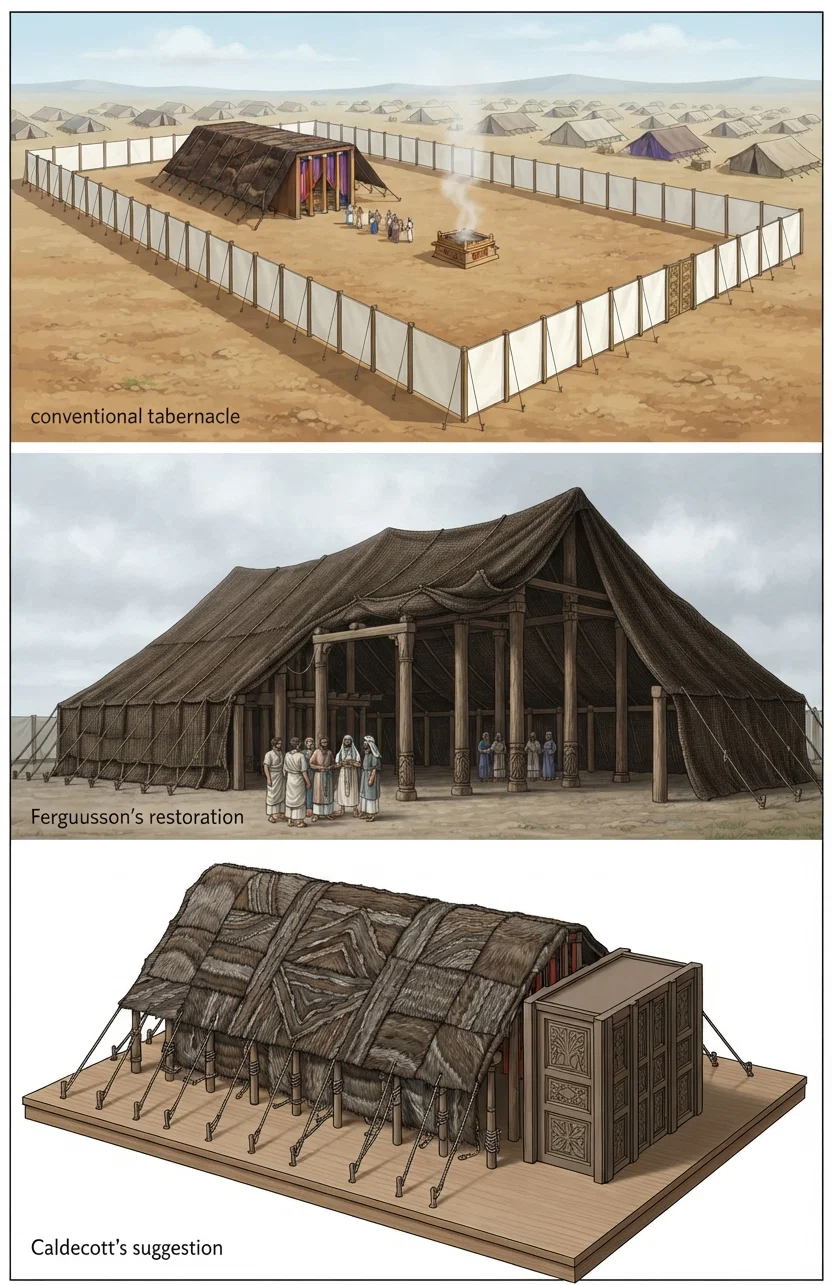
Three Views of the Tabernacle. The first is the conventional tabernacle similarly pictured by so many different persons. Secondly, Fergusson's restoration; the lower one as suggested by Rev. Mr. Caldecott.
It was with Him at Mount Sinai, the third month out of Egypt, that they entered into covenant that they would obey His voice "indeed" and keep His covenant. And when all the people heard that voice, in peals of thunder which shook the earth, they heard the Ten Commandments; "and He added no more."
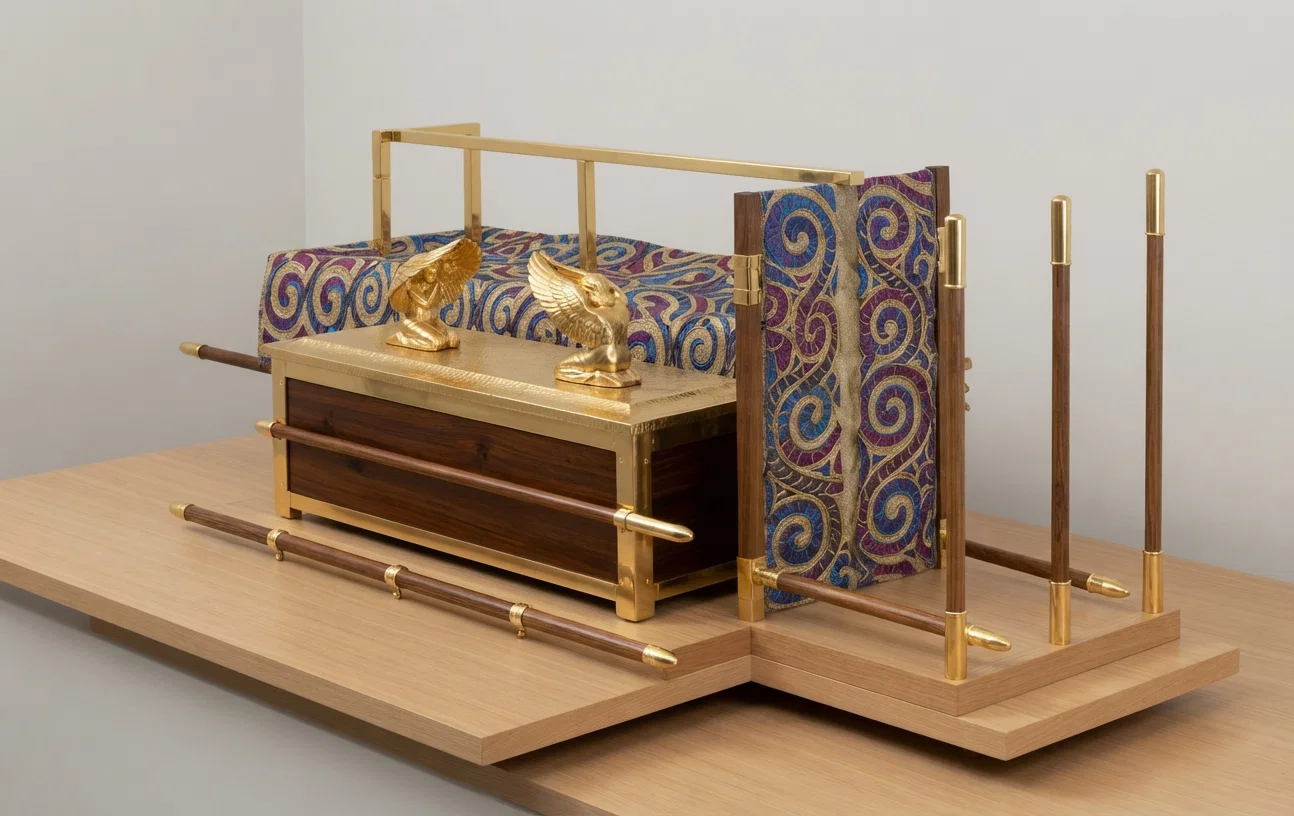
The Erection of the Tabernacle. Third stage. From "The Tabernacle—Its History and Structure," by Caldecott.
Very soon after this, "the Lord spake unto Moses, saying, Speak unto the children of Israel, that they bring Me an offering: of every man that giveth it willingly with his heart ye shall take My offering. . . . And let them make Me a sanctuary; that I may dwell among them." Ex. 25:1-8.
In this sanctuary, and by the lessons it taught, their God purposed to dwell with His people, and teach them the heavenly way.

Even Then the People Sinned

But notwithstanding their experience thus far, their idolatry was so deep-rooted that Moses had been gone scarce forty days in the mount, receiving instructions concerning this sanctuary and its services, before they demanded, and Aaron made for them, the golden calf, or bull, the symbol of Egyptian sun worship—the worship of the elements of reproduction. And with becoming respect to this form of debasement, the people, with undraped bodies, on Moses' return, were singing and dancing with idolatrous glee. Ex. 32:18-25.
And for a time the matter hung in doubt as to whether their God could consistently carry out His purpose in respect to the sanctuary, His dwelling-place among them.In fact, under the circumstances, the three thousand of the impenitent and defiant ones had been slain by the sword at God's command, the fate of the others hung so much in doubt, that the Lord at first refused to go farther among them.
The Erection of the Tabernacle. First stage. From “The Tabernacle—Its History and Structure,” by Caldecott. It will be seen by this that Mr. Caldecott’s plan of the tabernacle works out somewhat differently from those of other artists and investigators. The folding around of the curtain in front in his idea makes a sort of porch at the entrance.
The "tabernacle of the congregation," in which He had been wont to meet the leader of His people, was removed from the midst of the camp, and it looked as if their Deliverer was about to remove from them entirely. God can not live in the midst of sin, nor in a camp of practising sinners. To sin God is a consuming fire. It is thus that God's presence in the midst of a people who hold to sin, must needs consume both sin and sinner. But blessed is the fact that, to the one who hates sin, and desires a separation, to such a one God consumes the sin and converts the sinner.
And through the intercession of the Spirit of God, and that of Moses, Israel repented, and humbled their hearts, and God forgave them. And after this, it was possible again that their Lord should dwell among them. Now the plan of God in reference to the sanctuary could consistently be carried out.

Purpose of the Sanctuary Service

Accustomed as they had been, in Egypt, to an elaborate ceremonial, the Lord saw fit Himself to establish one. But His was not a ceremonial without meaning. Every detail of this remarkable structure, its furnishings, its priesthood, were but "a shadow of good things to come." But this we reserve for our consideration next week.
"And Moses said unto the children of Israel, See, the Lord hath called by name Bezaleel the son of Uri, the son of Hur, of the tribe of Judah; and hath filled him with the Spirit of God, in wisdom, in understanding, and in knowledge, and in all manner of workmanship; and to devise curious works, to work in gold, and in silver, and in brass, and in the cutting of stones, to set them, and in carving of wood, to make any manner of cunning work. And He hath put in his heart that he may teach, both he, and Aholiab, the son of Ahisamach, of the tribe of Dan. Them hath He filled with wisdom of heart, to work all manner of work, of the engraver, and of the cunning workman, and of the embroiderer, in blue, and in purple, in scarlet, and in fine linen, and of the weaver, even of them that do any work, and of those that devise cunning work." Ex. 35: 30-35.
In this manner were men prepared from the midst of a nation of slaves, whose occupation had been only to make bricks and possibly to lay them, to perform in the most skilful manner the most delicate work as above described.
The tabernacle proper was thirty cubits long, ten cubits wide, and ten in height. It was enclosed with boards set on end, and secured by two tenons at the end fitted into sockets of silver. Each board was ten cubits in length, and a cubit and a half in width, and overlaid with pure gold.
The coverings of the tabernacle were four in number. The inner was of fine twined linen, curiously wrought with cherubim, in the most exquisite needlework. Next this outward, were curtains of woven goats' hair, then the rams' skins dyed red; and last of all, a covering of badgers' skins. This made the outer part very plain and uninviting; but it was all glorious within, for here the surface of the walls was of polished, glittering gold, reflecting the cherubim-wrought curtains, the golden furniture, and the priests who served therein.

Symbol of the Abiding God

The tabernacle was divided, by means of a veil, or curtain, into two apartments, called the "holy" and the "most holy." In the first, at the right as one entered, was seen the table of showbread; at the left the seven-branched golden candlestick, which was kept constantly burning, for the tabernacle had no windows. Just before the veil which separated the two apartments, was the altar of "perpetual incense;" while within that veil, in the "holiest of all," was found only the ark of God, containing the ten commandments within, the book of the law in its side, and this covered with the mercy-seat and the cherubim of gold, and over this the symbol of the abiding presence of God. At the door of the tabernacle stood the altar of burnt offering; and between it and the tabernacle, the laver which held water for the purifying of the priests' hands and feet, the last thing before entering the sanctuary; for nothing impure might enter there.
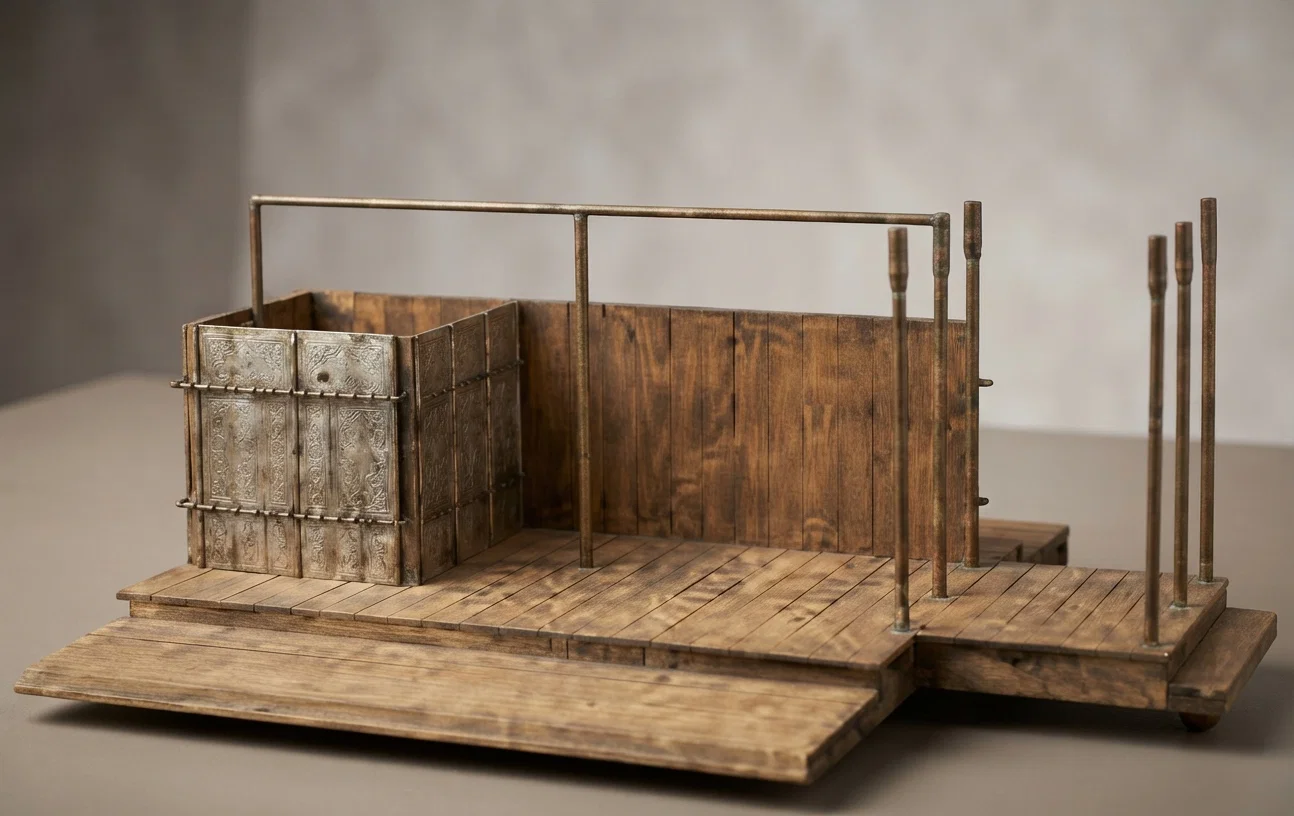
The Erection of the Tabernacle. Fourth stage. From "The Tabernacle—Its History and Structure," by Caldecott.
Surrounding all, at a proper distance, was a curtain-enclosed court. On the four sides of this were the twelve tribes pitched in camp, and God dwelling in the midst, His glory filling the tabernacle.
Here the Divine Presence communicated with Moses, and from hence Moses carried the word to the people. Here did the priests serve in making atonement for sin. Of its significance, we have not further space in this paper to make mention; but as it wraps within itself the entire Gospel, in type, we are sure all will desire to study, in future articles, something of its meaning.
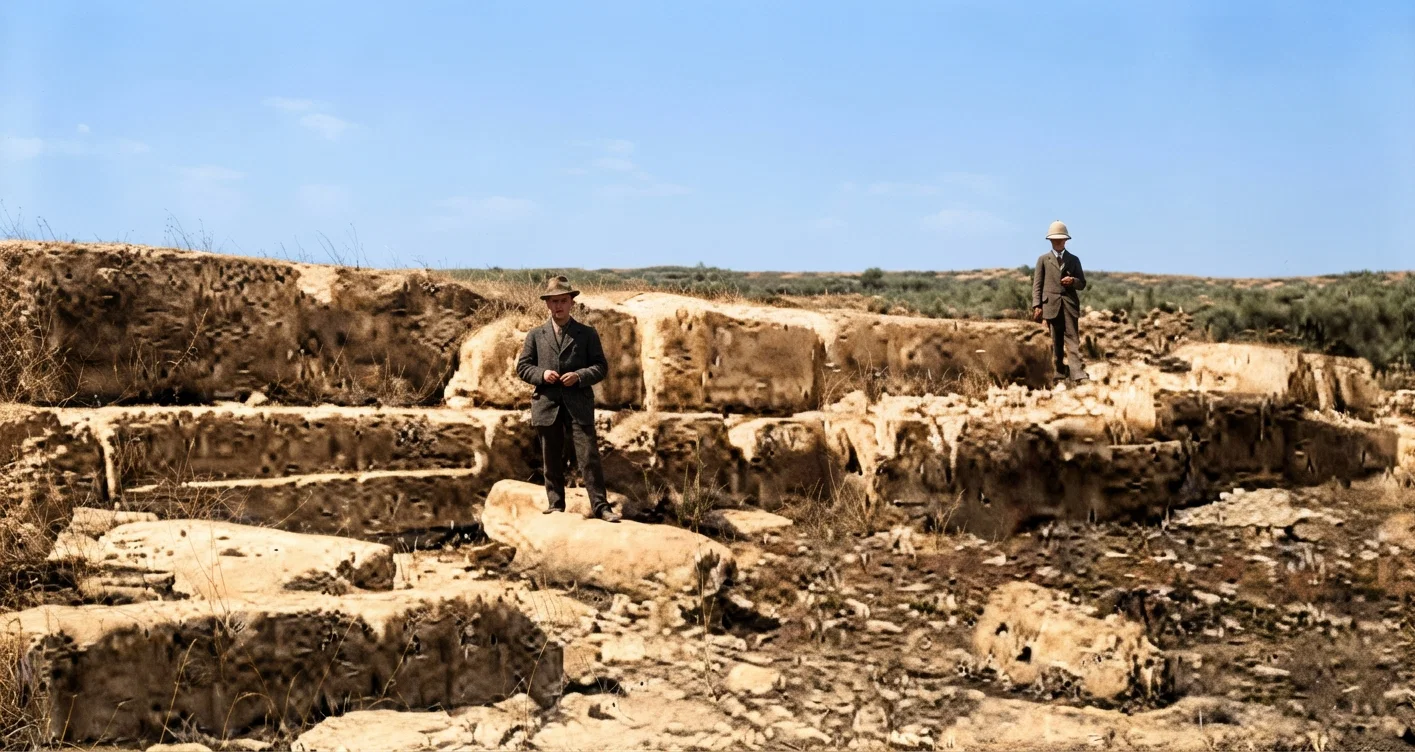
The Ramet Enclosure. Ruins found at Rama, Palestine, where Samuel had his altar. The Rev. W. Shaw Caldecott declares in his "Tabernacle—Its History and Structure," that the measurements of this ruin correspond perfectly with the measures of the sanctuary, and therefore he concludes that this ruin was once the structure in which the sacrifices were carried on in the days of Samuel before the temple was erected. He also determines from this that there were two cubits used; the ordinary one, 14 4-10 inches, and the great cubit, 18 inches.