ALL this stirring of the depths in the great non-Christian lands, of which the news despatches are ever telling us, is full of meaning in the missionary advance.
Everywhere through heathen lands there is presented to our vision the view of open doors, for the moment thrown more widely open than ever before, but threatening to fly shut at any time. Never was there a situation more urgently appealing for earnest and instant action on the part of those who know the Gospel message. The awakening of Asia has passed into hackneyed phrase within the last few years, but it is a tremendous fact always with us in facing the missionary problem. Not long since the London Spectator, in a serious article on the situation, said:
"The fact is often disputed, but there undoubtedly is a comity of Asia which is at least as operative as the comity of Europe, or it is possible that there is an emotion akin to the one which produced the crusades, and that, tho not so directly connected with any religious impulse, still is fatal to quiescence, and is sweeping through Asia from Nagasaki to the Bosphorus, stirring up races which for ages have slept the sleep of content, but are now determined to advance upon some path, mental or physical, which they think open."
Who can fail to see in this sudden rousing of the great continent of ancient heathenism the fulfilment of one of the signs given by Joel the prophet, by which men were to know when the day of the Lord was near at hand?
"Proclaim ye this among the Gentiles; Prepare war, wake up the mighty men: . . . let the weak say, I am strong. . . . Let the heathen be wakened. . . . Multitudes, multitudes in the valley of decision [or cutting off]: for the day of the Lord is near in the valley of decision."
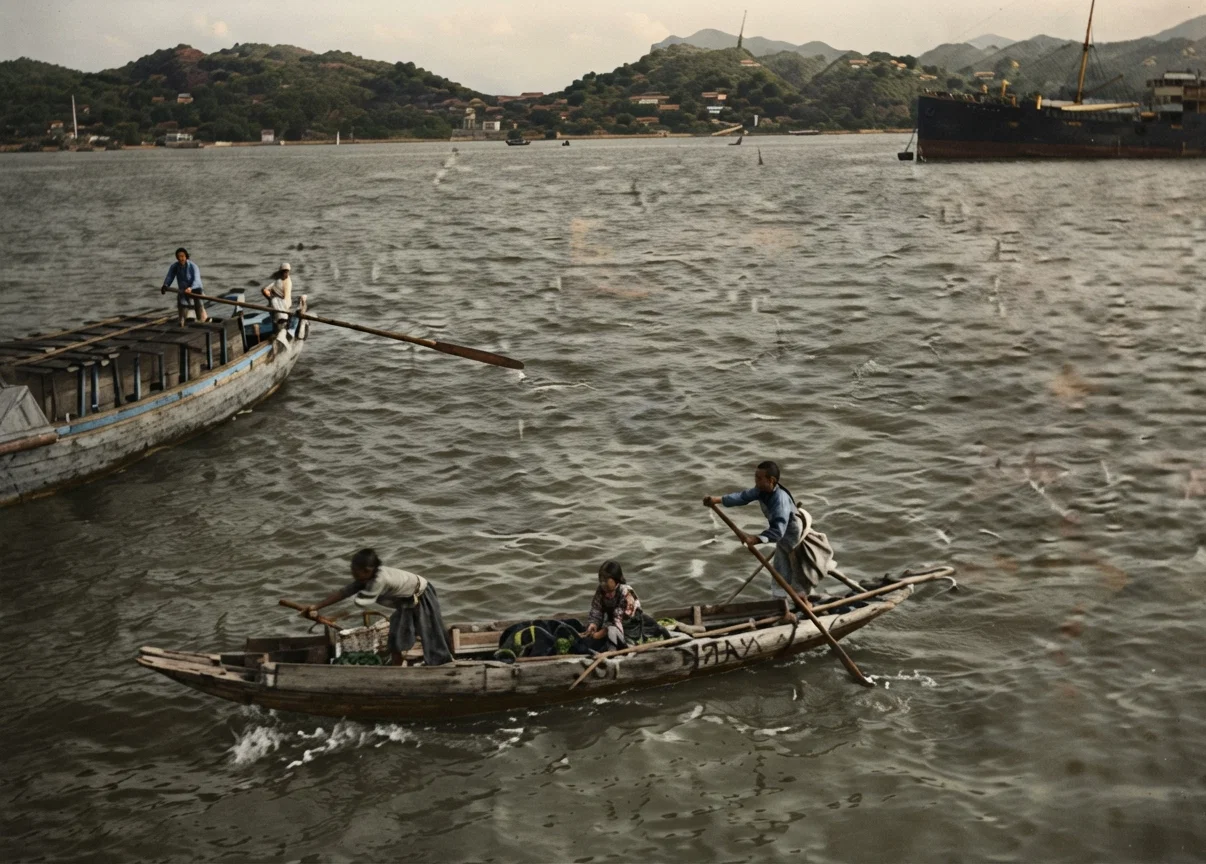
Swatow (China) Rowboats
And history and prophecy alike forbid the popular idea that somehow out of this stirring of new life among the ancient peoples the world is to glide grandly into millennial peace. The new time does not mean this. But in it all we may see the world hastening on to the final crisis, and gather inspiration for more earnest efforts than ever before to evangelize these peoples.
In the London Contemporary Review of last September, Mr. Newton Marshall summed up the Asiatic question in the forceful words:
"The whole of Asia is in the throes of re-birth. At last we may see these three—the yellow race, the Indian race, and the Arab-Persian Mohammedan race. And all that is, working for the Armageddon."
Now in this little time of peace is the auspicious hour to reach the ears of all these races with the message of salvation. The century of missions has prepared the way for a sharp, short work in our time. We hardly appreciate what the last few years have wrought, and I, for one, like to have it told me again and again. For instance, Dr. Selmon, editor of our Chinese paper, Shi Chao Yuch Pao (The Signs of the Times), speaking of one province of China, Honan, recently told us:
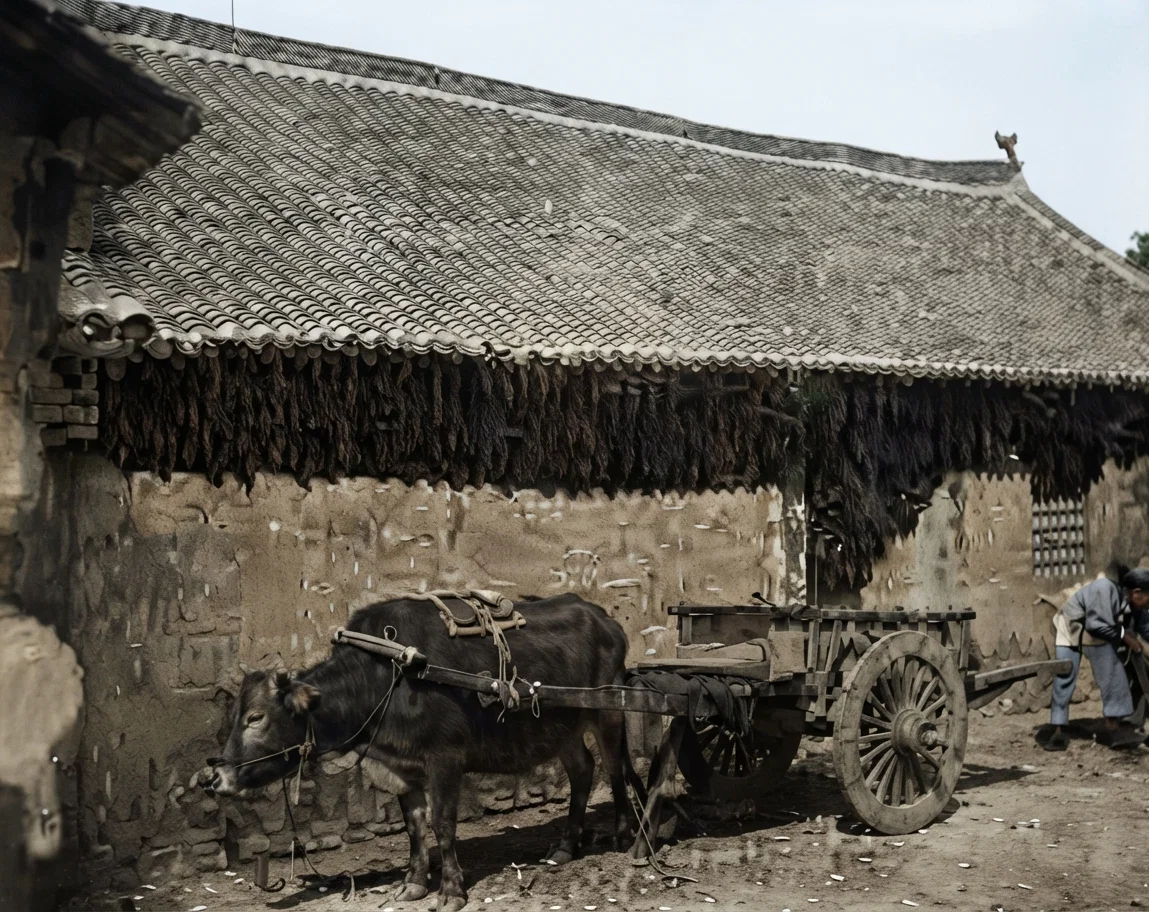
Farm Ox-Cart in Shang Tsai, China
"Previous to 1900, Honan possessed not a single foot of railroad; and only a few of the larger cities had post-offices. But now there is a trunk line from north to south and another from east to west; and not a city or town of importance in the province is without a post-office. God is surely preparing the way for us; for how could we send forth the truth-bearing page without post-offices and post-roads? While a few years ago in one city of two hundred thousand not more than three newspapers were subscribed for, to-day in this same city, newspapers are read by every merchant and educated man."
Then speaking of the educational decree of 1901, he adds:
"By this one decree an educational system was abolished that had been in vogue for millennia, and several millions of China's brightest young men, who were in the schools of the old order, with their faces toward the dead past, executed a 'Right about, face!' and are now looking toward a living future."
And he tells of seeing workmen tumbling idols out of the temples, and putting in tables and chairs and the equipment for a modern school. Thousands of temples, the latest news informs us, have been turned into schools.
Never a decade of modern history brought such appeals for missionary activity as this first decade of the twentieth century; and so far as China is concerned, an ominous note comes to us in the words just spoken by the retiring Chinese minister to Germany. Announcing a change in China's policy regarding militarism, he shows how quickly the newly awakened life is to be turned into channels that will add ever-increasing difficulties to the country's evangelization. He said:
"If we make all the available men join the military, we have such an enormous population—some 400,000,000—that we shall overshadow all other armed nations. The details of the plan have not been worked out, but we propose to make our young men soldiers, not only through drill, but by education. They must learn what a shame it is for the most ancient, and in population the greatest, nation on earth to be so weak."
It is almost an echo of the prophet's words, "Let the weak say, I am strong."
Again, the great Indian race is passing through similar evolution. It was of India's age-long indifference to great world movements that the poet wrote:
"The East bowed low in earnest thought,
In silent, deep disdain;
She heard their legions thunder past,
Then bowed in thought again."
But this is not the India of 1910 and onward. And while the new time and the breaking away from the bondage of old customs presents the golden opportunity for missionary work, we know well what lies but a little way beyond. Our missionaries in India, north, south, east, and west, appeal to our Mission Board as never before for the reinforcements of men and means to take advantage of the golden opportunity. So it is with every society.
At the recent Student Volunteer Convention in Rochester, Mr. George Sherwood Eddy, fresh from India, gave a view of the situation so informing and up-to-date that I must quote three paragraphs:
"The most encouraging thing I have seen in India is the present unrest. While this has been partially caused by the partition of Bengal and Japan's conquest of Asia, its real cause lies deeper. That cause is found in the conflict of the new civilization with the old, the work of the leaven of a new principle, the upheaving of a new life. Five causes have led up to this; namely, Western education, the natural antipathy for foreign rulers, the poverty of the masses leading to natural dissatisfaction, the agitation of the educated Indians for self-government, and the dissatisfaction of the people with the old order, both political and religious.13"England is hated in India to-day as the United States is hated in the Philippines, and Japan is in Korea. But common honesty demands that recognition be given the work which she has done for the country. England has given to India 30,000 miles of railways, 50,000 more miles of telegraph lines, 25,000 miles of irrigating canals reclaiming twenty million acres of waste lands, more than 50,000 miles of macadamized roads, a splendid educational system, with five universities, 145 colleges, and 5,700,000 pupils to-day, a splendid medical work with 2,500 hospitals and dispensaries treating 22,000,000 of patients last year. Further, in spite of the poverty of India, under British rule the trade of the empire has increased tenfold in sixty years.
"But the marvelous thing in India is the awakening of that empire; an awakening, first within the church, and second, without the church in the leavening of the life of the people. It is an awakening involving the reaction of Christianity upon the non-Christian religions and upon the whole nation. . . . While during the last decade the population has increased 2½ per cent, the Parsees have gained 4 per cent, the Jews 6 per cent, the Mohammedans 8 per cent, while the Protestant native Christians increased 63 per cent, more than twenty times as fast as the population."
Truly the signs of the times in India are full of significance from the point of view of missions.
A few words must sum up Africa and the new time. A recent writer in the World's Work, Mr. C. M. Keyes, says of Central Africa:
"Where Stanley blazed the way, the cohorts of civilization have followed closely. The very cannibals who hurled against the canoes of the intrepid explorer clouds of arrows, are to-day themselves the pilots, the firemen, the engineers of the river steamboats."
Now the railways, south and east and west, land our missionaries at points which formerly represented weeks or months of weary travel.
And the inroad that Mohammedanism is making in the Dark Continent, throwing a blighting influence over tribe after tribe, challenges everywhere the vanguard of the missionary advance. Without a doubt the recent events in Africa and Persia will consolidate and strengthen the Moslem races, for whose evangelization scarcely anything has as yet been done. At the same time the progress toward constitutional government swings open a door hitherto but slightly ajar.
From every part of the great non-Christian lands, with over half the population of the world, the voice of current events sounds like a trumpet in our ears, "Now, just now, is the time."