Halley's Comet

3%

Pacific Press Publishing Association · Mountain View, California · Apr 26, 1910

FromSigns of the Times, Vol. 37, No. 16.

Read the full edition

Halley's Comet

By Professor Charles Burckhalter
[We are very glad to be able to present the following article from the pen of one well known in astronomical circles. The author has been for many years the director of Chabot Observatory, Oakland, has conducted solar eclipse expeditions to Japan, India, and Georgia, and is in solar photography an expert. He is a careful observer, and his article is dependable.—Ed. S. of T.]
SO much of unworth is being published about Halley's comet, that many people do not know what to believe. I would not blame them if they said just what the psalmist says that he said in Ps. 116:11. It is a little unfortunate that some are getting quite nervous about it. I read an editorial that had so many misstatements in it that I was struck with admiration. There were twenty-three statements, supposed to be facts, of which nineteen were untrue, uncertain, or sheer nonsense.
It is not absolutely certain, nor anywhere near certain, that the earth will pass through the tail of the comet. Personally I want to have it happen, but am fully prepared for a big disappointment. IF the comet's tail is pointed directly AWAY from the sun, AS THE TAILS OF COMETS SELDOM ARE, and IF the tail is long enough to reach beyond the earth, then the earth will certainly pass through the tail of the comet on the afternoon and evening of May 18. But if the tail is curved, as the tails of comets USUALLY ARE, it is easily possible that the earth will pass UNDER it, several hours, or even a day or two, AFTER the 18th. I have not seen this possibility (perhaps I should say probability) pointed out before.
If the tail is too short to span the gulf of 15,000,000 miles between the earth and the comet at that time, why, of course nothing can happen. The tail may easily be much longer than is necessary, and may just as easily be too short. Which will it be? Astronomers can not tell how long any comet's tail will be at any time. Comets have been seen to break up under the very eyes of astronomers. The critical time in the history of a comet, seemingly, is when it is near the sun; and there are not a few astronomers who fear that Halley's comet has seen its best days; and they are not very enthusiastic about its present appearance, altho the conditions are considered unusually favorable, and in some respects extremely so, for a big display.
It should be understood that Halley's comet is not a GREAT, but only a BIG comet. It is true that it appeared as a terrifying object in 1066 and 1456, but at other times it has been only a big or fair-sized comet, while at yet other times not even that. Its appearance, size, and shape depend greatly on the relative positions and distances of the comet, earth, and sun. At this apparition, as remarked before, the conditions are exceptionally good for a fine display of tail, so that, if the comet does its full part, we may expect to see something worth remembering.
The great fame of this comet does not rest upon its bigness, like the comet of 1858, and others, but upon the fact that it was the first comet known to be "periodic." That is, it was the first comet known to travel around the sun again and again, in nearly regular periods of time; and Halley's name is associated with it because it was through his great labors that this fact was discovered. Until his time, comets were considered, even by astronomers, to be only chance visitors, passing near us for the first and the only time. Halley predicted this comet's return, at a certain time long after his death. His prediction came true, and this comet has ever since been known by his name.
The English astronomers Hind, Cowell, and Crommelin have added greatly to the comet's fame and their own by tracing its history backward mathematically and otherwise to the year 250 B. C.! The latter two gentlemen have received the praise and admiration of astronomers for predicting its present perihelion passage (its nearest point to the sun) within three days. This can be appreciated all the more when we remember that it has been invisible since 1835 and that it is about two years ahead of its average time. This is its twenty-ninth appearance, but it seems to be a hopeless task to trace it farther back. It may very well be that it came into our system at that time.
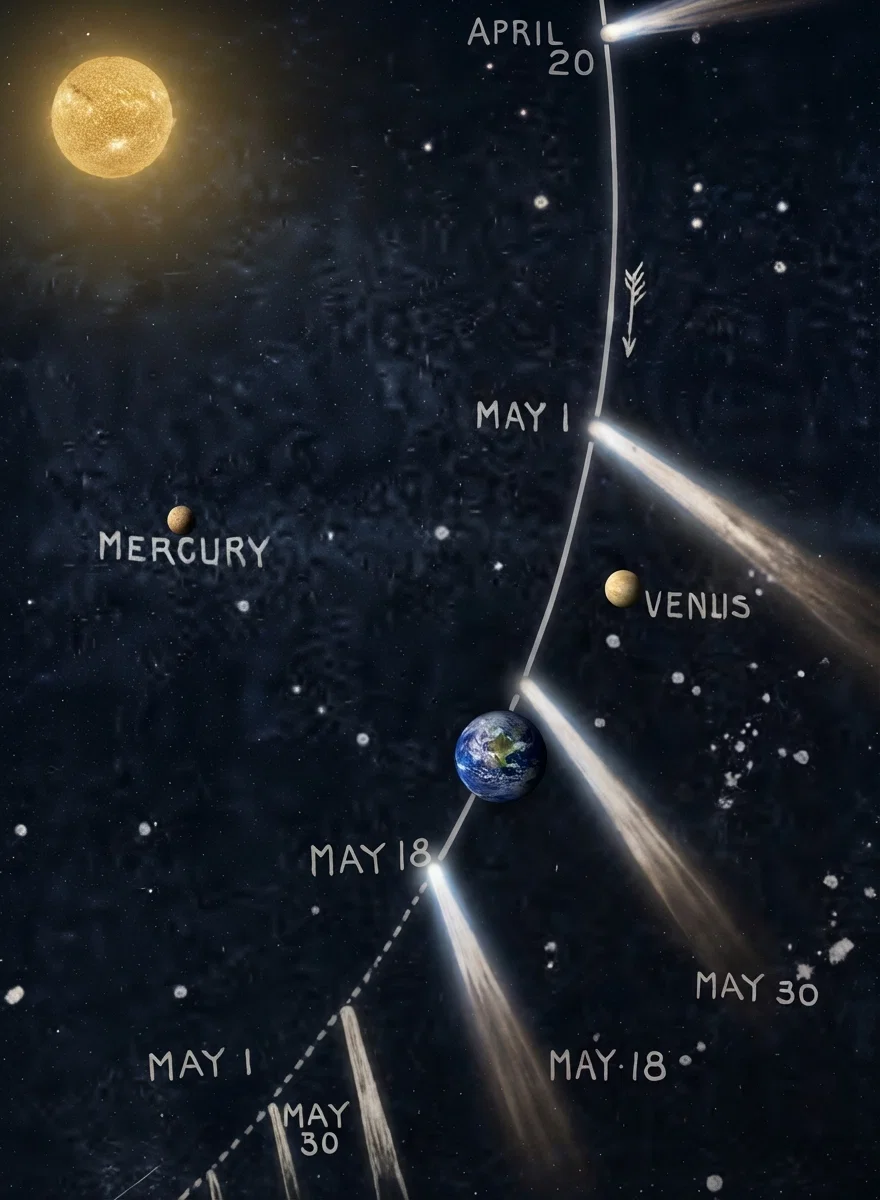
HALLEY'S COMET, THE SUN, AND THE EARTH The sun is the large sphere; the earth the small sphere not named.
A recent writer, with airy flippancy, says he "can pack a comet's tail in a trunk;" another, that he "can carry it in his hat!" Neither gave the size of the comet's tail, the trunk, or the hat. No one KNOWS much about the tail of a comet, but the speculations and guesswork about them would fill many trunks. It is safe to say, however, that the tail contains very little solid matter; for stars that would completely disappear when near the horizon, on account of our earth's atmosphere, have been seen DISTINCTLY shining through a comet's tail where it was a million miles or more in thickness. The tail, taken generally, is perhaps more nearly a vacuum than can be produced by the best air-pumps.
A great geologist, the greatest of his time, instead of naming a certain definite period of time as the age of the earth, as many smaller men have done, contented himself with simply saying, "The time was long," and let it go at that. Why not say the same of the matter in a comet's tail?—the amount is small. When we go beyond that, in our present state of knowledge, it is guesswork, not science.
I was once authorized to ask my friend the great astronomer Barnard, to lecture before a certain body. He readily consented, asking what he should take for his subject. As he had, at that time, discovered more comets than any other living astronomer, and had studied and written much about them, and, I must confess, with the hope of learning myself about these perplexing bodies, I suggested comets. "But I don't know anything about comets," said Barnard; and he—wisely, I think—chose another subject.
The present apparition of Halley's comet is a practical demonstration of the fact that the mathematical astronomer can, when he has the reliable observations that can be furnished by the skilful observer, pursue a comet to the uttermost confines of our system; and altho it may be invisible for a thousand or thousands of years, and travel with inconceivable speed, it is never for even a single hour beyond his ken. Yet no astronomer can answer this simple question: "What is a comet?" They are among the greatest, if they are not THE GREATEST puzzles with which astronomers have to deal. Changes take place within a day that make the comet almost unrecognizable. Some have completely disappeared, and there is an actual list of "lost comets!" A whole issue of the SIGNS could be filled with the remarkable doings of comets.
The spectroscope, an instrument as wonderful as the telescope, has given us valuable information about the elements, or at least some of them, of which comets are composed. Cyanogen, which is one of them, was discovered in Halley's comet by Frost. Now, while the spectroscope tells us that there is such and such a gas or metal in a comet, it does NOT tell us in what proportion, or how much. Mix a quart of sea water with a barrel of pure water; dip a piece of paper in it, and let it dry; then burn the paper before the spectroscope, and you will detect the presence of salt as certainly as if you were burning salt by the pound.
I know nothing of chemistry, but am told that cyanogen gas is deadly; but, as one may see from the above illustration, the fact that cyanogen is present, does not prove that it is in such quantity as to be dangerous. Our fifty or one hundred miles of atmosphere will give us perfect protection in any event.
The following quoted from Chambers' "The Story of the Comets," page 190, gives still another view of this interesting point: "The important part played by cyanogen in the spectra of comets, considered in conjunction with solar and laboratory observations of the cyanogen spectrum, led Newhall to propound the following interesting questions concerning the nature and origin of cometary radiations: 'Is it not possible that the hydrocarbons, nitrocarbons, etc., whichseem to be evidenced by the spectra of all comets, are always present in circumsolar space, and rendered incandescent by some process connected either with the motion of the solid parts (including dust) of the head of the comet through vapors, or with the emission of some influence from the comet's head?' Are we to say that all comets, wherever they may come from in the universe, and whatever their main material may be, always bring with them the cyanogen and hydrocarbons which give them luminosity? Or is it not more rational to say that the spectra of all comets are approximately similar, because they always find the same vapors spread in their path as they approach the sun, and can only elicit the spectra of the vapors?'"
In other words, the author of this interesting theory believes there is cyanogen all around us, and that the comet merely makes it visible. If this is true, then the earth has been passing through this much dreaded cyanogen since the morning stars sang together! Moreover, if it is only the comet's head that renders the vapors incandescent, then the danger, if any, would be some fifteen million miles from the earth, for that is about the distance the head will be from the earth May 18, when the earth, sun, and comet are in a straight line.
There is some reason for believing the earth passed through part of the tail of the great comet in 1861, on Sunday, June 30, near sundown. A certain vicar thought it unusually dark, and ordered the pulpit candles lighted; and Sir Robert Ball, the eminent and witty Irish astronomer, says that the burning of those candles "was the only loss to the earth!"
It seems, then, that there is nothing to fear, altho, if the comet makes a fine display in the middle of May, as every astronomer fervently hopes it will, I feel safe in predicting the biggest prayer-meeting, at that time, in the history of the world.
The distance of the comet from the earth for the following dates is calculated from the Ephemeris of Mr. Crommelin:
April 20 111,900,000 miles
" 28 84,900,000 "
May 6 55,700,000 "
" 10 40,900,000 "
" 12 33,800,000 "
" 14 26,900,000 "
" 16 20,800,000 "
" 18 16,100,000 "
" 20 14,300,000 "
" 24 20,700,000 "
" 30 40,600,000 "
It will be observed that the earth and comet are nearer together after they have been in a straight line, than at that particular time. The comet actually passes only about 6,000,000 miles from where the earth will be in the first week in May. Its nearest approach to the sun (or perihelion) will be on April 19—about 58,000,000 of miles. Its greatest distance, 3,300,000,000 miles, will be reached in about thirty-eight years.
From April 19 to May 16 the comet and the earth will approach each other at the rate of 3,500,000 miles a day; while near the end of May they will recede from each other at about the same rate. After the 19th of April, until it reaches the other end of its path—far beyond Neptune—it will constantly diminish its speed.
If one of the planets were traveling in the place of the comet, astronomers could tell with certainty just about how bright it would appear to us, but a comet is so uncertain, in nearly everything except its position and motion, that the following theoretically calculated brightness must not be taken as trustworthy, but only roughly approximate:
Calling the brightness on April 20 25, on May 1 it should be (theoretically) 50, on May 6 76, on May 10 125, on the 15th 324, on the 16th 410, on the 19th 696, on the 20th about the same, and by the 25th it will diminish to 185. It is possible that the above may prove to be reasonably correct.
I expect, in a clear sky, we will be able to see the comet without a telescope by May 1, or before. From May 1 to the 15th it will rise about two hours before the sun. The observer's latitude has something to do with it; and the SIGNS being a great traveler, I will not particularize, except to say that in certain parts of the country it will rise nearly two and one half hours before the sun. About one hour must be taken off this for the strong light of the dawn.
It will rise, during all this time, near where the sun rises, the end of the tail rising earlier—how much earlier depends upon the angle, which is known, and is variable; and the length of the tail, which can not be predicted.
Between the 15th and the 18th, whether it can be seen or not depends upon its brightness, and the same may be said from the 18th to the 20th. On the 18th it will change to an evening object, setting AFTER the sun, going down tail pointing east and up, something like the big comet we saw last January; but I hope to see Halley's as a more conspicuous object than comet 1910a. On the 20th it will set about an hour after the sun, and nearly four hours later toward the end of the month; but it will be rapidly receding, becoming fainter every day.
April 13.