Shiloh: the Man of Sorrows

3%

Pacific Press Publishing Association · Mountain View, California · Apr 26, 1910

FromSigns of the Times, Vol. 37, No. 16.

Read the full edition

Shiloh: the Man of Sorrows

Copyright, 1910, Pacific Press Publishing Association
By Mrs. L. D. Avery-Stuttle

Chapter VIII. From Egypt to Nazareth

MEANWHILE the carpenter of Nazareth still abode in Egypt. The lavish and generous gifts of the Eastern princes had made this long journey possible, and contributed to the support of the heaven-blessed family while in a land of strangers.
One glad night while Joseph slept under Egyptian skies, the angel once more spoke to him, and on the morrow Joseph made known to Mary the import of the heavenly message:
"See, my Mary, we be again appointed to return homeward; for in the visions of the night I saw the angel; and he said unto me, 'Arise, Joseph, take the young Child and His mother, and go again into the land of Israel; for they are dead which sought the young Child's life.' Shall we go again into Judea?"
"Verily; and into the city of Bethlehem if it pleaseth thee?"
Finally in their journey they had passed the land of Simeon and entered the borders of Judea.
"Art thou weary, my Mary? See, the Babe sleepeth soundly. The sun dippeth his broad shield deep into the waters of the Great Sea. Yonder are the mountains of Judah. Our journey draweth near its close, — and blessed be the God of our fathers."
"But look ye, mine husband, we be scarcely two days' journey from Jerusalem, and we know not who succeedeth Herod as king. Come; yonder lieth the city of Beersheba; let us rest until the morning."
That night as they ate their humble meal prepared for them by Reuben, their kindly host, the man questioned, turning toward Joseph:
"Thou hast traveled far with this thy daughter," he began; "from whence camest thou, and whither goest thou, my brother?"
"The woman is indeed my wife," replied Joseph proudly, glancing at the young woman, "and we are come from Egypt, from the city of Heliopolis. To-morrow, if the Lord wills, we journey on toward Bethlehem."
"Toward Bethlehem!" exclaimed Adah, the wife of Reuben. "Verily ye have not heard what King Herod hath done in Bethlehem!"
"But Herod is dead," replied Joseph. "Yes; but of a truth he lived long enough to cause every male infant in Bethlehem to be slain, according to his word."
The face of the young mother turned white as marble, and she pressed her Babe closer in her arms. The delicate head bent lower until the waves of shining hair fell over her brow, while the violet eyes glanced timidly upward, with a frightened, appealing gaze, like that of the forest fawn, hiding from the hunter.
"How beautiful — how beautiful she is!" whispered Adah; "and the Child — how wondrously beautiful! I shall never forget the face of the woman."
"Who reigneth in the room of Herod, if thou knowest?" asked Joseph, uneasily, after they had listened to a description of the horrors of the massacre, from the lips of Adah.
"Archelaus, the son of Herod, doth reign," replied Reuben; "and much I fear he hath the temper of his father."
The next morning, the guests of Reuben made an early departure. But instead of passing north, through the country of Judea, as they had intended, they made their way in a somewhat more zigzag course, toward Nazareth of Galilee.
Nazareth — "the watched and guarded one." Completely shut in by a natural guard of some thirteen mountains of white and gray limestone, the quiet village lies in the valley of green, — itself an elevated plateau. The contrast between the white hills, which form the background from every direction, and the spring-time verdure of the valley, is very effective. Everywhere the landscape is dotted with brilliant flowers. The red of the anemone and the white and yellow of the rock-roses blend beautifully with the pink of the phlox and the yellow of the wild marigolds.
The rough mountain road, little better than a donkey path, approaches the village from the south.
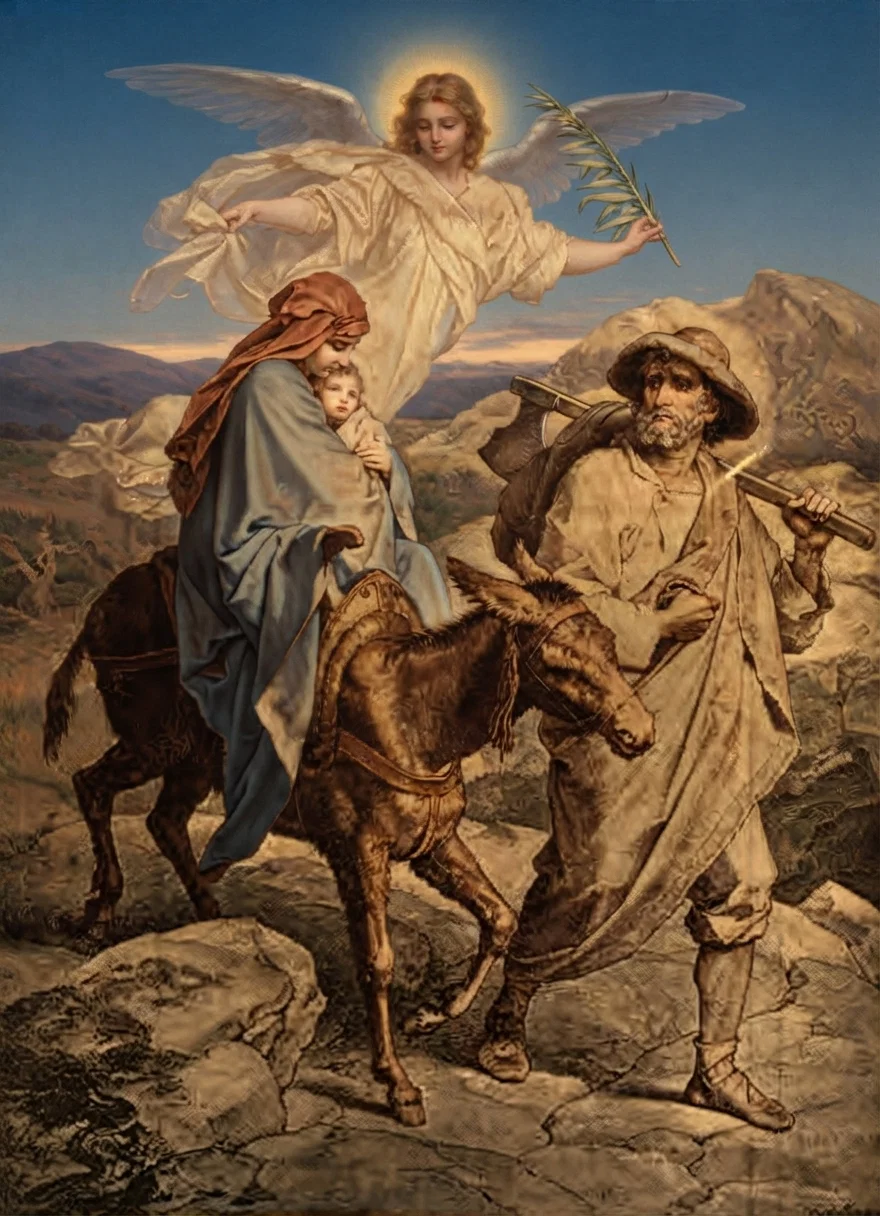
The Holy Family between Egypt and Judea
At a little distance is the natural fountain upon which the simple villagers depend for their daily supply of pure water. Here gather the women, young and old, with their rude water-jars; while cattle and donkeys quench their thirst at the troughs scattered conveniently about. In every direction are gardens of figs and almonds, and orchards of pomegranates and oranges, while the trees and hedges of cactus are alive with song-birds.
Into this quaint little village, with its flat-roofed limestone houses and its narrow, winding streets, tramps a little procession from the south, at the close of one bright day: a tall, dignified-appearing man somewhat beyond the prime of life, and a beautiful woman, hardly past the first flash of maidenhood, seated upon the humble animal which has borne them all the long journey from the land of the Pharaohs.
In the arms of the woman lies a sweet Babe, to worship at whose infant feet journeyed the wisest princes of the East; for whom sang the angel choir over the hills of Bethlehem; and for whose sake the cries of the weeping Rachel echoed in the ears of the prophet.
Ah, it is that Babe upon the success of whose tremendous and mysterious mission depends the eternal weal or wo of every son and daughter of Adam.
And here, gentle reader, we will leave them, while the flowers of a dozen spring-times lift their heads and again wither and die upon the mountains of Galilee.
(To be continued)