Our Letter from Athens

3%

Pacific Press Publishing Company · Mountain View, California · Dec 23, 1908

FromSigns of the Times, Vol. 35, No. 21.

Read the full edition

Our Letter from Athens

III.—Progress of Reform in Turkey.

DIPLOMATISTS say, to quote the words of a pasha of the old regime who escaped with his life to Italy the other day, that "the sultan granted the constitution to check the interference of the powers in the Macedonian question."
To give color to the opinion, we have only to recall that when the constitution was promulgated in 1876, Turkey was at least as near dismemberment through foreign interference as she is to-day, and that the proclamation of the constitution then was as great a surprise to the world as was its issuance on July 23, 1908. In 1876, the near Eastern Question was at a very critical stage, with Russia the chief instigator. In 1908, Russia again, shut out in the middle and the far East, is apparently the prime mover in the recent crisis, with England at her heels, as she also was in 1876.
Altho Turkey did not avoid serious loss of territory and prestige by the granting of the constitution the first time, she seemingly is to gain more advantage by the same course in the present situation; for, while there are apparently insuperable obstacles in applying a constitution to a country of so cosmopolitan a population cherishing intense prejudices and interracial hatred, in a land where the fatalistic, polygamous, antichristian spirit of Mohammedanism prevails, where moral and political corruption have been rife for centuries, yet daily recurring events indicate almost incredible progress in reforms instituted only a month ago. The hand of the reform party, the so-called New-Turks, is unsparing in overturning, rooting out, purging, reorganizing, and regenerating, with little serious resistance by the Anti-Reform, or Old Turkish Party, and with at least the acquiescence of the sultan.

Results of the Reform Movement.

The reform movement grew out of an organization among progressive army officers, by the name of "The Union and Progress Society." In time it spread extensively through the ranks of the army, which gave it great strength when the time came to strike. It broke out in Macedonia, but was soon found to have strong supporters in Constantinople itself. All European Turkey is now under martial law. One despatch says:
"The sultan does not direct affairs in Turkey to-day. Neither is there any regular government, for all government is dissolved. The New-Turks are everything. They have taken into their hands the direction of all European Turkey, from Constantinople to the smallest Macedonian hamlet."
The pressure they brought to bear on the sultan brought the constitution. What they have accomplished to date may be briefly summarized as follows:
1. The sultan virtually acts at their dictation.
2. The political spy system is abolished, thus saving an annual expenditure, it is said, of eight to ten million dollars.
3. The censorship of speech and of the press has been lifted, the first uncensored telegram being sent July 28. Weekly newspapers have changed to dailies, and the size and number of dailies increased, and yet the demand can scarcely be met.
Up to the present, no one dared utter the words "freedom," "fatherland," or "nation," without fear of arrest. Not a Turkish dictionary has contained the words "liberty," or "equality." Only to-day a publisher announces a new edition of his dictionary, to contain for the first time for thirty-two years these two and many other words forbidden heretofore by the censors. The sultan has expressed a wish to have medals or souvenirs struck off bearing the inscription, "Liberty, Equality, Justice," and post-cards have arrived in Athens with an imprint of the same in colors, with a bust of the sultan in the center.
4. A general amnesty has been proclaimed to all political prisoners and exiles. In Monastir alone, 1,600 prisoners were set free, and 2,100 in Thessalonica. One steamer leaving Alexandria the other day had 500 Greek, Armenian, and Turkish exiles aboard, returning to Constantinople. Thousands who have been in exile from one to twenty years, are returning from all points of the compass, among them the son of Midat Pasha, author of the constitution, who had been in banishment twenty-seven years.
5. The resignation of the first cabinet formed under the constitution, because of the opposition tendencies of its personnel, and the forming of a new cabinet that gives general satisfaction, three members of which are said to be Christians—one an Armenian Catholic, one a Syrian Catholic, and one a Greek Catholic. The secretary of war returns from an exile of twenty-two years in Tripoli to take one of the most responsible portfolios in the cabinet. His wife is a Greek of the line of Themistocles. The prime minister has announced his intention to transform the military harbors of Turkey into commercial ports, and thus solve, as he says, the much-discussed question of the Dardanelles.
6. The removing of governors of provinces who belong to the old party, and the substitution of New-Turks in their offices; and the recalling of the Turkish ministers at Washington, Paris, Berlin, and St. Petersburg, for the same reasons.
7. The arrest for trial of many Pashas, Beys, and Effendis, whose unjust and extortionate practices are so well known that the populace clamor for vengeance. Some of this class have made their escape, and a few have been murdered or have committed suicide, notable among the latter being the chief of the secret police system. Of the fugitives, one will serve as a fair sample, Izzet Pasha. He was second secretary to the court at Yildiz, and chamberlain to the sultan. Once arrested, he escaped from confinement, shaved off his beard, disguised himself in a priest's garb, and boarded an English boat just departing, having forced the harbor boatman at the point of a revolver to row him to the steamer. A deputation of New-Turks gave chase with a launch, but being delayed in obtaining the launch, the steamer outstripped them, and they returned to flog severely the official who had resisted their taking the launch. They then telegraphed to the Dardanelles to hold up the steamer there, but the captain refused to give up his passenger without authorization from the British consul, who telegraphed the home office for instructions. A negative answer came on the basis of no extradition treaty between England and Turkey, and Izzet made good his escape.
Izzet Pasha is of Arab extraction, from Beirut, educated in the school of Jesuits there. He is not supposed to have all his harem with him, two of whom are Jewesses, but at least two were seen on the steamer when it touched at a Greek port. Cartoons sold on the streets of Constantinople represent him fleeing, clean shaven, with a blood-stained bag of pounds sterling under his arm, and with the body of a serpent 'because he was a serpent all through his life.' His salary was $250 a month, but his property is valued at 'the dizzy sum of fifty million dollars,' as a Greek paper puts it. An English mechanic who has visited the mansions of many aristocrats, lords, and American 'billionaires,' testifies that he never before had seen such luxurious and costly furnishings as he found in the mansion of Izzet Pasha, one chandelier alone being worth $20,000. The checks on his person when he fled are variously estimated from one-half million to a million and a half dollars. One of his crimes is said to be the accepting of a bribe of $75,000 from the Rumanian Government. The constitution party purpose to confiscate some of the property of these public robbers, and restore it to rightful owners or to the poor.
8. The setting on foot of proper measures for the registration of citizens and the holding of general elections in November.
9. The emancipation of woman. The Union and Progress Society has branches largely composed of Mohammedan women. The Thessalonica branch recently held a public mass-meeting. The vice-president of that branch is the daughter of a former attorney-general in the sultan's cabinet and wife of the present governor of Serres. She and her sister are among the most highly educated of Mohammedan women. At the mass-meeting she appeared for the first time in public uncovered, and prefaced a patriotic speech which she delivered in Liberty Square, with the words, 'Long live the nation! Long live our fatherland! Long live Liberty!' In her address she said:
'Freedom, who, in the person of those who have dared speak in her behalf, has sat bound in the galleys for thirty years, has been liberated from her fetters by the sacred society of Ottomans, 'Union and Progress.' This accomplishment permits us to lift up our heads and look life in the face. In the Koran it is said that we ought to be taught and educated from the cradle to the grave. The Ottoman women who have heeded this injunction of the Koran, fully sense to-day all the mighty significance of the word 'Liberty,' which they have ardently adored. Without renouncing the sacred duties which Islamism imposes upon the companions of men, we unite our joy with that of the whole nation, and heartily fraternize with all. At this transcendent movement we reckon it a duty —
'1. To congratulate from our inmost souls the Ottoman society of 'Union and Progress,' and to cry from the depths of our hearts, 'Long live the Society!'
'2. To curse the memory of the spying ministry who hunted down the noble liberators of our country.
'It is impossible to express our thanks to all these brave champions of liberty, but we include them all in the person of the most esteemed and energetic member of this body, Rephek Bey, whose hand we press from the heart.
'Let us therefore, lady citizens, all shout together, 'Long live Rephek Bey! Long live the Society! Long live Liberty!'
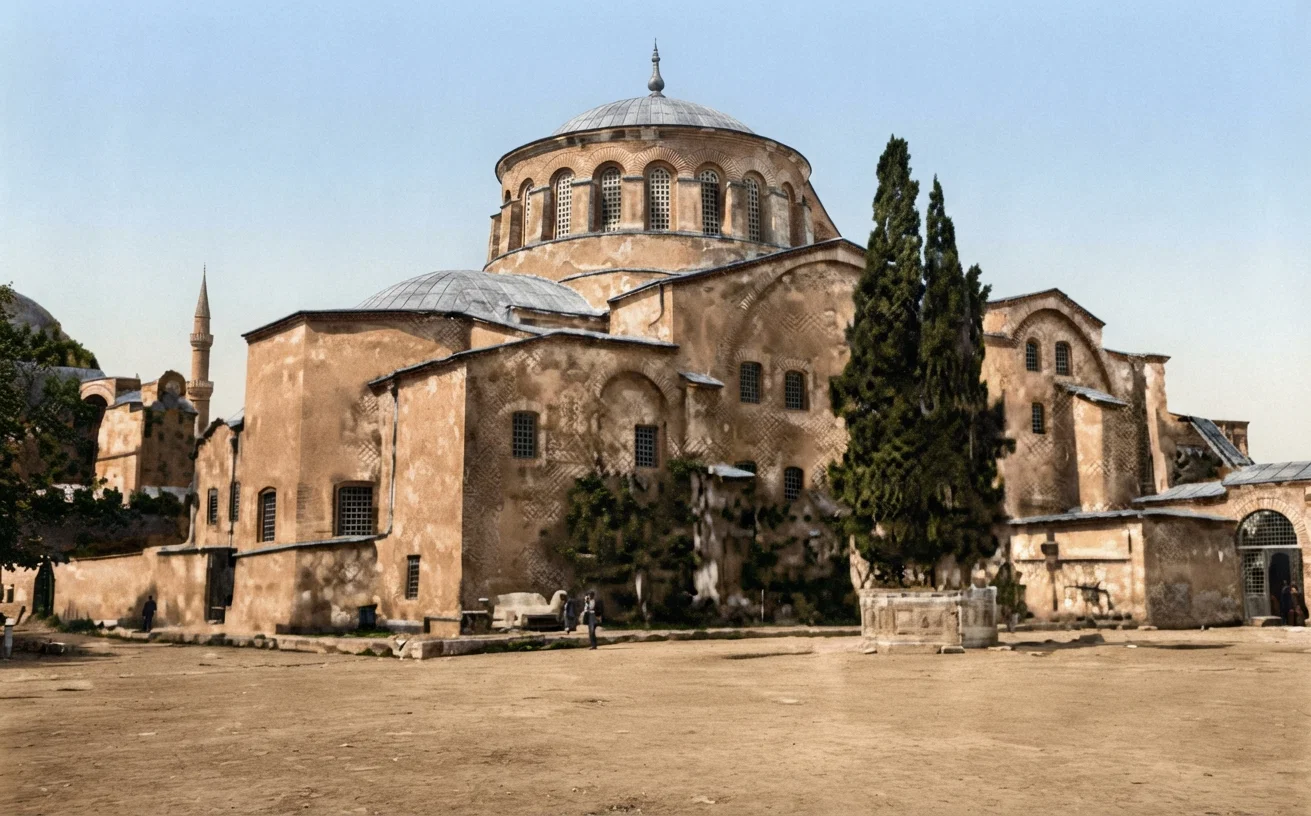
Greek Church of St. Irene, built in the Sixth Century, now used as a museum.
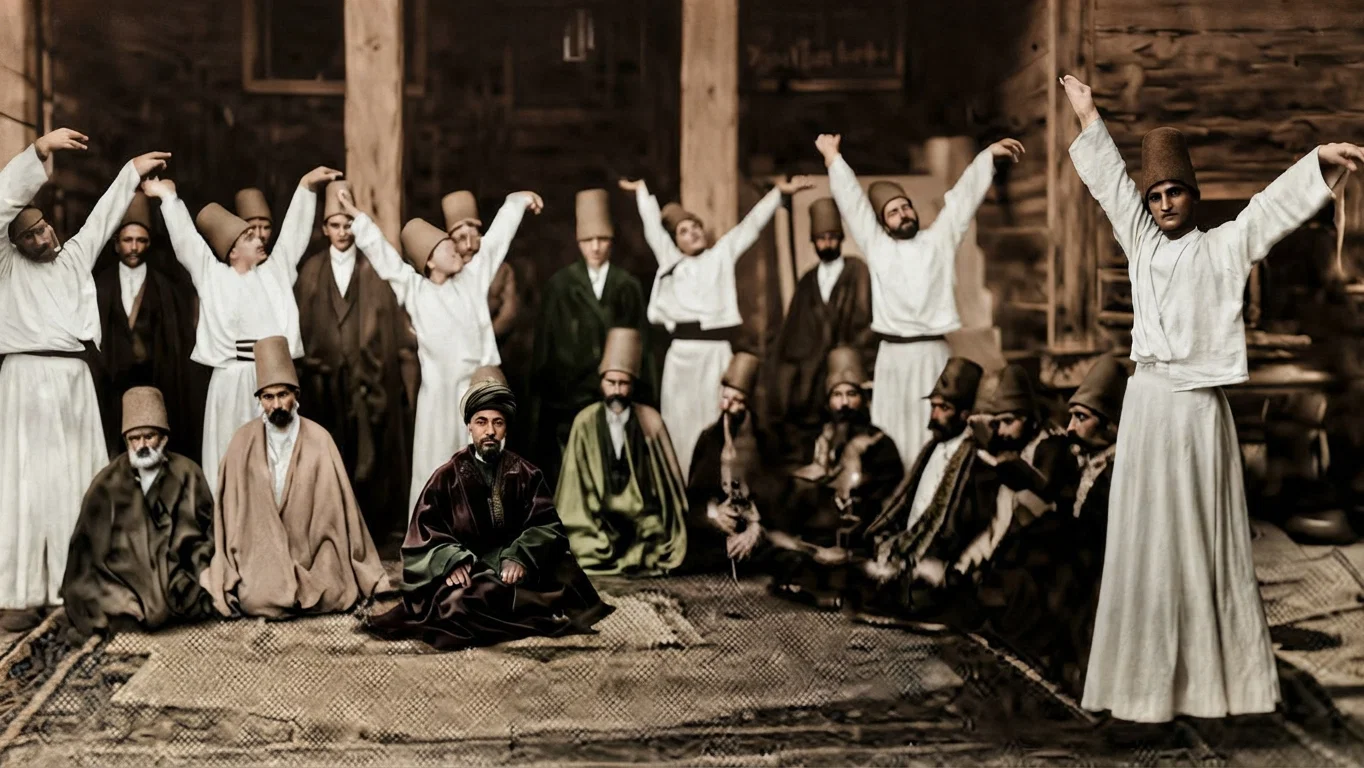
Dervishes at worship. In Mohammedan countries they resemble the monks of Christendom. They have enjoyed the highest respect of Mohammedan princes and Turkish sultans, and do still that of the people. They are to some extent under the supervision of the Sheik-ul-Islam. Their sheik, or leader, sits on the mat, in the center of the picture.
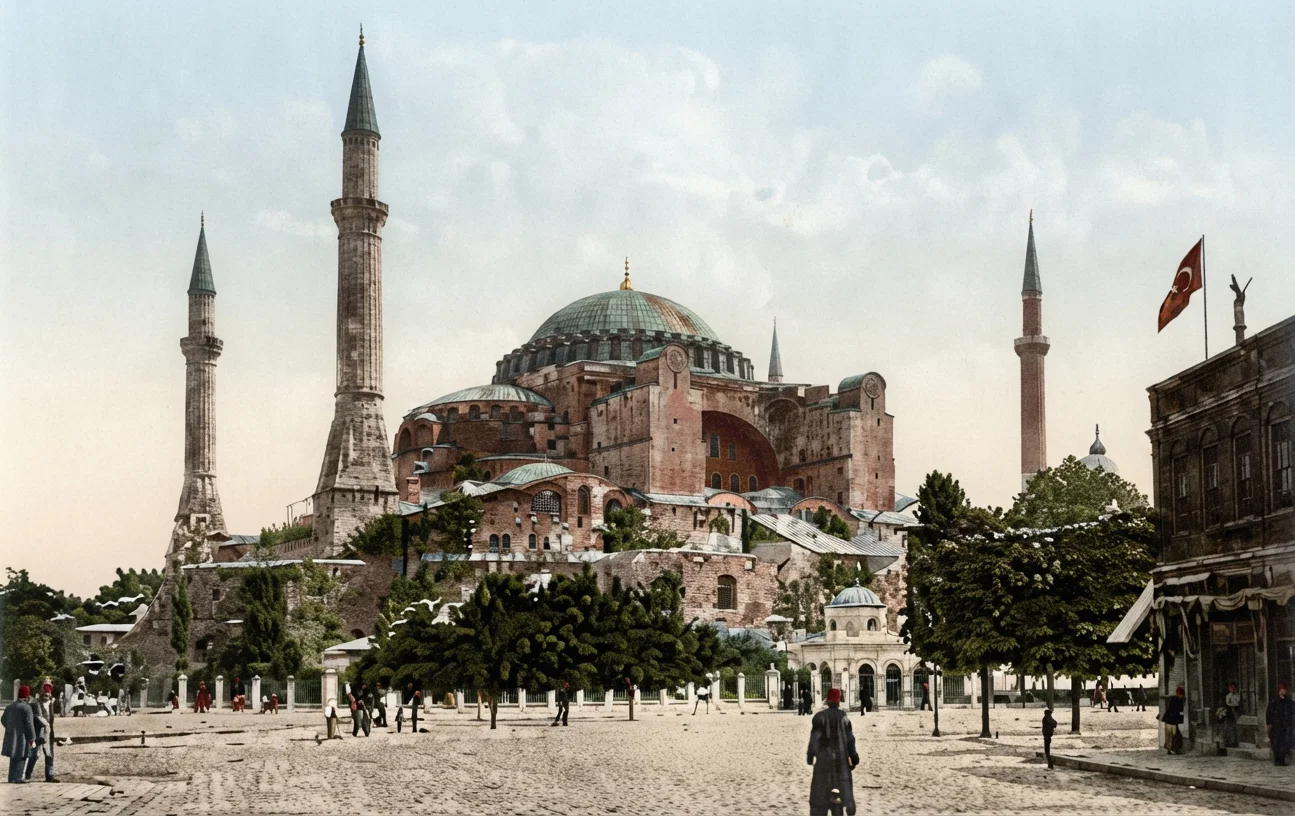
The Celebrated Cathedral of St. Sophia in Constantinople.
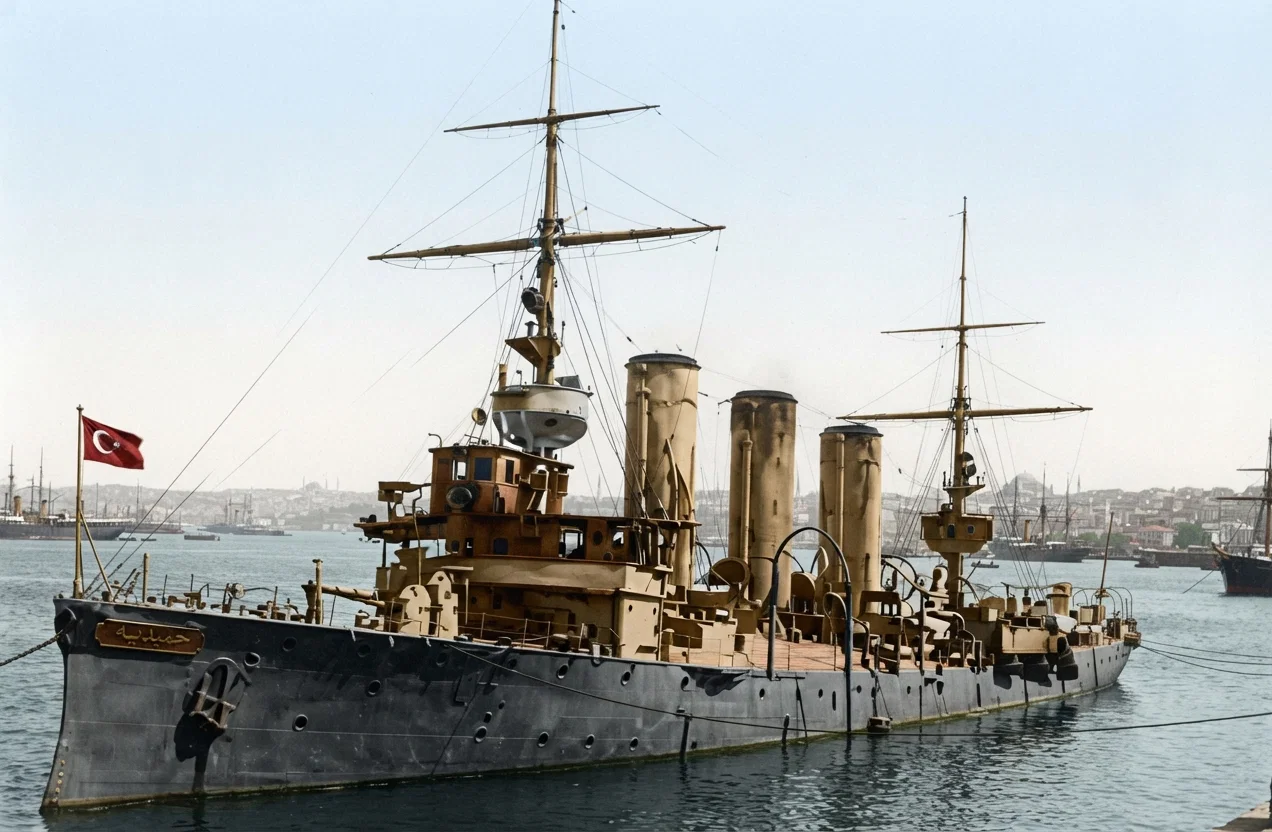
Turkish battle-ship, “Hamidie,” named after the sultan.