Killed

3%

Pacific Press Publishing Association · Mountain View, Cal. · Oct 17, 1916

FromSigns of the Times, Vol. 43, No. 41.

Read the full edition

Killed

by a Sunday Law

Good Citizens Imprisoned

Others Suffer Death

By William H. Martin

“Enough potatoes for dinner.”
It is oftentimes stated that there is no danger of any one's suffering through the enactment of religious laws; that we have passed the age of persecution.
It was the writer's lot to live in a state where there was a rigid Sunday law, and to experience and observe its workings.

The Dangerous Law Enacted

IN the year 1885, the legislature of Arkansas passed a stringent Sunday law; and what follows is a brief record of some of the things that occurred in the two years before it was modified.
My father, William Martin, was an elder of the Seventh-day Adventist Church in the little town of Springdale, in the northwestern part of the state of Arkansas. Previous to his accepting the Adventist faith, father was not a Christian; but he was converted under the preaching of two Adventist ministers, in the year 1884. He then set up the family altar. The current of his life was changed, and he became a devout Christian. The change in his life was recognized by his neighbors and friends, among whom he was highly respected. Each Sabbath morning, he would take his family, and drive from the farm, one and a half miles out of town, and worship in the little village church, with his brethren.

Religious Bigot and Spy

ONE Sunday morning, after having kept the Sabbath according to the commandment, father and I took our horses and plows and went into the cornfield, half a mile from any public road, and were quietly working.
A neighbor left his home that morning, came through a quarter of a mile of woods, then another quarter of a mile along a rail fence opposite the field where we were working, saw us about our business, and the next day went before the justice of the peace and swore that our working "disturbed" him.
My father was tried as a criminal before the law. This shows that it is a dangerous thing to put power into the hands of a religious bigot, thus enabling him to persecute his fellow men.

Dug Potatoes and Was Put in Jail

ANOTHER elder of the church, J. A. Armstrong, went into his garden one Sunday morning to dig enough potatoes for the family dinner. A neighbor of his, whom he had many times befriended, passed by his house that Sunday morning, saw him in the garden, and indicted him before the mayor of the town. Mr. Armstrong was tried, convicted, and taken to prison by a drunken deputy sheriff with two six-shooters buckled around him, and compelled to lie in jail four and a half days, for the simple act of digging, on Sunday morning, enough potatoes for dinner.
He was a good citizen and a good Christian, yet he was branded a criminal.
All history testifies that religious laws enacted at the behest of those who make a profession of Christianity have operated to the great disadvantage of those who are really devout Christians. Sunday laws are no exception to this rule.
Belonging to this same Seventh-day Adventist Church was a man named Swearingen. This man was one of the deacons of the church. After having worshiped with his family on the day which he thought was pleasing to his Master, he and his son were hauling wood to their home one Sunday morning.

Squirrel Hunter Convicts Him

A NEIGHBOR of his came strolling through the woods with his rifle, shooting squirrels. He came upon Mr. Swearingen and his son, and stopped for a while to converse with them, then passed on. A few days later, this neighbor was called before the grand jury to testify concerning violations of the Sunday law. Of course, he told the incident of having seen these men at work. A bill was found against them by the grand jury, they were tried in the court at Bentonville, the county seat of Benton County, were convicted, and sent to prison, where they served a term of twenty-six days.
It was the writer's privilege to go into that foul-smelling jail, spend a little while with these men, and then bow in prayer to the God who always hears the oppressed and the persecuted.

Took His Horse and Cow

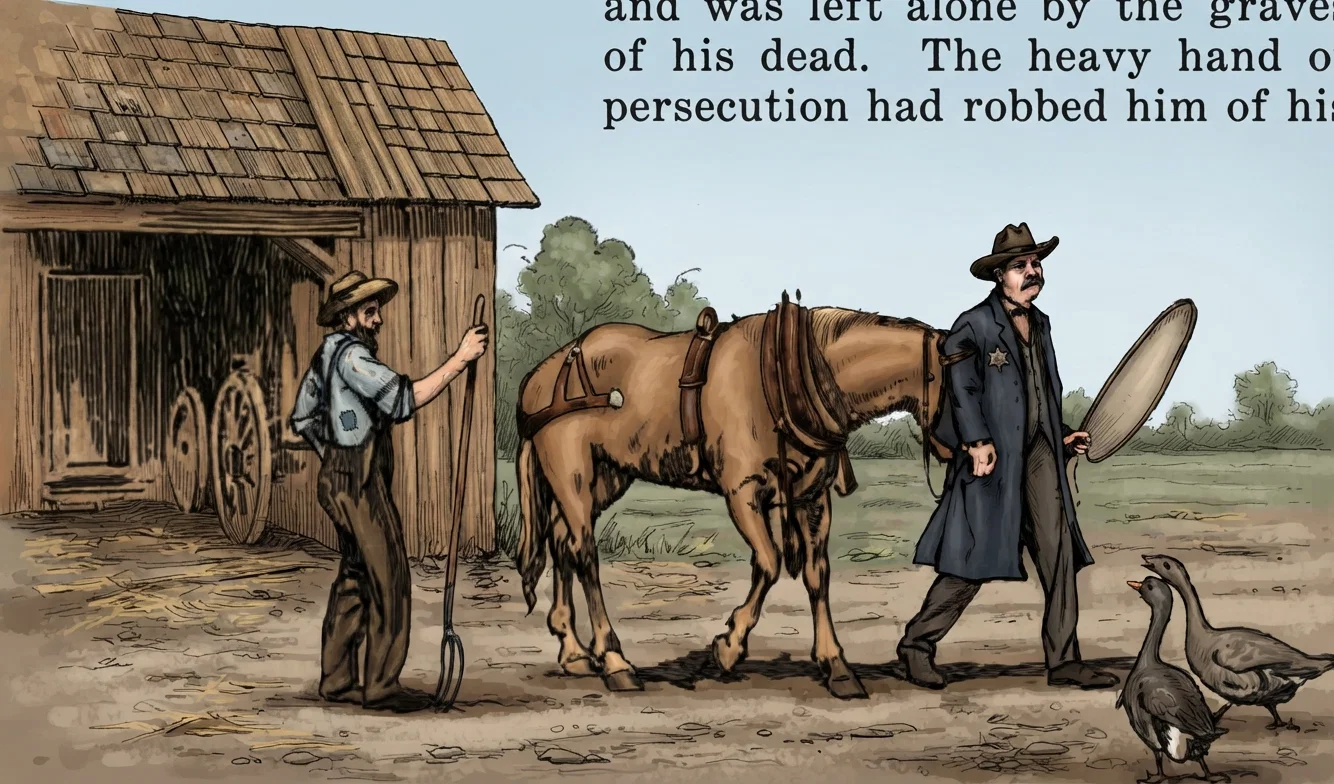
WHEN the prison term was up, Mr. Swearingen and his son went home, thinking they were free men, and that the demands of the law had been met. A few days later, however, the sheriff of the county rode up to the gate, called Mr. Swearingen from the house, and presented to him a bill for the board of himself and son while in prison. The old man stated that he had no money; so the sheriff levied on his horse, led it away, and sold it. The bill was not yet paid; and the sheriff, returning, levied on the only cow, and was intending to sell it; but kind neighbors
So the sheriff levied on his horse.
paid the fine, and the cow was saved to the family. If there was ever persecution during the Dark Ages, this was persecution that was brought upon this godly man, causing him to suffer imprisonment and the loss of his goods. The God who marks the sparrow's fall has written this all down; and sometime, some one will have to answer for it. These cases all came under the direct observance of the writer of this article.
When the legislature convened again, in the year 1887, honest-hearted men were tired of such proceedings; so a bill was introduced by Senator Robert H. Crockett, grandson of the noted David Crockett, intended to place all citizens of the state on an equality before the law. In his argument for the passage of his bill, Senator Crockett told not only of these cases mentioned, but of others just as true. We have taken pains to verify the following, as given by Senator Crockett:
A young Seventh-day Baptist and his wife, newly married, came from a northern state and settled in Arkansas, there to make their home. They were God-fearing, humble people, industrious and honest. In course of time, a sweet babe came to their home, and their cup of joy was full. This young man believed that the God who commanded him to rest on the seventh day gave him the privilege of working six days. A neighbor saw him at work in his field on Sunday, and indicted him before the grand jury. He was tried, convicted, and sentenced to prison. Persecution with its venom had entered his home, and a deep shadow fell across his household. The wife was deprived of her husband, and the babe of a father. A good citizen was counted as a criminal.

His Baby and Wife Killed by a Sunday Law

A FEW days later, the baby sickened. The young wife called a messenger, and sent him to prison with a request that her husband be allowed to come home, as the doctor had said the baby must die. The hard-hearted jailer said "No," that the man must serve his prison sentence.
That night, the baby died, and kind neighbors carried it to the cemetery for burial. The wife came home broken-hearted, and took to her bed. Again a messenger was sent to the prison to ask that the husband be permitted to come home, as the wife was dying; but again the request was met with a refusal. When the next morning broke, the young wife's life was gone out, a victim of the persecutor's misguided zeal.
The following day, when the neighbors were gathered in that humble home, the husband and father, having completed his sentence, was released, and came to the spot made sacred by the presence of his wife and baby, but over which now deep gloom was spread.
He followed the remains of his wife to the cemetery, and there saw the flowers, scarcely withered, on the grave of his baby. Bowed down with grief and sorrow, he saw his wife lowered into the earth, heard the few simple words spoken by the minister, and was left alone by the graves of his dead. The heavy hand of persecution had robbed him of his dearest treasures on earth, and had ruined his home, just as religious legislation has always done in the past and will always do in the future.
The only safe rule is, to leave the question of how and when man shall worship, to the individual and his God, and adhere to the true American idea that the state should have nothing whatever to do with the control of the religious belief of its citizens.