When the Church Enters the Political Arena, She Divorces Herself from Her Divinely Appointed Sphere
By
Phil. C. Hayward
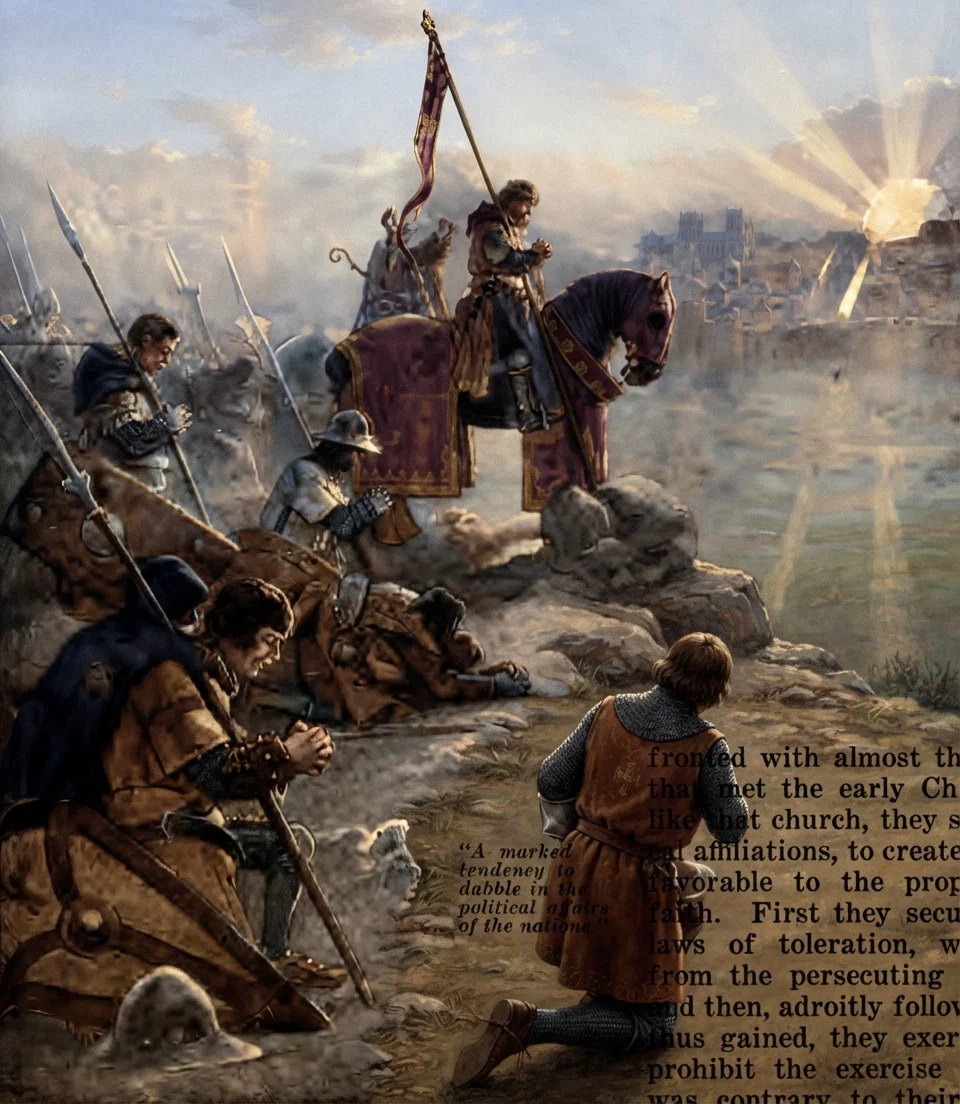
WHEN the Christian church enters the field of politics, she is evidently out of her place; for her Master has said, "My kingdom is not of this world." But unmistakably plain as is the meaning of this assertion, the church, very early in her history, developed a marked tendency to dabble in the political affairs of the nations with which she came in contact. This was probably due to two primary causes: first, an honest desire, on the part of some, to create an environment more favorable to the propagation of the Christian religion; and second, the ambitions of a worldly-minded, power-loving bishopric.
Of the two, however, the latter very early became by far the more important factor; and under the conditions favorable for growth which were created after the Roman Empire became Christian in form, the bishops of the church sought political preferment, obtained political offices, wielded political power, secured political sanction for their dogmas and decrees; and soon, by these perfectly natural steps, they dominated the affairs of the nation.
It was through these influences that the ecclesiastics were able to induce Constantine to propagate the first "Christian" Sunday law the world ever knew. Also it was under these influences that pagan philosophy began to control the teachings of the Christian schools. And these influences, with their corrupt practices, led the world into the midnight of the Christian church.
The Footprints of Intolerance
SUCH were undoubtedly the effects, upon the Christian church, of her adulterous union with the civil power. But what was the result to the state with which that union was formed? For a nation to allow itself to be dominated by a church is as fatal as for a church to allow itself to be dominated by the civil power; and the immediate effect of this union, upon the state, was the complete ruin of the Roman Empire. It is more than a coincidence that the days of the greatest political power on the part of the Christian church were the days of the decline and complete dismemberment of the Western Empire of Rome.
When the morning star of the Reformation had dawned, the Protestants were confronted with almost the identical conditions that met the early Christian church. And, like that church, they sought, through political affiliations, to create an environment more favorable to the propagation of the true faith. First they secured the enactment of laws of toleration, which protected them from the persecuting hand of the papacy; and then, adroitly following up the advantage thus gained, they exerted their influence to prohibit the exercise of any religion that was contrary to their own conceptions of what the true faith was.
Under these influences, bitter controversies sprang up, between the different Protestant bodies, as to what form these religious laws should take in the several countries. The Lutherans, the Catholics, the Zwinglians, and the Calvinists were each the persecutors in their own country, but were the persecuted whenever they might chance to be in a country whose laws happened to favor some other creed or form of faith. Because of this, much bitterness and hatred was engendered between the German, the British, the Netherlands, the Swiss, and the Scandinavian countries. And the conditions thus created were fatal to the progress and prosperity of those countries for more than two hundred years.
Duplicated Atrocities of the Dark Ages
AND as to the effect of these conditions upon the church, the great historian of Protestantism, D'Aubigné, well said of the work of Zwingle in Switzerland, "The Reformer, deserting the paths of the apostles, allowed himself to be led astray by the perverse example of popery." He himself "resolved to be at one and the same time the man of the state and of the church. . . . This double, this triple part of the Reformer was the ruin of the Reformation and of himself." "Zwingle played two parts at once — he was a reformer and a magistrate. But these are two characters that ought no more to be united than those of a minister and of a soldier. We will not altogether blame the soldier and the magistrate in forming leagues and drawing the sword, even for the sake of religion; . . . but we must decidedly blame the Christian minister who becomes a diplomatist or a general."
And this principle of mixing the religion of the church with the politics of the nations impeded the Reformation throughout Europe, and made possible atrocities that rivaled those of the Inquisition. Of the persecution of the Anabaptists, which was general among all the Protestant nations, Mosheim says, "It is true that many Anabaptists suffered death, not on account of their being considered rebellious subjects, but merely because they were judged to be incorrigible heretics."
It was because of these conditions that the Pilgrim Fathers left the Old World and came to the wild American shores, that they might establish "a church without a pope," and a state which would make possible the free exercise of religious belief. But in their zeal to protect themselves in this sacred right, they forgot to protect others in the same right, and there followed fines, foggings, imprisonments, banishments, burnings, and the most barbarous tortures, inflicted upon men and women because they dissented from the state religion of the colonies.
"Leave Politics Alone"
IT was to guard forever against the possibility of a repetition of these conditions, that the American constitution was amended to read, "Congress shall make no laws respecting an establishment of religion, or prohibiting the free exercise thereof." The founders of this republic jealously guarded these rights, and handed them down to bless the generations that were to come.
But their work was not without opposition. Zealous clergymen were ever anxious and alert for an opportunity to bind the church upon the back of the nation. Upon one occasion, General Washington is reported to have said to an English Wesleyan minister who was meddling in politics: "Mr. Wesley I respect; but Mr. Wesley, I presume, never sent you to America to interfere with political matters, but to preach the gospel to the people. Now go and mind your own proper work, and leave politics alone."
It would be well indeed if all our lawmakers to-day could have the courage to say the same thing to the political preachers who646come to them with a great burden to have laws enacted favorable to their own particular brand of religious belief.
More than sixty years ago, such a law was fastened upon the people of Oregon, not for civil purposes, but for religious. The only reason why those laws have done no particular damage to either the church or the state during all these years is that they have not been enforced. If they had been enforced according to their letter, they would have worked great hardship upon a vast majority of the citizens of the state, and many would have been fined and jailed, "not on account of their being considered rebellious subjects, but merely because they were judged to be incorrigible heretics."
Increases Federal Problems
THE truest and best citizen in the state of Oregon to-day could be thrown into prison or fined if he should open his grocery store and sell a loaf of bread to a hungry neighbor on Sunday. But what benefit could possibly accrue to the state or to the church from such a course? It would be but to make an honest citizen a criminal in the eyes of the state, and a heretic in the eyes of the church. By the state, conviction for crime is usually regarded as sufficient grounds for divorce.
The enforcement of this law of the church, instead of helping to solve the great moral problems with which both the state and the church are confronted, would add to those problems by making children fatherless, disrupting homes, depriving families of their rightful support and protection, and taking from the path of honorable industry men whose only offense was selling a loaf of bread, or quietly engaging in an honest, inoffensive, and productive vocation, upon the first day of the week.
But that is not all. If Oregon's present Sunday laws were to be enforced according to their evident intent, thousands of our citizens would be convicted, fined or imprisoned, and robbed of their citizenship, and of the right to help in the affairs of their state and community — and all because of the state's trying to enforce a religious law of the church. This would surely be disastrous to both the state and the church. They would both go down under such a régime, just as they always have in the past under like conditions.
This being true, it is doubtful whether there is a thinking man or woman in the state of Oregon to-day who would vote for a literal interpretation and a strict enforcement of the Sunday laws that are now upon our statute books. But if these laws are not to be so interpreted and enforced, why should they exist at all? Why not adopt the policy of true Americanism and of true Christianity, and repeal these laws, and have here a church patterned after Him who said, "My kingdom is not of this world," and a state whose recognized office it is to protect each individual in his constitutional and inherent right to work lawfully or to worship peacefully, as his own conscience shall dictate?
Why not support the repeal measure at the polls November 7, that we may be free to be religious or not to be religious, without having our citizenship tested by our relations to any church?
" 'CIVIC righteousness' is exemplified in nothing so much as in the conduct of citizens toward each other, each recognizing and respecting the rights of his fellow men. In nothing is the lack of this 'righteousness' so surely demonstrated as in the efforts of one class of citizens to bring another class of citizens to their mode of religious conduct by the compulsion of civil law. That is 'civic un-righteousness' and religious tyranny."
“A marked tendency to dabble in the political affairs of the nations.”