Is Truth to Be Determined by Ballot? — The Worthless Passport — Truth's Defender at the Stake
By Lucas A. Reed
TRUTH is eternal and unchangeable. The statement seems almost trite; but men's attitude toward truth throughout the centuries shows that while many mentally recognize these qualities of truth, in practice they utterly ignore them.
Men will fight over a fact or a reality or a truth, seeming to say that the strongest must be right. Can fighting a duel determine which is right? Is the victor always on the side of truth? Can wars determine of themselves alone what is just? Appeals to force are not arguments for truth, yet force is men's time-honored expedient. If a wall is black, will arguments or quarrels or appeals to force make it white? Men's attitude toward truth does not change truth, though it may change men. Truth cannot be determined by calling an election.
Never before was there such a gathering.
Over and over again, it has been seen that some certain individual has held a closer, finer, more exalted conception of truth than all the other men of his time. Could majorities vote his noble conception of truth into an error, though they should all join in the effort? Yet once in the history of this world, God permitted over four thousand of the greatest men of the time to vote against a solitary man on a question of truth. The one man was in a painful minority. The others were overwhelmingly and unanimously in the majority. They settled a question of truth, as they thought, for all time; but not many years after, it was discovered that while majorities may vote as they please, truth is by them unchanged, for the truth is mighty, and must prevail. As the inspired writer has said, "We can do nothing against the truth, but for the truth."
But to come back to the majority that thought to decide a matter of right and truth: Who were they, and what were they about?
Sigismund was emperor of Germany. He wanted a council of the cardinals and other prelates of the church called to see if they could unite under one pope; for there were two popes at that time, both claiming to be the true and sole head of the church, and each bitterly fighting the other. Hence to settle this dispute, and another matter also, a great council was called at Constance, in Switzerland.
The Violated Passport
NEVER before was there such a gathering. The emperor was there in great state. The pope of Rome was there. And there, too, were seven patriarchs, twenty archbishops, twenty cardinals in their royal red cloaks, twenty-six princes, ninety-one bishops, one hundred forty counts, hundreds of doctors of divinity, and many priests — over four thousand in all. Then multitudes of the people came, filling the old town to overflowing, and making the dull streets alive as they had never been. Peddlers, hucksters, tricksters, mountebanks, charlatans, tramps, monks, friars, beggars, — these all, too, flocked to Constance.
While the council sat month after month, to the great profit of all the shopkeepers and grocers in the place, the one man heretofore mentioned was shut in prison. True, he came of his own free will; came because his emperor wished; came with a passport in which the emperor gave his sacred word to protect him.
But why was he in prison? Had he not the emperor's written promise of protection?
Oh, yes! But the council declared, and the pope asserted, that faith was not to be kept with heretics. John Huss was in the power of the council; and regardless of promises, he was in prison to pay the penalty for being a heretic.
One Against Four Thousand
BUT pause a moment. Watch the narrative, and you will see that even popes, emperors, and cardinals cannot break their word, even with a heretic, without disaster. Truth is mighty, and will prevail, though over four thousand stand on one side against it, and only one is left its champion. One with God is a majority. The events of history, as with a pen of blood, write this eternal truth regarding the council of Constance. Listen to the record a little further, and you shall see.
July 6, 1415, John Huss was to be roasted at the stake. By this means, the truth was to be demonstrated indeed, and righteousness plainly set forth, forsooth!
The procession forms to escort the prisoner from the prison to the cathedral. The cross-bearer is at the head. He carries a gilded crucifix, that crucifix a symbol of the Lamb of God, who died because He refused to resort to force, to call upon His Father for legions of angels; who said His kingdom was not of this world, wherefore His servants would not fight; and who proclaimed, in solemn dignity, that if any man received not His words, He judged him not.
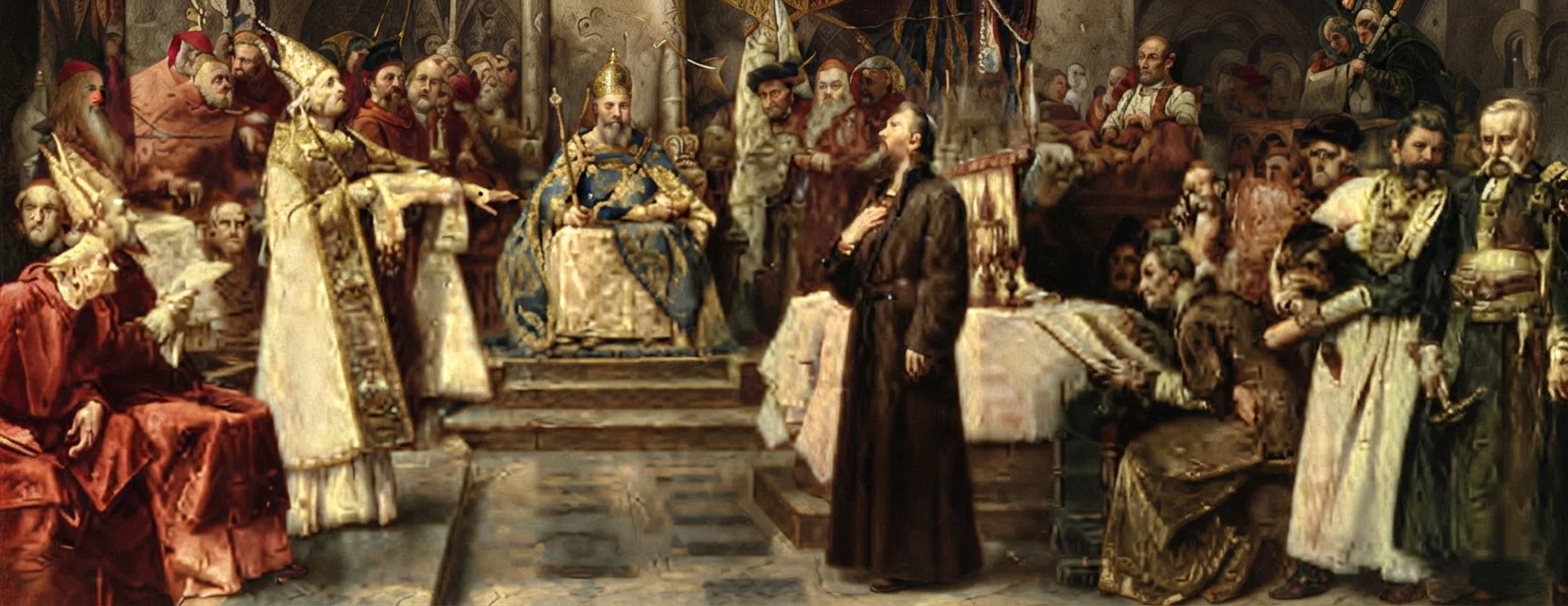
Behind the cross-bearer comes the bishop of Riga, in his gorgeous robes, then a company of armed soldiers, guarding the prisoner against escape. The procession winds through the crowded streets, and enters a great hall. The emperor is there, wearing his golden crown, and seated in a royal chair. At the right stands the duke of Bavaria, holding a cross; at the left, the governor of Nuremberg, with a drawn sword. Around are cardinals and archbishops, bishops and priests, monks and friars, and a great multitude of people. John Huss ascends the platform, mounts a table, kneels, clasps his hands, and looks up toward heaven. The soldiers file away. The dignitaries take their places in the council.
'Execute This Stiff-Necked Heretic'
BISHOP LANDINUS ascends the pulpit, and preaches a sermon from the text, "Shall we continue in sin?" Heresy, he says, is a great sin — one of the greatest a man can commit. It destroys the church. The secular magistrates should destroy those with whom it originates. Turning to the emperor, he says:
"It will be a just act, and it is the duty of your imperial majesty, most invincible emperor, to execute this stiff-necked heretic, since he is in our hands; and thus shall your majesty attain an immortal name, with old and young, so long as the world shall stand, for performing a deed so glorious and so pleasing to God."
At length a bishop reads the charges against Huss:
"You have disobeyed the archbishop of Prague. You teach that there is a holy catholic church other than that of which the pope is the head — a community of all the faithful ordained of God to eternal life — which is heretical."
"I do not doubt," Huss replied, "that there is a holy Christian church which is a community of the elect, both in this and the other world."
"Hold your tongue! After we get through, you may answer," says Cardinal Von Cammerach.
"I shall not be able to remember all the charges."
"Silence!" shouts the archbishop of Florence. John Huss drops upon his knees, and lifts his hands toward heaven. If they will4not hear him, there is One above who will. "O God," he cries, "I commend my cause to Thee."
The Royal Blush of Shame
THE last charge is read. John Huss turns toward the emperor, and declares: "I came to this council of my own free will, with a safe-conduct from the emperor. I came in the full confidence that no violence should be done me, and that I might prove my innocence." The emperor grows red in the face; and that blush of shame has its mighty influence in days to come, when another emperor is tempted by church dignitaries to destroy Luther, though he has a passport, as had John Huss. All the bitter years, over a hundred of them, have preached their lesson; and Luther goes away from the council unharmed. Thus the truth has grown mighty enough to prevail against the church dogma that faith need not be kept with heretics.
But to resume: Sigismund blushes at the true words of Huss, for the emperor knows that the safe-conduct has been taken away. In shame and confusion the emperor sits, with downcast eyes. Everybody can see the
reddening of his cheeks. Without trial, Huss is sentenced to death. He is to be burned. Huss prays for God to forgive them, and the council smile at his prayer. Then Huss is officially degraded. A bishop’s robe in derision is thrown over his shoulders.
"Confess your errors and retract them before it is too late."
Huss turns to the people. "The bishop," he says, "wants me to retract; but if I were to do so, I should be a liar before God."
"Silence, you stiff-necked and wicked heretic!"
They place a chalice in his hands, then take it away, saying, "O thou cursed Judas, we take from thee this chalice, in which the blood of Christ is offered for the remission of sins."
"Confiding in my God and Saviour," Huss replies, "I cherish the hope that He will not take from me the cup of His salvation."
Does Might Make Right?
THUS did majorities seek to prove that they rule in questions of conscience, of right, of truth. But greater than the majority, greater than emperor, pope, or archbishop, is John Huss, calm, peaceful, quiet, while the emperor sits shamefaced, a coward. One word of his would set the prisoner free. But a trimmer to the demands of the enemies of Huss, he has come to think that he is not obliged to keep faith with heretics. He even believes that the council has power to make wrong right. Yet the emperor cannot forget the untruth of his act, cannot but read the dictates of conscience. He knows that he is committing an act that will ever be potent to redden his cheeks with shame.
"Let him be accursed of God and man eternally." Such is the decree against Huss; but he replies, "I am willing thus to suffer for the truth in the name of Christ." Then they place a paper cap upon his head—a mock crown, with figures of devils upon it, and the inscription, "This is a heretic."
At last the emperor speaks the fatal words, "Give him over to the beadle." And so they burn him, though Bishop Silvias says of him, "He goes as if on his way to a banquet." Huss is not afraid. He trusts in the power of truth and the great God of truth. And when he has burned in the fire they kindled, they throw his ashes into the river. They of the council think they are rid of John Huss, but they are not. The emperor lives to rue the day when he broke his word to the martyr. The people of Bohemia resent the death of Huss. A great war is the consequence—a war that lasts many years, and drenches Sigismund’s kingdom with blood.
Can Majorities Rule in Conscience?
THE great lesson of July 6, 1415, is this: Majorities cannot rule in questions of right or truth. Majorities may decide who is to be president or city mayor; but in questions of conscience, of truth and right, one man may overrule a dozen nations.
Yet history repeats its solemn follies. The prophecies declare that in the last days, a world will appeal to majorities to rule in questions of conscience. They outline one of the most awful confederations against truth in support of error the world has ever seen. A mighty religious despotism is to be set up in the last days, and all whose names are not written in God’s book of life will go in the way of deception and error. Read Rev. 13: 8; 19: 19, 11-18.
What, then, is the lesson to us as individuals, but the one lesson not to trust to majorities to establish a question of truth or right! There are many who travel in the broad way, there are few who find the narrow way. Jesus Christ Himself said that. Then why suppose that votes can determine5whether we should worship God in this way or in that? The Bible is the standard of truth. It shall judge all, majorities or minorities, on the attitude they take. The Word shall judge them at the last day. Do not rely on numbers.
Do not trust in majorities. More than once, one man has more than conquered against a host. Have we forgotten the lesson of Daniel and his companion, of the three in the fiery furnace, of the early apostles and disciples, of Jesus Christ Himself, and of all the long line of martyrs, who “loved not their lives unto the death,” but who overcame “by the blood of the Lamb, and by the word of their testimony”? Rev. 12: 11.
Votes Cannot Reverse Truth
WHEN majorities have voted the sun out of heaven; when they have stopped the leaves from growing on the trees; when they have turned back the stars in their courses in the skies; when they have caused rivers to reverse their directions and run raging uphill,—then can men vote error into truth, and cast out the truth as error. Truth is but God’s revelation of His divine, unchangeable character. How can votes change God, or reverse the principles of His government? Learn the lesson of the ages. God speaks from the pages of history.
Majorities do not rule, cannot rule, in questions of conscience. Man’s will cannot be coerced. Religious liberty is each man’s God-given heritage, his royal birthright. All the hosts of earth cannot take it away. Christ came to “break every yoke,” and to “let the oppressed go free.” “Stone walls cannot a prison make, nor iron bars a cage.” He whom Christ makes free, is free indeed. All the men of earth but he may join in voting him martyr or slave, but he may still remain in his divine prerogative a free, true man.
Truth is what it is, regardless of men’s attitude. It is eternal, unchangeable. It is forever mighty, and it will and must prevail.