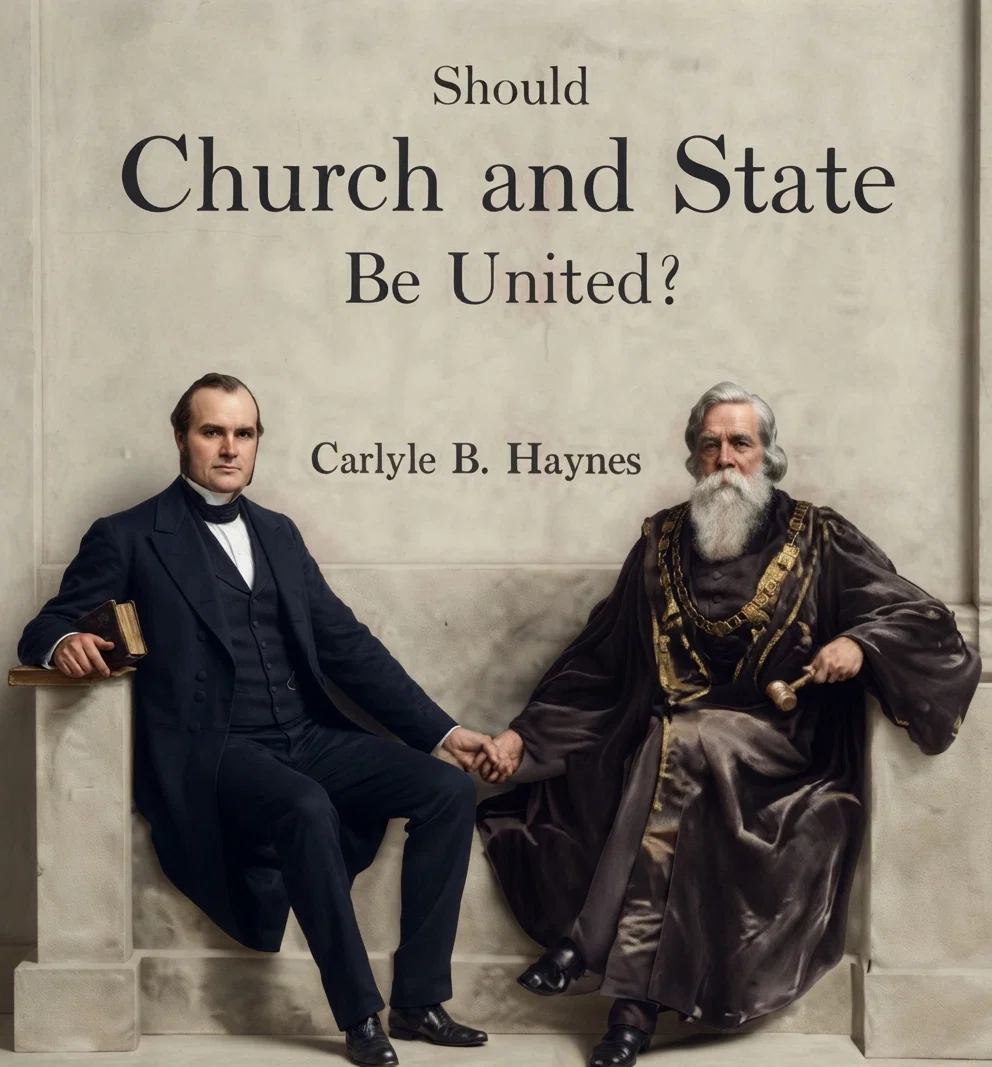
They Are Not One, but Two; and No Attempt Should Be Made to Have Them Act as One
BOTH the state and the church are ordained of God. The church has a divine commission to do its work of preaching the gospel, and that commission is recorded in Matt. 28: 18-20. The state also is divinely commissioned to do its work of securing and maintaining the rights of men, and punishing for the violation of those rights. Of the state in this legitimate sphere, God says, "The powers that be are ordained of God." Rom. 13: 1.
The very fact that both church and state are ordained of God is sufficient evidence to prove that they should operate in different spheres, for God would not create two different institutions to perform the same work.
The church has a sphere of action all its own, and in that sphere it has complete freedom to operate, and the state should not interfere with it. The state also has a sphere of action all its own; and while it is operating in that sphere, the church should not interfere with it. When either of these institutions goes beyond its sphere, they are bound to come into conflict with each other. Such is the unvarying testimony of history.
The proper sphere of the church was defined by Christ Himself at the time of the giving of the gospel commission: "Go ye therefore, and teach all nations, baptizing them in the name of the Father, and of the Son, and of the Holy Ghost: teaching them to observe all things whatsoever I have commanded you: and, lo, I am with you alway, even unto the end of the world." The church, then, is in this world for the purpose of propagating the religion of its divine Author, and the chief end of that religion is the salvation of the souls of men. And the church should confine itself to this work of preaching the gospel.
To Protect the Rights of All
THE proper sphere of the state lies within the realm of justice, that realm which covers the relations of men with their fellow men. The true purpose of civil government may be seen if we consider what conditions would prevail did civil government not exist. The strong would oppress the weak. The weak would have as much right as the strong to life, liberty, property, and happiness; but, being weak, they would be unable to secure to themselves these rights. They would be deprived of their rights by the strong. Without the restraining hand of civil government, anarchy would prevail.
The state, therefore, is organized to secure for all their rights. It should protect the majority in their rights; it should protect the minority in their rights; it should protect one lone man in his rights. In fact, its special purpose is to secure for the minority and the weak their rights,—rights which they could not secure for themselves, because of being weak and in the minority.
The primary purpose of the state, of civil government, is made wonderfully clear in the Declaration of Independence, in the words, "That to obtain these rights [life, liberty, and the pursuit of happiness], governments are instituted among men."
A further purpose of the state is to protect all in the exercise of the rights which the state has secured for them. The object of civil law is to protect life, liberty, limb, and property, and to restrain evildoers from violating these rights. It also regulates civil conduct.
And another purpose of the state is to punish for the violation of human rights. It is to punish incivility and crime. The purpose of the state is not to make any one good. It is to restrain evil deeds, and, if unable to restrain and prevent, to punish them.
Thus the church operates in the realm of a man's relation to his God, and the state operates in the realm of a man's relation to his fellow men.
The moment a government attempts to regulate an individual's conduct with reference to things which do not concern the rights of others, it does just the opposite of what it was instituted to do; it invades, not protects, the rights of men.
Is Sabbath Keeping a Civil Duty?
THE keeping of a Sabbath is a religious duty, a duty which man owes to God, and not to his fellow man. It lies, then, in the sphere of religion, and not at all within the sphere of civil government. The keeping of a Sabbath is not a civil duty. The Sabbath is not a civil rest day. It is a divine institution, coming to man directly from the hands of his Creator.
Jurisdictions are observed among the nations and the states. Only within the confines of its own territory can a state or a nation enforce its law. God has committed to men the making of laws regulating the nations of the earth, but He has never committed to men the making of laws for the kingdom of God. Such laws, if man should dare to make them, would be void for want of jurisdiction. In making such laws, legislatures go beyond the power conferred upon them, and their laws are not binding. For man to legislate concerning the Sabbath, a religious institution, would be for the state to invade the realm of religion and conscience, in which it has no right and no authority; and such laws would be void, without jurisdiction, and binding upon no one.
The rest of the Sabbath is not a civil rest, but a spiritual rest. For a human government to legislate on the matter of a weekly rest day is to assume the power and authority which belongs solely to God.
And the state cannot compel its citizens to distinguish between days of the week for religious worship, without enacting religious legislation.
All Sunday laws, then, are wrong, and are void for lack of jurisdiction. In enacting them, the state steps out of its rightful sphere into the sphere of religion, of one's duty to his God, in which it has no right and no authority. It assumes the power to regulate the relations of men to their Creator. But it has no such power; and the laws regarding religion, regarding Sunday observance, which it makes on this wrongful assumption, are bad laws.
All such laws, including all Sunday laws, should be repealed, not enforced.