The Word of Prophecy

3%

Pacific Press Publishing Association · Mountain View, Cal. · Feb 24, 1909

FromSigns of the Times, Vol. 36, No. 8.

Read the full edition

The Word of Prophecy

By B. G. Wilkinson, A.M., Ph.D.

The Horn, Little but Mighty.

(Concluded.)
TWO predictions of Daniel respecting this evil power have, as we see, met their fulfilment. There are others more signal and more convincing yet, which it behooves us to study particularly.

III. It Had a Mouth Speaking Great Things.

The tongue is, at any time, a difficult member to control. A man needs much grace of God to keep this unruly member from evil and to make it ever contribute toward righteousness. But when it is a question of the tongue of a power full of avariciousness, no matter how pious an exterior that power may affect, the tongue will betray its wickedness the moment the mouth begins to speak. What have been the utterances of the Papacy? Do they go toward locating it and it only as the little horn, or can the Papacy free itself from this accusation by pointing back to the purity of its utterances? And by these utterances we do not mean individual sentences expressed now and then, but we mean those declarations which are the official expression of the policy of the church.
Listen to the utterances of Pope Gregory VII:
“The pope is the universal bishop; he is unquestionably holy and never deceives himself.”
“To him alone it belongs to make new laws.”
“No one can weaken his decrees, and he can abolish the decrees of all.”
“No human creature has power to judge him.”
“He alone deposes and absolves the bishops, constitutes or abolishes churches, and presides over the councils.” (Senator Vallee, “French Senate Debates for 1905,” p. 149.)
Listen to the utterances of Innocent III:
“The pope is the vicar of Jesus Christ, under God, above man; smaller than God, greater than man.”—Idem.
And to Pius VI:
“I protest against liberty of conscience and against giving non-Catholics access to public employ.”
Could any other power answer this prophetic description more fully than the Papacy?

IV. It Made War upon the Saints.

“I beheld,” said Daniel, “and the same horn made war with the saints, and prevailed against them.” Verse 21. Again, verse 25: “And he shall speak great words against the Most High, and shall wear out the saints of the Most High.” Certainly the saints who felt the persecuting arm of this power, were not at a loss to point it out by name. Huss and Jerome, who were burned at the stake in the city of Constance, 1415 A.D., tho an express pledge had been given to the contrary, could certainly indicate the ruler which under a Christian garb persecuted the saints! The thousands of Albigensians, Waldensians, Huguenots, and others, who fell before the authoritative claims of the Papacy, would have no trouble in naming a power which was wearing out the saints of the Most High. “The Castilian,” says Prescott, speaking of the Catholic Spaniard, “too proud for hypocrisy, committed more cruelties in the name of religion than were ever practised by the pagan idolater or the fanatical Moslem. . . . It is a melancholy and mortifying consideration that the most uncompromising spirit of intolerance — the spirit of the Inquisition at home, and of the Crusades abroad — should have emanated from a religion which preached peace on earth and good will toward man.”—“Conquest of Peru,” Bk. II, chapter 1, p. 195."As regards Protestants," says the Hon. Paul Bert, so recently as 1787, "they had to petition for civil rights to be granted to their children." (Speech before French Chamber of Deputies, June 21, 1879.) So great have been the severities of the Papacy against those she considered as infidels and heretics, even tho in many cases they were believers in God, and were people free from scandalous lives, that some writers have computed at fifty millions those who have fallen before her persecutions. Upon this point the Holy See can not escape the convicting evidence which identifies her with the little horn.

V. It Continued a Certain Time as a Persecutor.
It had power to persecute the saints for three and one-half times, or 1,260 years. Even the length of duration allotted to this persecuting power was given to the prophet. Herein we may behold the love of God in declaring beforehand, that, tho the oppression of the church should be long, nevertheless it should have an end. The Most High would instruct His people not only about the nature of the events, but also about the hour in future time when these would terminate. “And he shall wear out the saints of the Most High,” declared the angel, “and they shall be given into his hand until a time and times and the dividing of time.” A time equals a year. “For the king of the north shall return, . . . and shall certainly come at the end of times, even years.” Dan. 11:13, margin. The little horn was therefore to be able for three and one-half years to suppress by persecution the religious liberty of dissenters. But these three and one-half years being found in prophecy, are prophetic years. Now, according to the Scriptures, a prophetic day equals a literal year; and a prophetic year consequently equals 360 literal years. See Num. 14:34; Eze. 4:6. Therefore a “time” equals one prophetic year or 360 literal years; “times” (two) equals 720 years; and “half a time,” 180 years; total, 1,260 years. This agrees with the prophetic statement of the apostle John found in Rev. 12:6 concerning the same events.
When did the 1,260 years begin? — Evidently they could not begin before the three horns which stood in the path of the little horn had been plucked up by the roots. As we previously stated, these were uprooted as follows: Heruli, 493; Vandals, 533; and Ostrogoths, 538. The uprooting of the Ostrogoths left the city of Rome free to the supremacy of the pope, and also to the execution of the decree of Emperor Justinian, issued in 533, by which the bishop of Rome was made “the head of the church and the corrector of heretics.” (See Justinian’s letter to Epiphanus, March 25, 533. Also “Nouvelles,” 9 and 31.)
Reckoning 1,260 years from the date 538, we are brought to the date 1798 as the point when the oppression of conscience by the little horn was to cease. Is there any event in 1798 which marks the end of that which was begun in 538? Yes, in the city of Rome itself, the last stronghold where the Papacy could restrict religious liberty, there was proclaimed, in 1798, religious equality by the armies of the French Revolution.
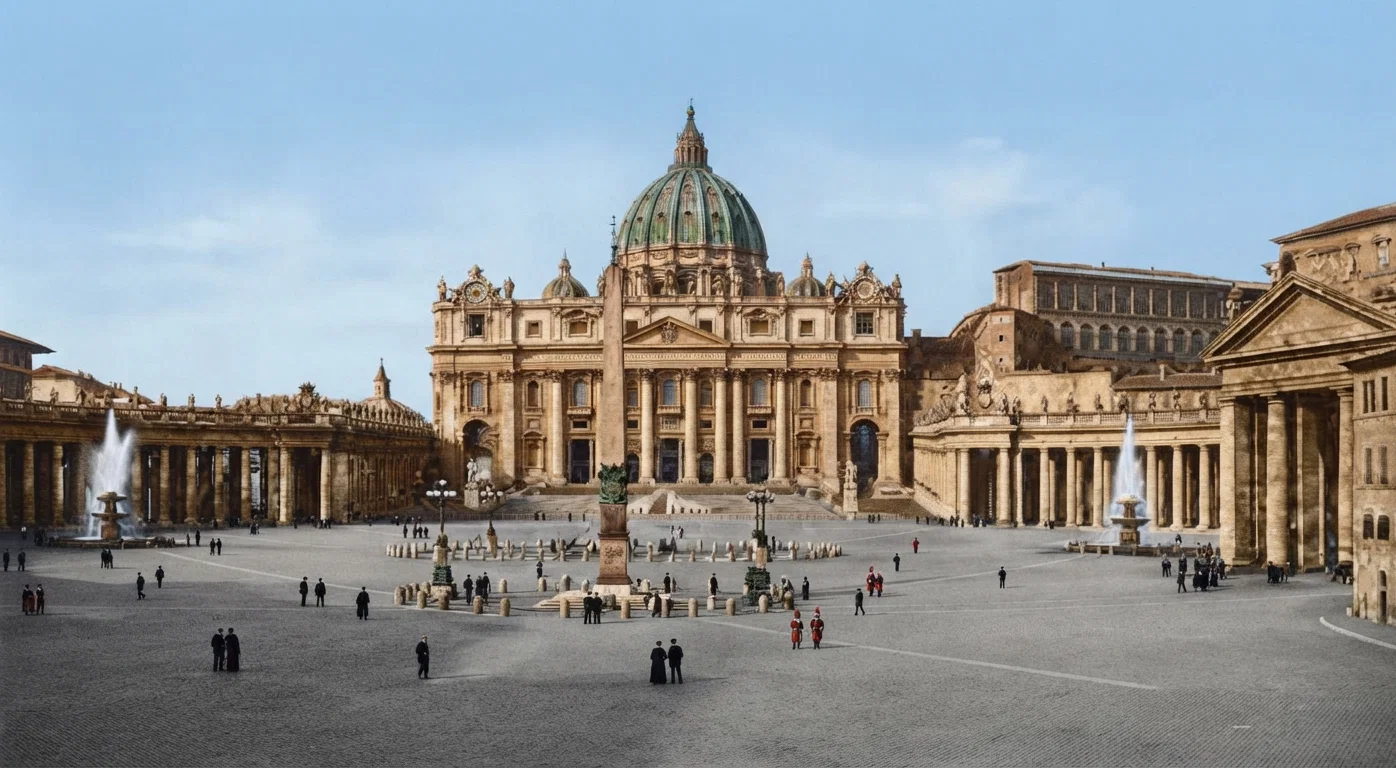
Basilica (Church) of St. Peter, Rome.
Listen to the testimony of the French Universal Dictionary by Larousse: “The assassination of General Duphot, a member of the French embassy to Rome, and killed by the papal troops, drew upon the city the dreaded phalanxes of the Great Republic. Berthier made his entry Feb. 15, 1798; the Papacy was destroyed, a revolutionary government set up, and the pope received his order to quit his estates. . . . Brought to Valence (France), July 14, 1799, he died, being a little over eighty years of age.”—(Article Pius VI.) Ranke in his history of the popes says that “it seemed as if the papal power was now forever at an end.”
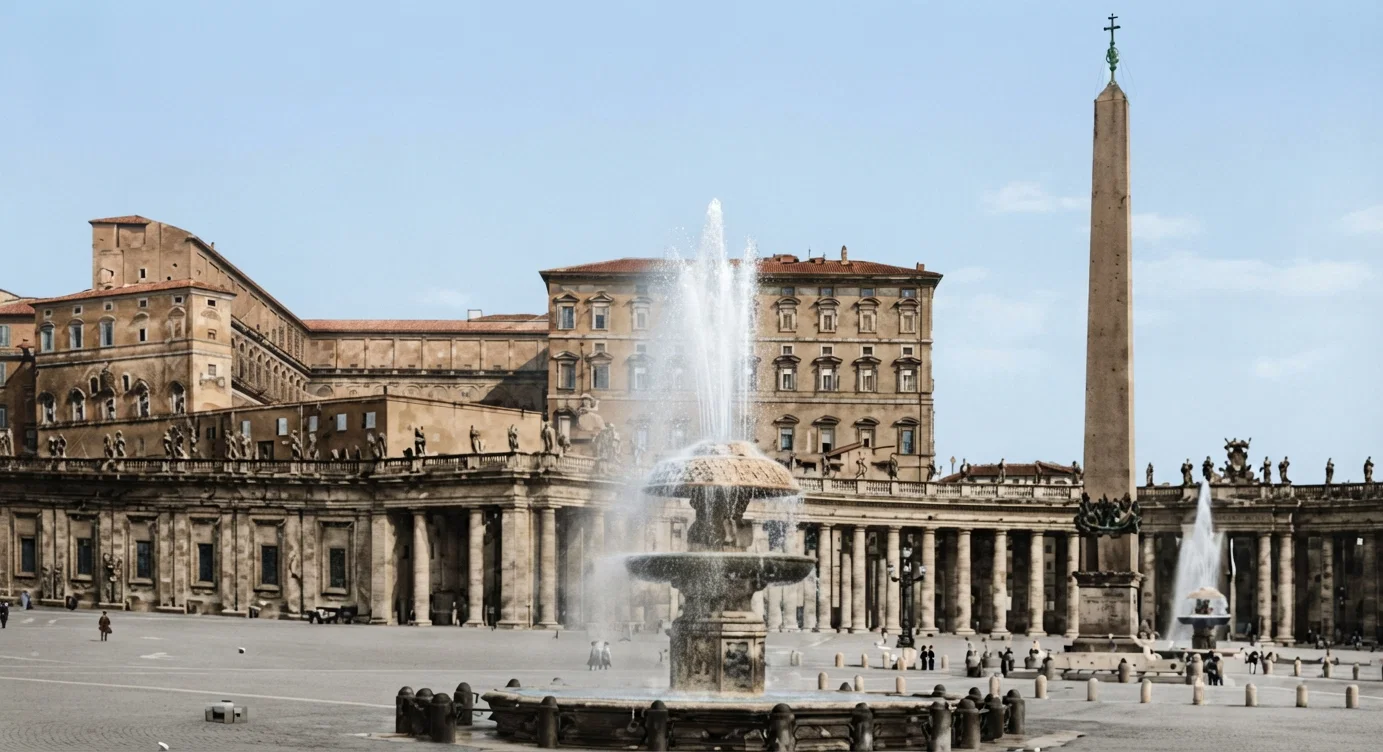
The Vatican, Rome, Headquarters of the Papacy.
How wonderfully have taken place the events just as Daniel foresaw them! The fulfilment of this portion of the prophecy, by bringing us to the year 1798, warns us that the time is near for the complete closing up of the vision. But there yet remains another definite specification in the prophecy concerning the work of the little horn:

VI. The Little Horn Was to Change God's Law.

That duty touches God's law. Daniel says of the little horn, “He shall . . . think to change times and laws.” Chapter 7:25. Evidently this presumptuous attack would be directed above all else at God's great moral law, the Ten Commandments, of which Spurgeon says: “The law of God must be perpetual.” The second commandment was changed from its original design when the Papacy received into the church and indorsed the worship of images. But the greatest change came on the fourth command, the Sabbath precept. In it God expressly says: “The seventh day is the Sabbath of the Lord thy God.” The Papacy, on the other hand, declares the first day of the week to be the Sabbath. Listen to the following from the highest authority, in the Catholic Church of the United States—Cardinal Gibbons:
“Cardinal’s Residence, 408 N. Charles St., “Baltimore, Md., Oct. 3, 1889. “Dear Mr. Franke: “At the request of his eminence, the cardinal, I write to assure you that you are correct in your assertion that Protestants, in observing the Sunday, are following not the BIBLE, which they take as their only rule of action, but the TRADITION of the church. . . . The Catholic Church changed the day of rest from the last to the first day of the week; because the most memorable of Christ's works were accomplished on Sunday. . . . “Yours very sincerely, “(Signed) W. A. Reardon.” (Taken from “The Bible Students’ Library.” “From Sabbath to Sunday,” page 7.)
This agrees with history. Many similar quotations might be given.
With this we must take leave of the subject. What has been given is enough to inform us of the solemn fact that the hours of earth's history are numbered. The great vision of Daniel 7 is drawing to its close; and its accomplishment means that, “the kingdom and dominion, and the greatness of the kingdom under the whole heaven, shall be given to the people of the saints of the Most High, whose kingdom is an everlasting kingdom.” Dan. 7:27. It will be the most glorious success a man can achieve to win a place in this kingdom. Shall we obey the little horn, or shall we serve the Most High? Shall we be counted as part of the world and its perishing glory, or shall we strive to enter that everlasting dominion whose servants are not of this world?