One Thing Thou Lackest

6%

Pacific Press Publishing Company · Mountain View, California · Jun 17, 1908

FromSigns of the Times, Vol. 34, No. 25.

Read the full edition

"One Thing Thou Lackest."

By Mrs. E. G. White.
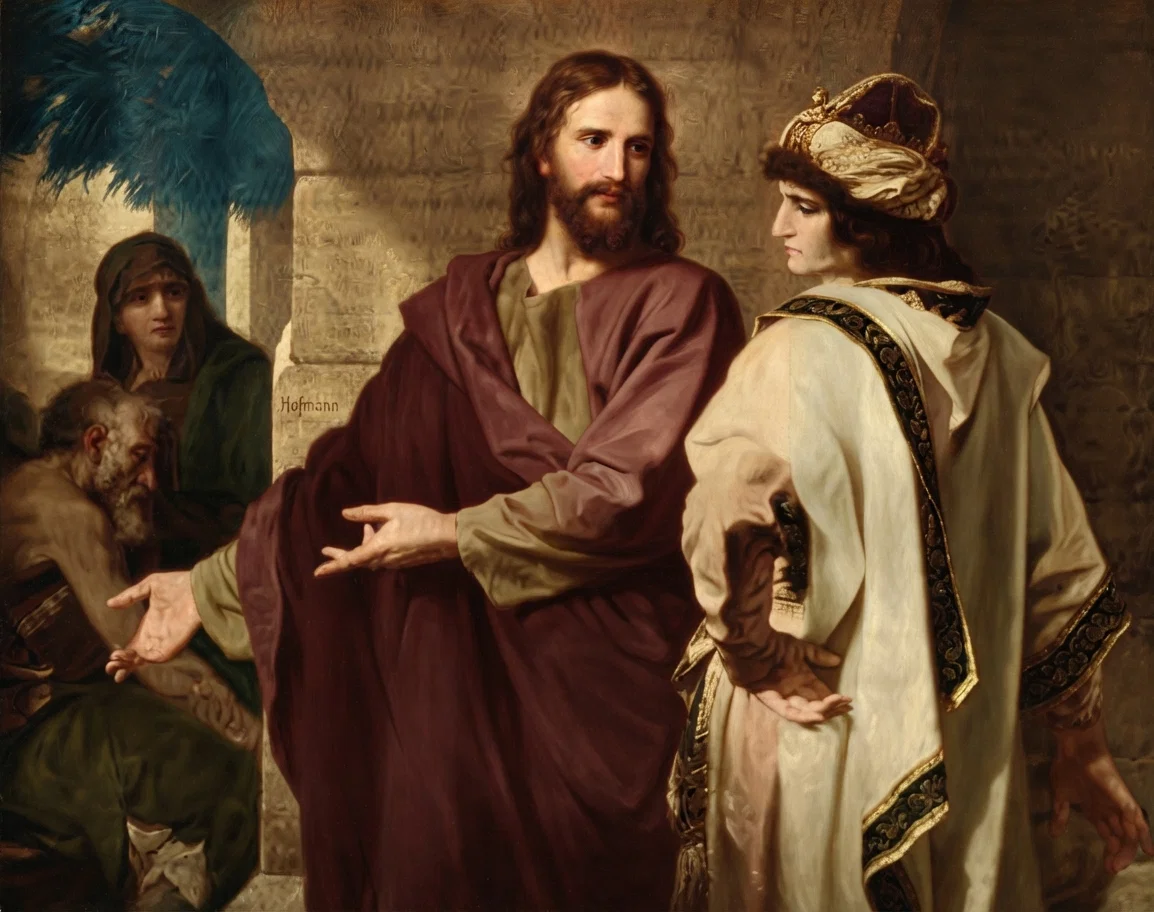
Christ and the Rich Young Ruler.
AND when He was gone forth into the way, there came one running, and kneeling to Him, and asked Him, Good Master, what shall I do that I may inherit eternal life? The young man who asked this question was a ruler. He had great possessions, and occupied a position of responsibility. He saw the love that Christ manifested toward the children brought to Him; he saw how tenderly He received them, and took them up in His arms, and his heart kindled with love for the Saviour. He felt a desire to be His disciple. He was so deeply moved that, as Christ was going on His way, he ran after Him, and kneeling at His feet, asked with sincerity and earnestness the question so important to his soul, and the soul of every human being, "Good Master, what shall I do that I may inherit eternal life?"
"Why callest thou Me good?" said Jesus, "there is none good but one, that is God." Jesus desired to test the ruler's sincerity, and to draw from him the way in which he regarded Him as good. Had he realized that the One to whom he was speaking was the Son of God? What was the true sentiment of his heart?
This ruler had a high estimate of his own righteousness. He did not really suppose that he was defective in anything, yet he was not altogether satisfied. He felt the want of something he did not possess. Could not Jesus bless him as He blessed the little children, and satisfy his soul-want?
In reply to this question Jesus told him that obedience to the commandments of God was necessary if he would obtain eternal life; and He quoted several of the commandments which show man's duty to his fellow men. The ruler's answer was positive: "All these things have I kept from my youth up. What lack I yet?"
Christ looked into the face of the young man, as if reading his life and searching his character. He loved him, and He hungered to give him that peace and grace and joy which would materially change his character. "One thing thou lackest," He said, "go thy way, sell whatsoever thou hast, andgive to the poor, and thou shalt have treasure in heaven; and come, take up the cross, and follow Me."
Christ was drawn to this young man. He knew him to be sincere in his assertion, "All these things have I kept from my youth." The Redeemer longed to create in him that discernment which would enable him to see the necessity of heart devotion and Christian goodness. He longed to see in him a humble and contrite heart, conscious of the supreme love to be given to God, and hiding its lack in the perfection of Christ.
Jesus saw in this ruler just the help He needed if the young man would become a colaborer with Him in the work of salvation. If he would place himself under Christ's guidance, he would be a power for good. In a marked degree the ruler would have represented Christ; for he possessed qualifications, which, if he were united with the Saviour, would enable him to become a divine force among men. Christ, seeing into his character, loved him. Love for Christ was awakening in the ruler's heart; for love begets love. Jesus longed to see him a coworker with Him. He longed to make him like Himself, a mirror in which the likeness of God would be reflected. He longed to develop the excellence of his character, and sanctify it to the Master's use. If the ruler had then given himself to Christ, he would have grown in the atmosphere of His presence. If he had made this choice, how different would have been his future!
"One thing thou lackest," Jesus said. "If thou wilt be perfect, go and sell that thou hast, and give to the poor, and thou shalt have treasure in heaven, and come and follow Me." Christ read the ruler's heart. Only one thing He lacked, but that was a vital principle. He needed the love of God in the soul. This lack, unless supplied, would prove fatal to him; his whole nature would become corrupted. By indulgence, selfishness would strengthen. That he might receive the love of God, his supreme love of self must be surrendered.
The ruler was quick to discern all that Christ's words involved, and he became sad. If he had realized the value of the offered gift, quickly would he have enrolled himself as one of Christ's followers. He was a member of the honored council of the Jews, and Satan was tempting him with flattering prospects of the future. He wanted the heavenly treasure, but he also wanted to have the temporal advantages his riches would bring him. He was sorry that such conditions existed; he desired eternal life; but he was not willing to make the sacrifice. The cost of eternal life seemed too great, and he went away sorrowful; "for he had great possessions."
His claim that he had kept the law of God was a deception. He showed that riches were his idol. He could not keep the commandments of God while the world was first in his affections. He loved the gifts of God more than he loved the Giver. Christ had offered the young man fellowship with Himself. "Follow Me," He said. But the Saviour was not so much to him as his own name among men or his possessions. To give up his earthly treasure, that was seen, for the heavenly treasure, that was unseen, was too great a risk. He refused the offer of eternal life, and went away, and ever after the world was to receive his worship.
Thousands are passing thru this ordeal, weighing Christ against the world; and many choose the world. Like the young ruler, they turn from the Saviour, saying in their hearts, I will not have this Man as my leader.
Christ's dealing with the young man is presented as an object-lesson. God has given us the rule of conduct which every one of His servants must follow. It is obedience to His law, not merely a legal obedience, but an obedience which enters into the life, and is exemplified in the character. God has set His own standard of character for all who would become subjects of His kingdom. Only those who will become coworkers with Christ, only those who will say, "Lord, all I have and all I am is Thine," will be acknowledged as sons and daughters of God. All should consider what it means to desire heaven and yet to turn away because of the conditions laid down. Think of what it means to say "No" to Christ. The ruler said, "No, I can not give you all." Do we say the same? The Saviour offers to share with us the work God has given us to do. He offers to use the means God has given us to carry forward His work in the world. Only in this way can He save us.
When Christ's followers give back to the Lord His own, they are accumulating treasure which will be given to them when they shall hear the words, "Well done, good and faithful servant; . . . enter thou into the joy of thy Lord." "Who for the joy that was set before Him endured the cross, despising the shame, and is set down at the right hand of the throne of God." The joy of seeing souls redeemed, souls eternally saved, is the reward of all that put their feet in the footprints of Him who said, "Follow Me."